
In this digital age computer networking is at the core of how we communicate, work, and access info. As you use the net, send emails, stream videos, or play online games you are using a network. For beginners to get into and master more advanced tech fields it starts with the basic principles of computer networking.
Computer networking can be very complex which is why we break it down into basic concepts that are easy to grasp. In this guide we will take you through it all from the what of a network to the how and why it is so important in today’s world.
What is Computer Networking?
Computer Networking: A network that has many computers and devices which share resources and which exchange data and communicate with each other.
A network can range from just two devices which are connected in a home setting to as large as millions of devices which are connected across the globe in the case of the internet.
Examples of Networks
• A home wireless network which connects your phone and laptop.
• A network in a school or office that connects many computers.
• The web which hooks up billion of devices worldwide.
Grasping the basic principles of computer networking allows you to see what goes on behind the scenes.
Why is Computer Networking Important?
Computer network is a must for that which it does best enable fast and easy communication and resource sharing.
Key Benefits of Networking
• Resource Sharing: Devices can use the same printers, files, and internet connections.
• Communication: Enabling email, messaging and video calls.
• Data Access: Access info from anywhere around the world.
• Cost Efficiency: Reduces the need for redundant hardware.
• Collaboration: Teams may work at the same time.
In the absence of networking, today’s digital environment does not exist.
Basic Components of a Computer Network

In order to grasp the basics of computer networking you must study the primary components which make up a network.
• 1. Vertices.
Nodes: Network connected devices.
Examples include: Includes examples:
• Computers
• Smartphones
• Servers
• Printers
Each node may also pass, have, or relay info.
• 1. Connections.
Links: Nodes’ patterns of communication.
Links can be: Connections are:
• Wired: Networking cables.
• Wireless: Wireless, Bluetooth.
Connections which transfer data between devices.
• 1. Network Equipment.
Network Devices: Software which runs the network.
Common devices include: Also known as:.
• Router: Connects various networks and routes data.
• Switch: Links devices in the same network.
• Modem: Connects your computer to the internet.
• 1. Information.
Data: That which is transferred over the network.
This can include: This includes:.
• Text messages
• Images
• Videos
• Files
How Does a Computer Network Work?
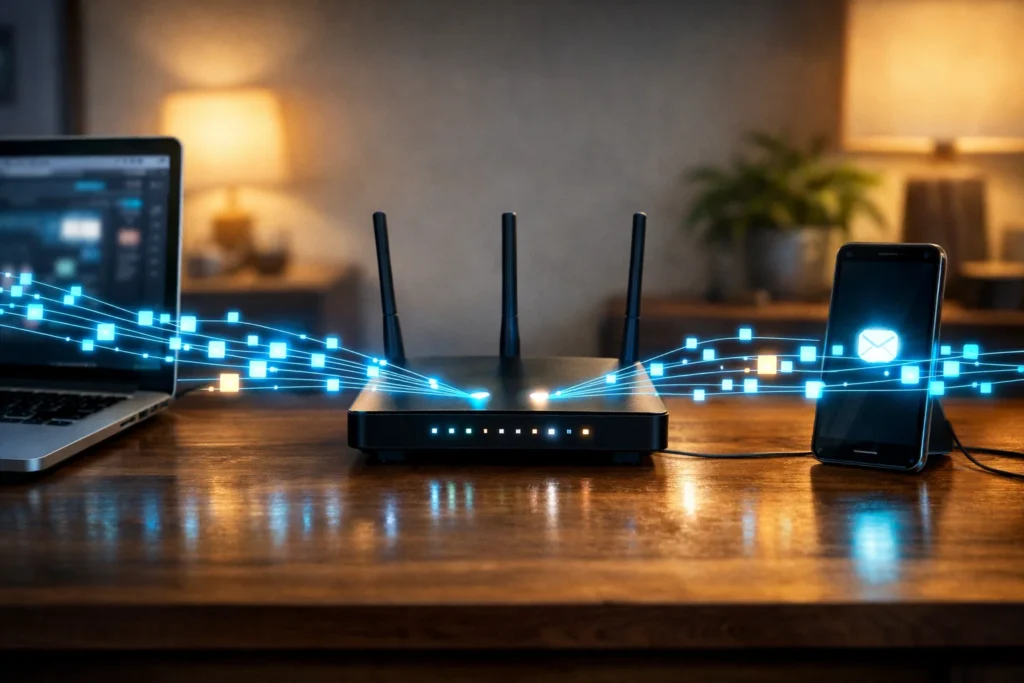
Study of how networks work is a base of what we learn in terms of the fundamental concepts of computer networking.
When it comes to sending data (such as a message) this is what transpires:.
• Your device breaks up the data into small parts which we call packets.
• Each packet takes different paths through the network.
• Network devices direct the flow of packets to their destination.
• The receiving device reconstructs the original data from the packets.
This is a very fast process which in fact you may not notice.
Communication Protocols Explained
Communication Protocols: Protocols for data transfer across a network.
Protocols make devices compatible.
Common Network Protocols
• HTTP (HyperText Transfer Protocol): For web access.
• HTTPS: Secure HTTP.
• FTP (File Transfer Protocol): For file sharing which also includes the transfer of large media files.
• TCP (Transmission Control Protocol): Guarantees data integrity.
• IP (Internet Protocol): Detects devices on a network.
Learn More About Networking
If you wish to study the fundamental concepts of computer networking, this resource is a great tool to use which will improve your knowledge.
Types of Computer Networks
There are various types of networks which are classified by size and purpose.
• 1. WAN (Wide Area Network)
LAN: A local network which serves a home, school, or office.
• Fast and secure
• Limited geographic area
• 1. WAN (Wide Area Network) — Large Area Network which also is a term to use in place of WAN.
WAN: A geographically large network.
• Connects multiple LANs
The Internet is the largest WAN.
• 1. METRO (Metropolitan Area Network).
MAN: A city wide network or large campus network.
• Larger than LAN
• Smaller than WAN
Understanding Network Topology
Network Topology: Network device layout.
Common Topologies
• Star Topology: All devices are connected to a hub.
• Bus Topology: Devices are on the same communication line.
• Ring Topology: Devices are in a circle.
• Mesh Topology: Devices are connected via many paths.
In each case the pros and cons of a topology present themselves.
The Role of IP Addresses
IP Address: A unique ID for each device in a network.
It is similar to a home address in that data is sent to the right place.
Types of IP Addresses
• IPv4: Most typical structure (e.g., 192.168.1.1).
• IPv6: New better version with larger address capacity.
Data Transmission Methods
Data Transmission: The transfer of data between devices.
Types of Transmission
• Simplex: Unidirectional communication.
• Half-Duplex: Turns of phrase which may be used include: Dual, but at different times Non-simultaneous but still two way Two but not at the same time Of the two, but out of sync Two in scope but at different times Which of the above is most appropriate may depend on the context in which the phrase is to be used.
• Full-Duplex: Two way instant communication.
Network Security Basics
As networks grow, security becomes critical.
Network Security: Steps put in place for the protection of data and devices against unauthorized access.
Common Security Practices
• Use strong passwords
• Install firewalls
• Use antivirus software
• Enable encryption
Security forms a base in the study of computer networking.
Real-World Example of Networking
Picture this you send out a message via your phone:.
• Your mobile device connects to a wireless network.
• The router transmits your data onto the internet.
• The message is sent through many networks.
• It reaches the recipient’s device
• The message appears instantly
This issue is of a complex nature which in fact is made up of many networking elements.
Common Networking Terms You Should Know
Here is a list of basic terms every beginner should know:.
• Bandwidth: What we see in terms of data transmission.
• Latency: Delay in data transfer.
• Packet: A data element.
• Firewall: A traffic monitoring system that which also does security.
• Server: A computer which serves others.
Challenges in Computer Networking
Despite what is put forward by networking it also brings issues.
Common Issues
• Network congestion
• Security threats
• Hardware failures
• Configuration errors
These play a role in effective troubleshooting.
Future of Computer Networking
Networking continues to evolve rapidly.
Emerging Trends
• 5G technology
• Cloud computing
• Internet of Things (IoT)
• Artificial Intelligence in networking
Learning the basics of computer networking prepares you for these future developments.
Conclusion
Computer networks are the base of today’s communication and tech. Out of which from we can learn that which basic principles of computer networking to study, in doing so we see also that which base we can develop for better future learning and careers.
From basic nodes and links to protocols and security we see that each element plays a key role in the smooth communication between devices. At first the topic may appear very technical but breaking it down into simpler concepts makes it accessible to all.
As technology advances, networking knowledge will grow in value. Whether you are a student, professional, or tech enthusiast, by learning the basics you take an important step toward that digital world.


