Abstract
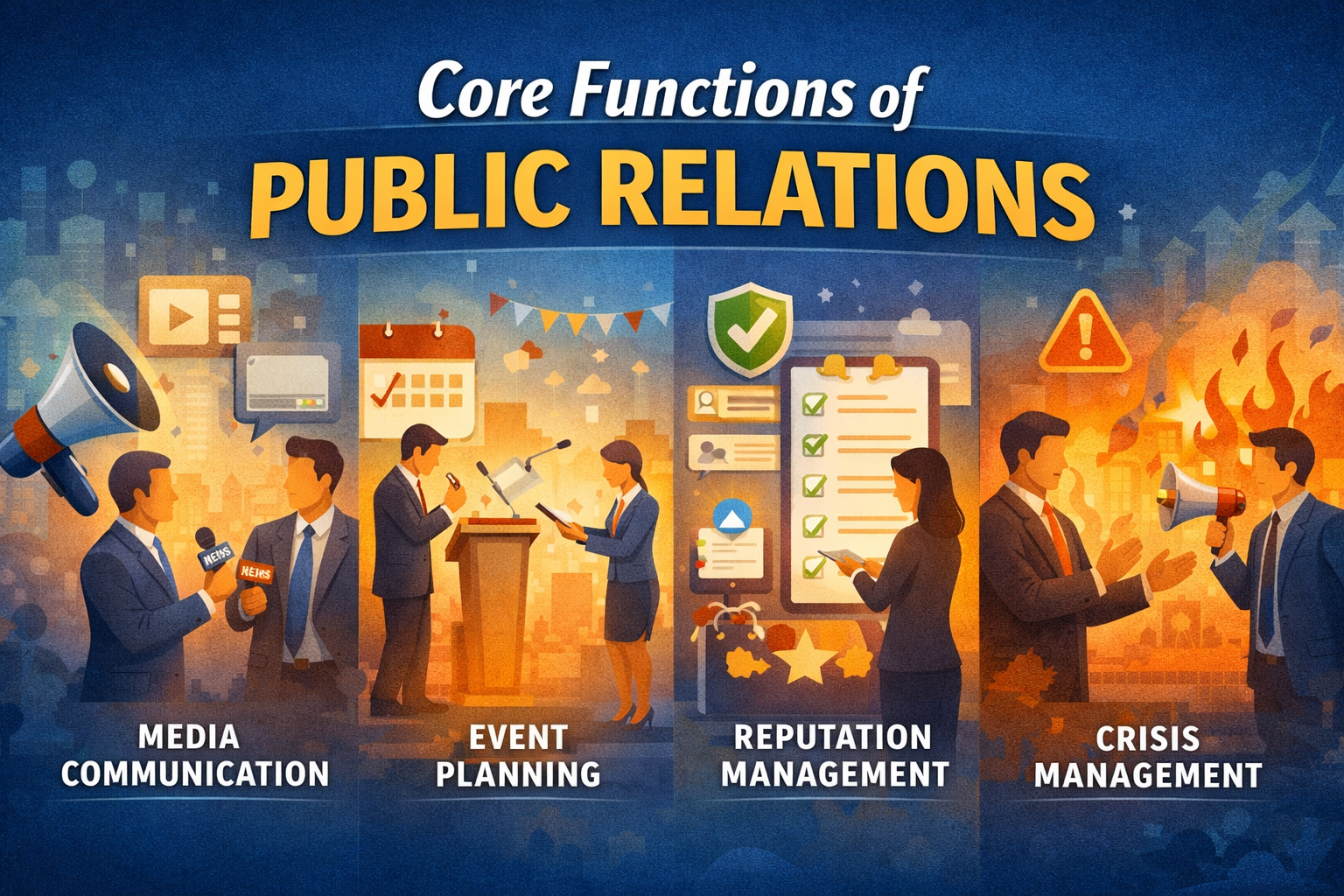
Public relations professionals are also vital in determining the organizational communication, reputation management, and preserving relationships with various stakeholders. This article will give a detailed outline of the role of PR professionals with emphasis on their daily activities, like media communication, event planning, reputation management, and crisis management. A qualitative conceptual approach used in the study combines the theoretical base with practical solutions in order to provide an idea of the competencies that can lead to success in the sphere. The conclusions imply that PR practitioners need to be able to think strategically, master the art of communication and be flexible and adaptable to the dynamics that characterize the communication space. The article concludes that PR is an active and necessary role that helps a lot in the effectiveness of an organization.
Keywords: Public Relations, PR Functions, Media Communication, Event Planning, Reputation Management, Crisis Management, PR Strategy
Introduction
In the current world of high-speed communication, organizations cannot afford to lose credibility in their endeavor to sustain good relationship with stakeholders without effective PR. PR practitioners play a critical role in facilitating interaction between organizations and their publics, and this interaction must be effective and functional, with consistency and alignment to organizational objectives.
The idea of responsibilities of PR professionals is a matter of diversity and complexity. PR practitioners do not only relate to the interactions with media, but they also participate in the strategic planning, brand positioning and crisis response.
The present article delves into the fundamental roles of PR professionals and gives an idea of what they do on a daily basis and what kind of skills they need in order to thrive in the profession.
Literature Review
Public relations professionals are a profession whose role has been extensively studied in the literature. According to Cutlip, Center and Broom (2006), PR is a management activity that defines and sustains mutually beneficial relations between the organizations and their publics.
Grunig and Hunt (1984) emphasize the strategic relevance of PR, and its ability to mediate between the two ways of communication. Their Excellence Theory implies that PR professional people should be involved in the decision-making process to promote the effectiveness of the organization.
Wilcox, Cameron, and Reber (2015) pay more attention to the practical side of PR, presenting the media relations, event management, and crisis communication as the tasks. Their work gives an in-depth insight into the day-to-day job of PR practitioners.
Also, Coombs (2015) emphasizes that crisis communication is worthwhile, and such organizations should be ready to react adequately to unforeseen occurrences. This highlights why PR professionals should have excellent analytical and communication skills.
Conceptual Review
The Profession of PR
PR is a strategic and operational activity. It includes planning, implementing and assessing communication techniques which meet the organizational goals.
PR Responsibilities Scope
The role of PR professionals is spread out in various areas such communication management, stakeholder engagement and reputation building. These roles take technical expertise and a strategic approach.
Essential Tasks of a PR Proffessional
Media Communication
One of the main tasks of PR professionals is media communication. This involves:
- Composing media statements and press releases.
- Development of contacts with journalists and media houses.
- Arranging meetings and press conferences.
Good media communication helps organizations to have a good image in the eyes of the people and to access their target audience.
Planning and Management of events
PR professionals usually carry out events to market organizational goals. These can involve product releases, press conferences and company functions. Key tasks include:
- Planning event logistics
- Arranging with suppliers and stakeholders.
- Controlling of on-site communication.
Effective event organization helps to increase the brand awareness and improve the relationships with stakeholders.
Reputation Management
One of the key roles of PR is to keep the organization positive. This involves:
- Following the perception of the population.
- Response to negative feedback.
- Spreading good stories.
The management of reputation needs to be an ongoing process with communication strategies.
Crisis Management and Public Relations
Situations of crisis may widely affect the image of an organization. PR professionals are essential in:
- Creating crisis communication strategies.
- Being able to respond to emergencies in a timely manner.
- Being transparent when communicating with stakeholders.
The response to the crisis should be excellent to reduce damage and work towards building trust.
Theoretical Framework
Excellence Theory
This theory focuses on the inclusion of PR within top management and the significance of two way communication. It emphasizes the strategic importance of PR to the success of an organization.
Systems Theory
Systems Theory is the idea of organizations that are interrelated and interact with the environment. PR professionals mediate these communications through control of the flow of communications.
Situational Crisis Communication Theory (SCCT)
SCCT offers recommendations on how to address a crisis, depending on its nature. It assists PR practitioners to adopt the right communication strategies in order to safeguard the reputation of the organization.
Methodology
The article under consideration follows a qualitative conceptual approach and utilizes second-level data, based on academic literature, textbooks, and reports on the industry. The method emphasizes the integration of theory and practice in order to offer an overall perspective on PR functions.
Findings
Diverse Skill Requirements
PR professionals need numerous skills such as communication skills, strategic thinking skills, and problem solving skills.
Strategic Significance of PR Functions
The roles that PR professionals fulfill lead directly towards the success of an organization, especially in the relationship building and reputation managing.
Important in Crisis Times
PR professionals play a crucial role in crisis management to provide efficient and timely communication.
As a part of Organizational Goals
PR activities are best performed in line with overall organizational strategies.
Discussion
The results show that the job of PR professionals is not limited to regular communication duties. They include risk management, stakeholder engagement, and strategic planning.
PR can be operational, as seen in the area of media communication and in event planning, or strategic as seen in the areas of reputation management and crisis handling. In this dual role PR professionals need to be creative and analytical.
Theoretical approaches like Excellence Theory and SCCT offer useful ideas about the way in which the functions of PR can be streamlined. Such theories support the idea that PR should be involved in organizational decision making.
The PR function is underestimated even though it is very important. Organizations need to understand the importance of PR practitioners and equip them with tools and power to deliver.
Conclusion
PR specialists are crucial to the contemporary organizations and oversee communication, relationship management, and reputation. Their tasks are varied and demand both technical skills and strategic acumen.
Knowing the essence of PR professionals, organizations and potential practitioners can better value the complexity and significance of the profession. With communication environments constantly changing, the PR professional will continue to be crucial to the organization success.
References
Coombs, W. T. (2015). Ongoing crisis communication: Planning, managing, and responding (4th ed.). Sage Publications.
Cutlip, S. M., Center, A. H., & Broom, G. M. (2006). Effective public relations (9th ed.). Pearson.
Grunig, J. E., & Hunt, T. (1984). Managing public relations. Holt, Rinehart and Winston.
Wilcox, D. L., Cameron, G. T., & Reber, B. H. (2015). Public relations: Strategies and tactics (11th ed.). Pearson.
SCORE India. (n.d.). Role of a PR professional. Retrieved from https://scoreindia.org/blog/role-of-a-pr-professional/