Melbourne summers are difficult, and your roof bears the full weight of every single one of them.
While you’re running the air conditioner and closing the blinds, your roof is silently absorbing the things that most homeowners won’t notice until it’s already too late. Surface temperatures exceeding 70°C. Daily thermal swings of 50 degrees or more. Sudden hailstorms on a 38°C afternoon. UV radiation strips protective coatings faster than any other season of the year.
And yet, the roof only enters the conversation when something goes visibly wrong, a ceiling leak, a cracked tile spotted from the driveway, or a ridge cap that’s come away after a storm. By that point, what could have been a straightforward restoration has already become an expensive repair.
This blog covers the three roof types found on the majority of Melbourne homes: cement tiles, Colorbond steel, and terracotta. Each ages differently, fails differently, and needs to be restored differently.
What follows is a practical, honest breakdown for homeowners to get benefits of roof restoration in Melbourne to make an informed decision!
What Happens to a Cement Tile Roof in Summer and What Does Restoration Involve?
Cement tiles are the most vulnerable of the three types to Melbourne’s summer thermal cycle. Your roof surface swings from roughly 18°C at dawn to over 70°C by mid-afternoon, a 50-degree shift repeated daily for four straight months. The tiles themselves handle this reasonably well. The sand-cement mortar holding your ridge caps together does not.
Mortar is rigid. It doesn’t flex with temperature movement. Each expansion-and-contraction cycle creates microscopic fractures that widen season by season. By the time you see crumbling or loose ridge caps, the internal breakdown has been happening for years. Cement tiles also absorb moisture during summer storms, and when that combines with heat, surface erosion and coating degradation accelerate faster than on any other roof type.
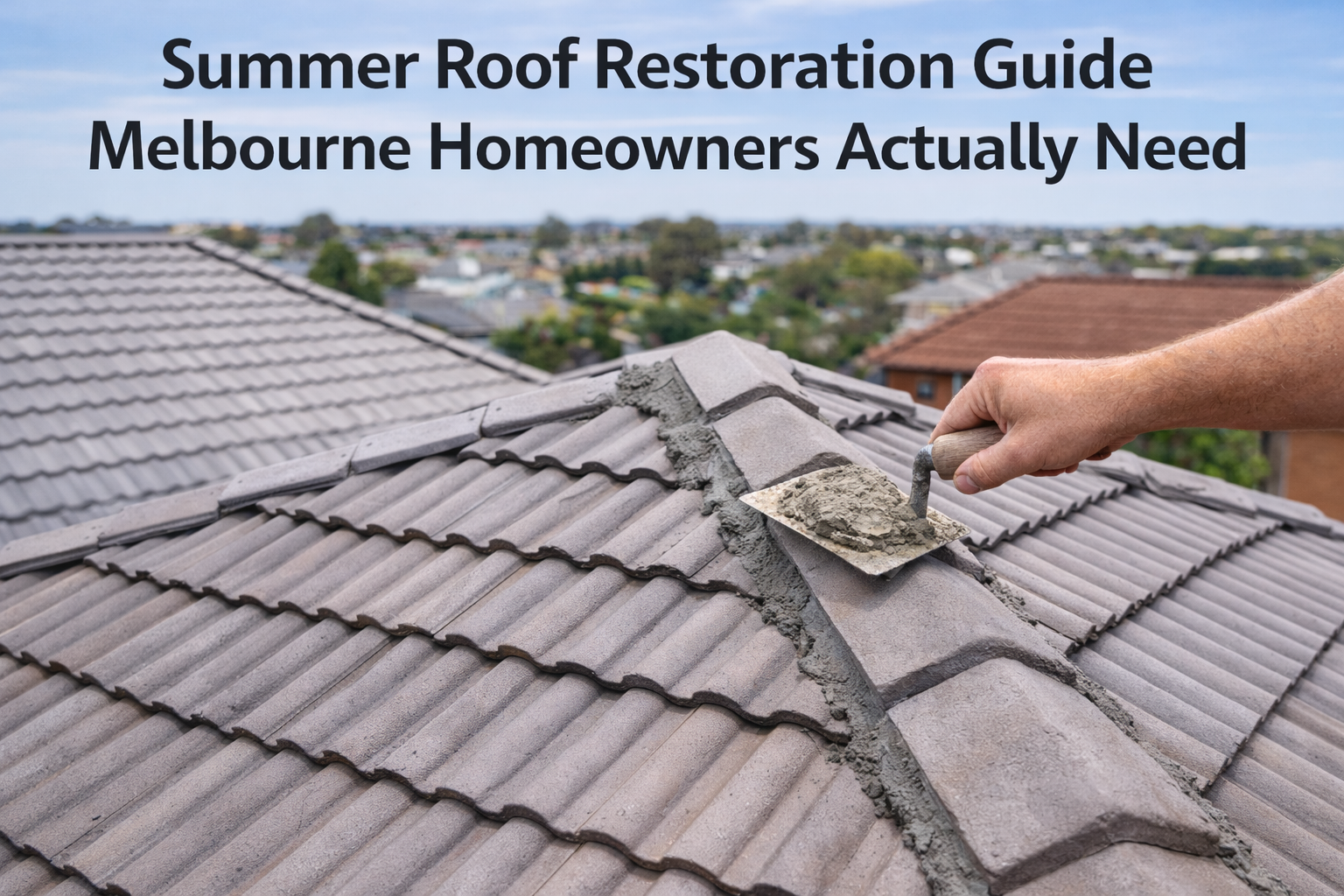
A proper cement tile roof restoration begins with high-pressure cleaning to strip moss, lichen, and grime. Ridge caps are rebedded and repointed using a flexible polymer compound rather than the original sand-cement mortar; this is what stops the thermal cracking cycle. Cracked or broken tiles are replaced individually, a primer coat is applied across the full surface, followed by two coats of membrane paint, typically an acrylic or elastomeric coating rated for Australian UV conditions.
When to restore: October and November are the sweet spot, dry and mild enough for coatings to cure properly before the real heat arrives.
Signs you need it: Chalky surface, crumbling ridge cap mortar, moss or dark staining on tiles, or ceiling marks appearing after rain.
What Happens to a Terracotta Tile Roof in Summer, and What Does Restoration Involve?
Terracotta is the most durable of the three roof types. Older Melbourne homes built with quality terracotta regularly outlast their cement-tiled equivalents, and a well-maintained terracotta roof can last 50 years or more. But durable doesn’t mean immune to summer damage.
The glaze on terracotta tiles breaks down slowly under UV exposure until the clay underneath starts absorbing moisture, and the frustrating part is it often looks fine from the street while this is happening. Once the glaze is gone, moss and lichen root structures work into the hairline cracks and widen them from the inside. Melbourne’s summer pattern of heavy storms followed by extreme heat keeps pushing that damage further with every season.
Terracotta needs a gentler touch than cement; too much pressure during cleaning damages the tile body, so that’s the starting point. After that, the roof gets checked carefully for any glaze loss or hairline cracks before repointing the ridge caps with the same flexible compound used on cement tiles.
The big difference with terracotta is the coating. It needs a breathable, penetrating sealer, not a surface membrane. Seal a porous terracotta tile with a solid paint film, and you’re trapping moisture inside the clay, which causes far more damage than you started with. If a contractor is quoting generic tile paint for a terracotta roof, that’s a red flag.
When to restore: Follow similar pre-summer timing to cement, but if tiles have developed significant porosity, a dry period of at least two weeks before work begins is essential. Moisture trapped beneath a new sealer coat causes adhesion failure.
Signs you need it: Loss of glaze sheen, visible hairline cracking, dark patches indicating moisture absorption, or any softening of the tile surface when pressure is applied during inspection.
What Happens to a Colorbond Roof in Summer and What Does Restoration Involve?
Colorbond metal roof restoration is a different discipline entirely from tile work, and it’s where the gap between an experienced contractor and a general roofer is most obvious. Steel expands and contracts with temperature more dramatically than either tile type. Fasteners loosen, laps and joins open fractionally, and sealants around penetrations crack. Over several Melbourne summers, these micro-movements compound into real vulnerabilities.
The surface degradation is equally distinct. When you see chalking or fading on a metal roof, that’s the paint system breaking down, leaving the steel progressively more exposed to rust and moisture. Colorbond also creates the worst heat transfer into your ceiling cavity of all three types. Metal absorbs and transfers heat faster than tile, meaning a Colorbond roof without ventilation upgrades heats your roof space far more aggressively, which directly translates to higher cooling bills and a home that stays hot well into the evening.
Metal roof repair in Melbourne starts where the damage is worst. Any rusted areas get a rust converter applied first, before anything else happens. From there, every fastener gets checked, tightened if it’s worked loose, or swapped out if it’s too far gone. All the laps, ridges, and flashings around penetrations are resealed with a metal-compatible sealant, because these are the spots that open up first after a few Melbourne summers. Once that’s done, a metal primer goes down across the surface, followed by a Colorbond-compatible topcoat, ideally one with a high Solar Reflectance Index to deal with the heat absorption that metal roofs are particularly prone to.
When to restore: February to April is the professional’s preferred window, or for any extra roof addition in Melbourne. Steel expands in peak heat, so coating it while expanded means the product bonds properly and moves with the metal as it contracts through autumn, rather than cracking or peeling away.
Signs you need it: Chalky or fading surface, rust spots, loose fasteners, lifted flashings, or a home that runs far hotter than it should.
Is Roof Restoration Effective or Is Full Replacement the Better Decision?
Roof restoration works with what’s already there. It’s appropriate when the tile or metal surface has surface-level wear, the timber frame shows no rot or significant movement, and damage is isolated rather than widespread. Replacement is necessary when structural failure has occurred, significant timber rot, widespread cracking across more than 20–25% of tile surfaces, or rust that has penetrated through the steel profile in multiple locations on a Colorbond roof.
Terracotta stands apart here; quality terracotta is a strong restoration candidate even at 30–40 years of age, provided the clay body remains sound. A simple absorption test during inspection will confirm this. Cement tiles become replacement candidates around the 25–30 year mark if no prior restoration has been completed. Colorbond restoration is highly cost-effective even for roofs with significant surface oxidation, as long as structural rust hasn’t taken hold.
The cost difference makes this decision significant. A professional restoration from a qualified residential roofing company in Melbourne starts from around $2,500 to $5,500 (approx) for an average home. Full replacement typically runs $15,000 to $30,000 (approx) or more, depending on size, pitch, and materials. A restoration that adds 10 to 15 years to a structurally sound roof is an exceptionally strong financial decision in almost every scenario.
Does a Degraded Roof Create Pest Entry Points in Summer?
As Melbourne temperatures climb, possums, rodents, wasps, and the occasional snake look for somewhere cool, dark, and sheltered. They get in through exactly the same vulnerabilities that let water in , cracked or shifted tiles, failed mortar at ridge lines, and deteriorated flashings around chimneys, pipe boots, and vents.
A cement tile roof with ageing mortar has multiple access points invisible from street level. A terracotta roof with glaze-loss micro-fractures opens small gaps at tile overlaps over time. A Colorbond roof that hasn’t had sealant inspection in several years almost certainly has open points around penetrations.
The most costly outcome is possum entry. Under Victorian law, possums are a protected species; removal requires a licensed handler, and re-entry must be physically blocked, typically costing $500 to $2,000 to resolve correctly. Roof restoration in Melbourne closes every gap across the entire surface far more comprehensively than a targeted pest-proofing visit. A thorough contractor will flag any evidence of entry during inspection, make a point of asking them specifically.
Does Roof Restoration Help Reduce Heat and Energy Costs in Summer?
Yes, and the mechanism is more specific than most homeowners realise. Without adequate ventilation, a Melbourne roof cavity in summer reaches 60–70°C. That superheated air sits directly above your ceiling insulation and radiates heat downward for hours after sunset. This is why many Melbourne homes feel hotter at 9pm than they did at 4pm, and why air conditioning continues to run long after the sun goes down.
A whirlybird or ridge ventilator installed as part of roof restoration reduces cavity temperatures by 15–20°C in documented cases. This compounds significantly with a high-SRI reflective coating, which reduces how much heat your roof surface absorbs in the first place. On a 38°C day, the difference between a standard dark tile surface (SRI of 5–15) and a quality restoration coating (SRI of 85–105) can translate to a surface temperature difference of up to 40°C, directly reducing the heat load your ceiling has to manage.
When getting roof restoration in Melbourne quotes, ask each contractor for the technical data sheet for the coating product they intend to use. Look for an SRI above 70 for light colours. Any reputable product will carry this data, and any contractor worth hiring should produce it without hesitation.
Conclusion
Your home’s roof is constantly exposed to the hot Melbourne summer, and in most cases, you will not notice the impact of this damage until it’s too late. You might have cement tile roofing that is losing their cement shed slightly losing is mortar, regenerating terracotta or Colourbond roofs have been losing fastening, the problem gets larger as these small issues build up over time, resulting in very expensive issues.
The benefits of roof restoration go well beyond aesthetics. It’s the difference between a roof that manages heat, repels pests, protects your solar investment, and keeps your home dry, and one that does none of those things reliably. For most Melbourne homeowners, restoration is not just the more affordable option compared to full replacement. It’s the smarter one.
If your roof is showing any of the signs covered in this guide, or simply hasn’t been looked at in the last decade, the time to act is before summer, not during it.
Get a professional inspection from a trusted residential roofing company, understand what your specific roof type needs, and make the decision on your own terms rather than in response to a crisis.