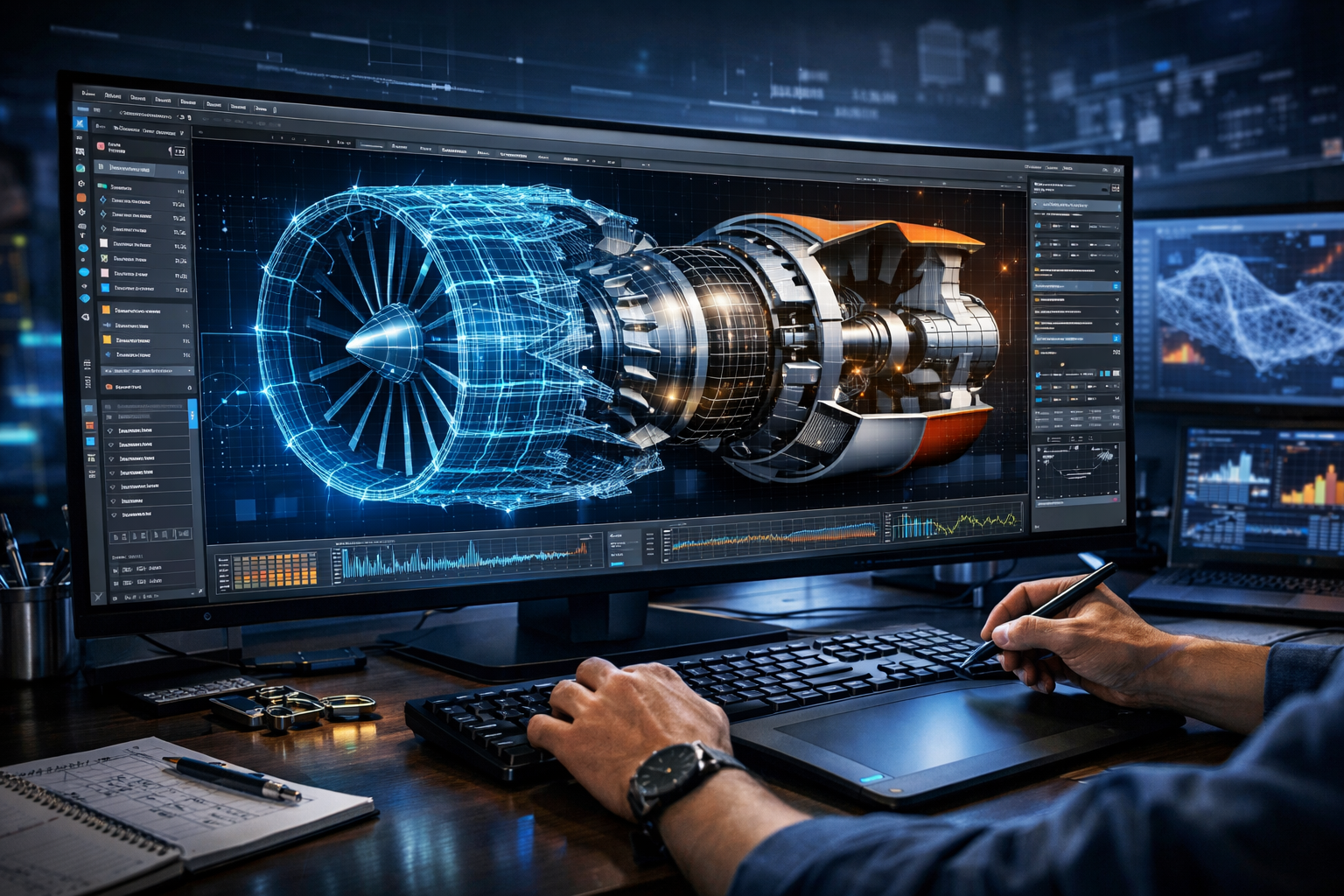
Geometric modeling forms the base of current visualization, and it supports the applications of computer-aided design (CAD) to virtual reality (VR) and scientific simulations. Geometric models enable the virtual analysis, manipulation and visualization of complex structures by expressing objects and spaces mathematically to assist designers, engineers and researchers in understanding the construction and use of jumbled structures. Although geometric modeling has a transformative potential, it is also associated with a number of inherent problems that restrict its effectiveness and applicability. This article critically criticizes the constraints of geometric modeling and discusses new technologies that are bound to transform the industry.
Getting to know about Geometric Modeling
Geometric modeling is said to be the mathematical model of the shape, surface, and volume to be visualized and computed. It entails the creation of correct, manipulable digital models by a variety of methods that include:
• Wireframe modeling – It is the representation of objects using vertices and edges.
• Surface modeling – Developing continuous surfaces in order to reflect the surface appearance of an object.
• Solid modeling A solid modeling defines the objects as a volume, enabling further simulations such as fluid dynamics or stress analysis.
The aim is to offer high-resolution, manipulable models to serve the purpose of engineering, design and visualization. However, the complexity needed to be precise tends to impose constraints on geometric modeling which is a problem to computational efficiency and interoperability. These issues relate closely to the core principles of user-centered design when visualization tools are built to improve interaction between users and complex geometric systems.
Existing Limitations in Geometric Modeling
Although there has been a tremendous improvement of geometric modeling in the past few decades, there are still a number of limitations that have hampered its maximum usage in visualization:
Computational Complexity
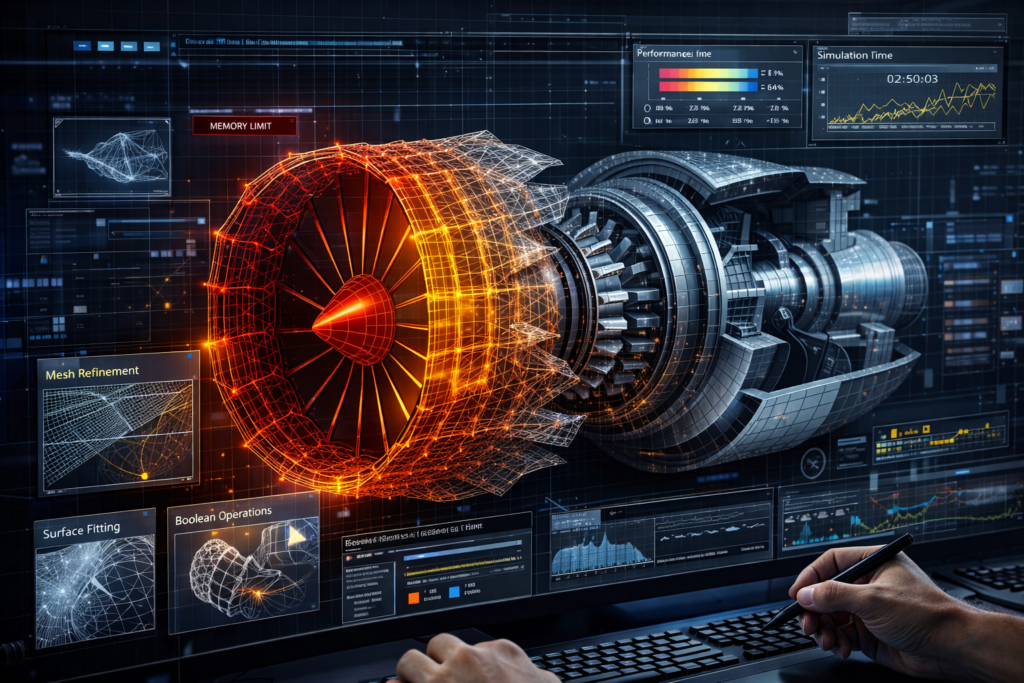
Computational complexity is one of the major problems in geometric modeling. In solid and surface modeling, which are high-resolution models, millions of polygons or control points are used. These models consume much processing power to render, simulate or manipulate.
• Memory limits: Storing and running of large models may be more than their capacity in normal hardware resulting to delays or crashing of systems.
• Algorithms: More complicated algorithms (such as surface-fitting algorithms, mesh-refinement algorithms, and Boolean algorithms) can exhibit time complexity scales that are only linearly proportional to the size of the model. As an example, a popular surface representation, NURBS ( Non-Uniform Rational B- Splides ), needs heavy computations to do transforms and intersections.
• Simulation overhead: Physics based simulation such as collision detection, fluid flow or even stress analysis increase the requirements of the computation.
Geometric modeling is impractical in real-time applications to VR or interactive engineering simulations since this computational bottleneck reduces practicality.
Data Interoperability
The interoperability of data, which is the possibility to share geometric models between platforms, software, and teams, is another serious problem. CAD systems, as those, usually have their own file formats, making cooperation more difficult.
• Fragmentation of file format: Popular file formats such as STEP, IGES or STL strive to be a standardized method of transferring data, though variation in implementation causes error.
• Fidelity: Data loss During conversion to different formats, data may be lost or estimated, which may affect the accuracy of design.
• Collaboration barriers: Multiswitch teams can have a problem integrating the software, which delays the project process.
Such interoperability problems highlight the importance of standardization and smart data translation software to achieve a flawless collaboration.
Rendering Constraints
There are more problems in converting geometric models into visual output:
• Limitations of real-time visualization High-fidelity models are challenging to interactively visualized on consumer hardware, and VR or AR real-time applications are challenging.
• Complexity of lighting and shading: It is exponentially more expensive to correctly render materials, reflections and shadows.
• Level of detail (LOD) management: Optimizing the visual and performance cost of a visual representation needs advanced LOD methods that are not always accurate.
The cumulative impact of making constraints is reduced visualization processes, particularly when a high level of interactivity is needed, such as design reviews or immersive simulation.
Accuracy Flexibility vs. Trade-Off
Trade-off between accuracy and flexibility: Geometric modeling is usually subject to a trade-off between accuracy and flexibility:
• High-precision models are both computationally intensive and not flexible to changes.
• Parametric models are flexible and easy to adjust but cannot be precise.
• This trade-off does not only have an impact on the visualization but also on downstream uses such as manufacturing where errors can be very expensive.
Balancing between these conflicting needs is one of the issues that continue to be of primary concern in the field of geometric modeling studies.
Integration to Emerging Technologies
Although the use of geometric modeling is at the core of most modern technologies, there exist certain obstacles to its implementation with the help of AI, machine learning, and real-time simulations:
• Limitations of data-driven modeling: AI-assisted modeling involves a lot of data to come up with realistic predictions or designs.
• Simulation accuracy: It should be physically realistic and this is challenging to highly complex models.
• Complexity of toolchains: Toolchain integration involves combining both traditional CAD tools with AI-based optimization, which is not always the case.
New technology notwithstanding these weaknesses, new technologies promise to break most of these boundaries, establishing more efficient and flexible geometry modelling processes.
The new Direction in Geometric Modeling
Innovation is being driven by the shortcomings of geometrical modeling. There are a number of new technologies that are transforming the process of generating, analyzing, and visualizing of geometric models.
AI-Assisted Modeling
Geometric modeling is becoming an area of application of artificial intelligence (AI) to speed up design, enhance precision, and run multiple tasks automatically:
• Generative design: AI can be used to produce a variety of design options under the stricture of constraints including weight, material and performance.
• Automated mesh optimization: Machine learning is capable of optimizing meshes, refining the mesh to detect regions with little impact on the visuals, decreasing complexities and demanding minimal computational resources.
• Error detection and correction: AI may detect discrepancies in models, including overlapping surfaces or gaps, which will decrease manual debugging.
This tendency decreases design cycles and calculations needs, which further allows the high-fidelity modeling to become more affordable to smaller teams.
Real-time Simulation and Visualization
Developments in simulation software and the development of GPUs are permitting real-time rendering and physics simulations:
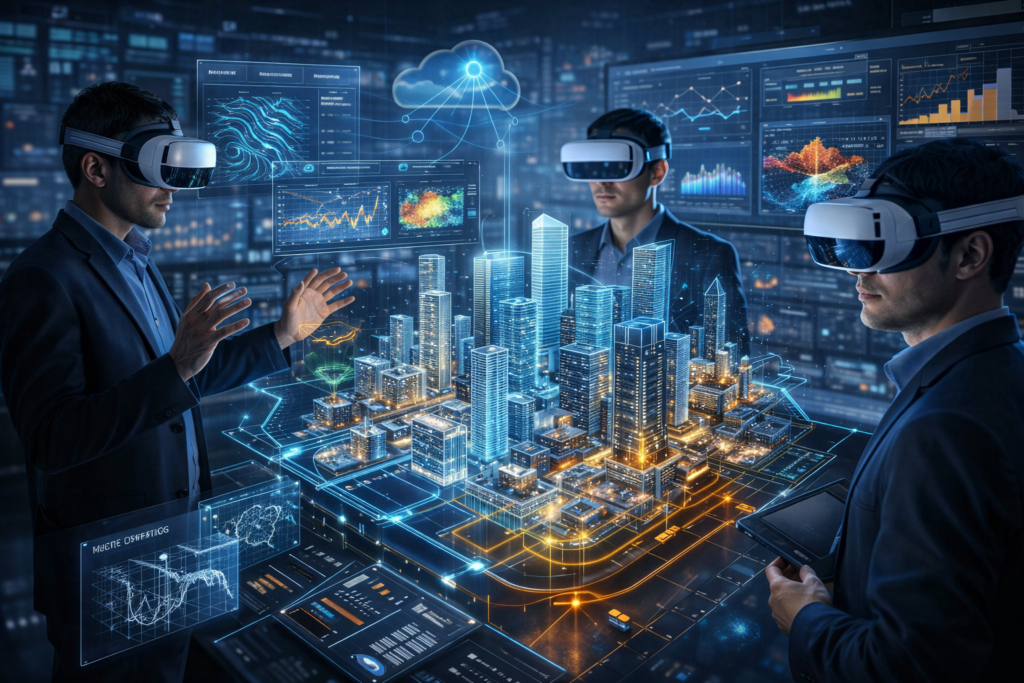
• Interactive VR/AR spaces: Designers will be able to feel and work with models in the types of immersive space to deal immediately with the scale, ergonomics, and beauty.
• Live feedback loop: Stress or thermal or fluid dynamics simulations can be kept as of real time to help guide the design.
• Procedural and adaptive LOD: Real-time algorithms dynamically add or remove detail in models depending on the camera closeness or attention, and they are optimized to avoid performance cost in terms of accuracy.
This system capability helps in closing the gap in conceptual design and practical analysis, and will facilitate inter-team and inter-stakeholder communication.
Cloud-Based Modelling and Cooperation
Geometric modeling Cloud computing is changing geometric modeling by making it possible to have distributed workflows:
• Remote cooperation: The teams can cooperate working on the models in real time and the changes can be synchronized.
• Scalable computing: The intricate simulations are also capable of utilizing cloud servers that have a large number of computing resources.
• Version control and auditing: Cloud services help to trace changes and minimize mistakes or improve accountability.
These systems provide collaboration through offloading computation and storage to the cloud to alleviate shortcomings of local hardware.
Combination of Multi-Physics and Multi-Scale Modeling
Next-generation modeling combines several domains into one of these holistic as well as accurate visualizations:
• Multi-physics simulations: Structural, thermal and fluid simulations give detailed information by combining these three simulations.
• Multi-scale modeling: Multi-scale models may be used to model phenomena at micro- through macro-scale, with important applications in biomedical, aerospace, and materials engineering.
• Multi-disciplinary visualization: The combination of geometric, topological and functional data can help to improve the interpretation and communication of complex systems.
These methods take visualization to the next level to be a predictive and analytical instrument.
Semantic modeling and Parametric Modeling
The development between the strictly geometrical to semantic and parametric modeling improves automation and transfer of knowledge:
• Parametric limitations: Models also have the ability to adapt to a change in design, minimizing human editing.
• Semantic annotations: Metadata embedding within models enhances interoperability and enables AI systems to exploit design purpose.
• Knowledge-based automation: Design rules and reusable components improve the development and minimize errors.
It is such development which hold out the promise of smarter models, dynamically tuned to the needs of the user and the real world.
Repercussions of Visualization and Communication in the future
New directions in geometric modeling will transform the way visualization and communication is being practiced within the industries:
• Improved stakeholder involvement: Visualizations are real-time and interactive, therefore, facilitating the grasping of complicated designs by non-technical stakeholders.
• Faster innovation cycles: AI-aided design and cloud computing will accelerate the iteration time and help to accelerate the product development process.
• Better accuracy and safety: Multi-physics simulations allow to foresee the situation better, reduce error and enhance the safety margin.
• International partnership: Standardized semantic models and cloud based platforms enable teams located in different geographical locations to work together in a seamless manner.
• Educational and training interfaces: AR/VR platforms based on advanced geometrical models would make the simulations of engineers, surgeons and pilots real training environments.
The trends show that the field of geometry modeling is shifting away form the conventional CAD software, toward a complete interactive, smart, and participatory visualization environment.
Conclusion
Although geometric modeling has limitations (such as computational complexity, data interoperability, limitations on rendering, and the accuracy-flexibility trade-off) which are major challenges, new technologies are overcoming these bottlenecks. Artificial intelligence (AI)-based modeling, real-time simulation, cloud and collaborative work, and multi-domain integration are reinventing the industry, allowing to visualize faster, more accurately and interactively.
Geometric modeling is moving toward the future, which is the development of smart, adaptive models that can be used to support collaboration, speed up innovation, and improve interdisciplinary understanding. These trends are still in their infancy, but as they keep evolving, not only will geometric modeling depict reality, but also forecast, streamline and communicate complicated phenomena in a way that has never been imagined before.