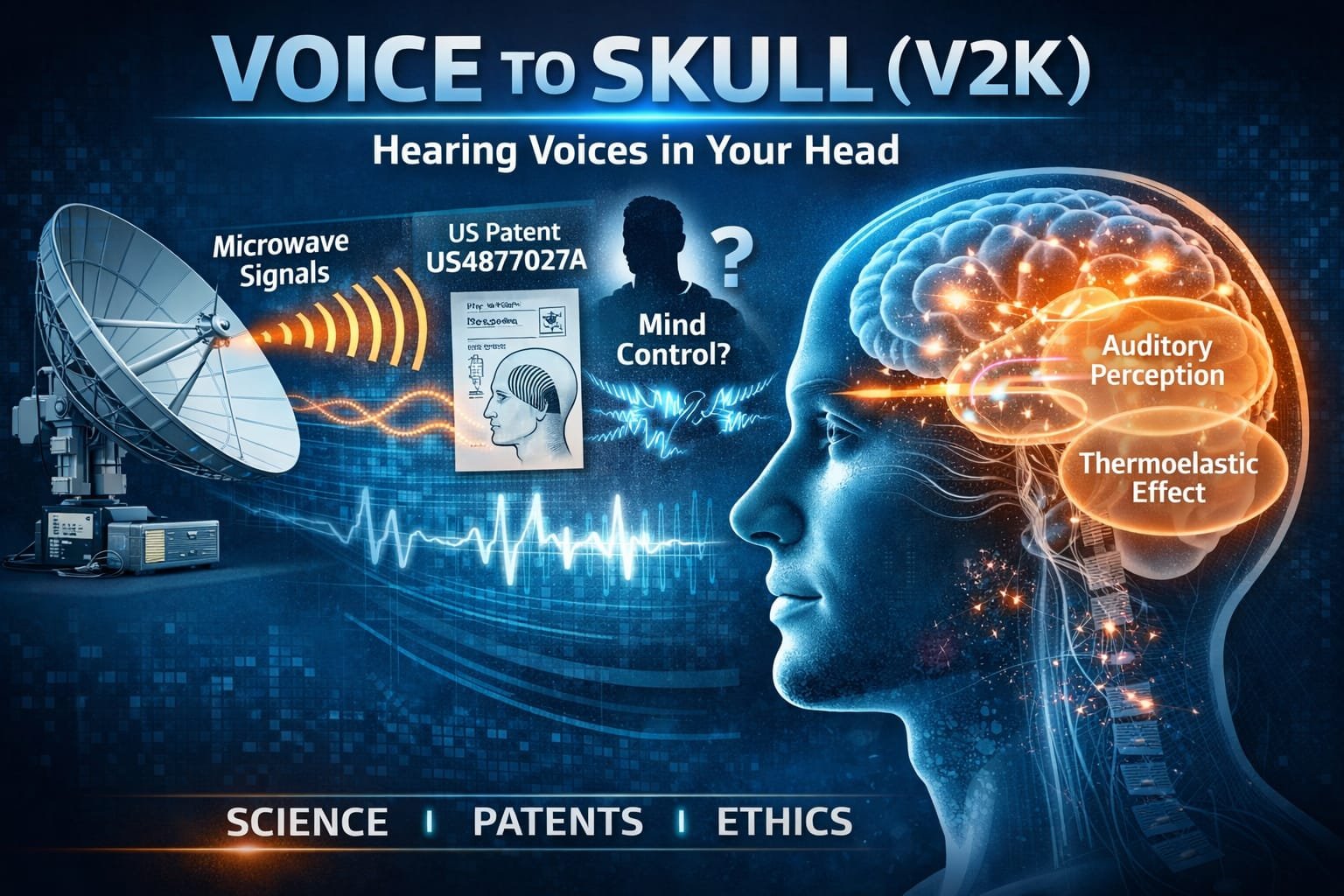
Have you ever wondered why some people report hearing voices in their head? While psychiatry links this phenomenon to auditory verbal hallucinations (AVHs), could voice to skull technology https://lov111vol.com/voice-to-skull play a role? Let’s explore the scientific, technical, and patent- based evidence.
What Causes Voices in Your Head?
Is hearing voices purely a neurological issue? Clinical research shows that during AVHs:
- Does the auditory cortex become active? Yes.
- Do Broca’s and Wernicke’s areas show activation? Absolutely.
- Can functional imaging demonstrate internally generated speech-like signals? Yes.
Evidence confirms that most voice-hearing experiences originate internally rather than externally. Supporting studies include:
- fMRI imaging (Shergill et al., 2000)
- EEG showing abnormal cortical activity
- PET scans demonstrating internally generated speech
If internal brain processes explain most cases, how do we reconcile claims about technological interference?
What Is Voice to Skull Technology (V2K)?
Could there be a way to transmit sound directly into a human brain? Voice to Skull technology (V2K)
aims to do exactly that. It describes systems that:
- Use microwave radiation
- Modulate radiofrequency (RF) signals
- Employ directed energy pulses
- Induce auditory perception via pulsed electromagnetic signals
Is V2K officially recognized in science? No, it’s a descriptive term, but the phenomena it studies- electromagnetic-auditory interaction-are well documented. The core principle is the microwave auditory effect, demonstrated by Allan H. Frey in 1961.
Read more: https://lov111vol.com/voice-to-skull
What Did Psychiatrist Amin Muhammad Gadit Say?
Can remote influencing technologies affect mental health? Amin Muhammad Gadit, Clinical Professor of Psychiatry at Memorial University of Newfoundland, addressed this in 2009:

- Do terrorist activities cause long-term psychological effects? Yes, including PTSD.
- Could new technologies mimic mental disorders? Potentially.
- Are psychiatrists prepared for these challenges? Gadit asked: ‘Are we prepared for this challenge?’
He noted bio-electromagnetic weapons could:
- Induce pain or paralysis
- Create hallucinations, including voices and visions
- Interfere with normal sensory perception
Does this mean V2K is widely used? No. His work emphasizes ethical awareness and clinical preparedness. (Official Position)
How Does the Microwave Auditory Effect Work?
Can microwaves create auditory sensations? Frey’s experiments showed:
- Pulsed microwave radiation can produce clicks or buzzing sounds.
- Do these sounds require acoustic waves? No.
- How are they detected? Thermoelastic expansion of brain tissue generates pressure waves perceived by the auditory system.
Are these effects reproducible? Yes, under controlled laboratory conditions. Do they allow transmission of complex speech? No. Only simple sounds are produced. This is a verified scientific fact. (Official Position)
How Does Patent US4877027A Demonstrate V2K?
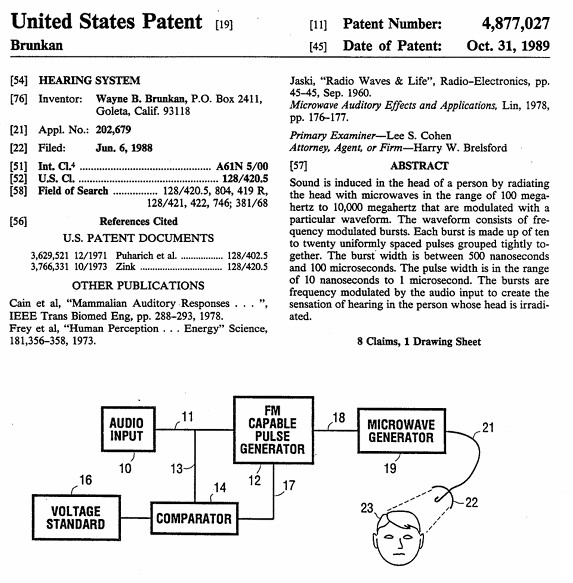
What does Patent US4877027A describe? It outlines a system for inducing auditory perception using microwaves:
- Carrier frequencies: 100 MHz – 10 GHz
- Pulse durations: nanoseconds to microseconds
- Modulation corresponds to audio signals How does the signal reach the brain?
- Audio is converted into ultra-short pulses.
- Pulses cause tiny thermoelastic expansions in the skull.
- Pressure waves reach the cochlea and are interpreted by the brain.
Does this mean operational systems exist? Not publicly. But engineers treated microwave auditory induction as a solvable technical challenge. (Official Position)
Which Patents Support V2K Research?
| Patent | Inventor | Year | Focus |
| US4877027A | Philip C. Stocklin | 1989 | Pulse-modulated microwaves for auditory perception |
| US3951134A | Robert G. Malech | 1976 | Early exploration of electromagnetic brain effects |
| US6587729B2 | James C. Lin | 2003 | RF-based auditory signal modulation |
| US4858612A | Joseph C. Sharp | 1989 | RF-induced auditory perception concepts |
Do these patents confirm serious research? Yes. They show engineers explored electromagnetic auditory systems even if public deployment is not verified. (OFFICIAL POSITION)
Are There Scientific Limits to V2K?
Can V2K reliably transmit speech over distances? Evidence shows:
- No verified large-scale operational systems exist. (Official Position)
- Energy and safety constraints limit range.
- Maintaining signal clarity through tissue is difficult.
- Full speech transmission has not been demonstrated. (Official Position)
So, can simple auditory sensations be induced? Yes, but complex voice injection remains unverified.
What Ethical Issues Arise?
Should research into electromagnetic auditory induction concern us? Key issues include:
- Cognitive liberty: protecting thought autonomy
- Mental privacy: preventing non-consensual neural interference
- RF exposure safety and research transparency
Albert Einstein warned: ‘It has become appallingly obvious that our technology has exceeded our humanity.’ This reminds us that ethics must match technical ability.
Evidence-Based Summary
What can we conclude from documented evidence?
- The microwave auditory effect is experimentally validated.
- Patents like US4877027A confirm engineering exploration.
- Professors, engineers, and physicists have studied electromagnetic-auditory interaction.
- No verified evidence supports remote complex speech transmission.
- Most cases of hearing voices are explained neurologically.
Thus, discussions about VOICE TO SKULL technology (V2K) should remain grounded in biophysics, neuroscience, patents, and technical limitations.
Acknowledgements
I thank Amin Muhammad Gadit, Clinical Professor of Psychiatry, for his research on mental health and remote influencing technologies. His insights provide essential ethical and clinical context for V2K.
- Marcin Szolke
References
- Frey, A. H. (1961). Human auditory system response to modulated electromagnetic energy. Journal of Applied Physiology.
- Stocklin, P. C. (1989). US Patent 4,877,027 – Microwave Hearing System.
- Lin, J. C. (2007). Microwave Auditory Effects and Applications. Springer.
- Malech, R. G. (1976). US Patent 3,951,134 – Apparatus for Monitoring and Altering Brain Waves.
- Shergill, S. S., et al. (2000). Functional imaging of auditory verbal hallucinations. The Lancet.
- Gadit, A. M. (2009). Terrorism and Mental Health: The Issue of Psychological Fragility.
Journal of Pakistan Medical Association.
- Sharp, J. C. (1989). US Patent 4,858,612 – RF Auditory Transmission Concepts.