Abstract
The impressive development in mass communication has led to different systems of media, which vary greatly in terms of their structure, technology, audience interaction, and philosophical approach to operations. One of such, broadcast media, and print media are two models on which the dissemination of information is based. This paper will discuss the essential differences between broadcast and print media through the use of immediacy, reach, sensory involvement, production processes, regulatory conditions, technological addiction, and patterns of audience interaction. The broadcast media exists in time-bound and signal-based systems where constant transmission of signals and real-time coordination is necessitated, whereas print media involves fixed textual presentation that is distributed physically or digitally to be read at a later date. Through conceptual and theoretical discussion grounded on available media research, the paper will outline how technology infrastructure can influence the practices of journalists, ethical responsibilities and the format of stories on both media. The results have shown that broadcasting is more immediate, experiential, and print journalism is more profound, permanent, and reflective. The paper finds that the knowledge of these structural distinctions is critical to practitioners of media, scholars, and regulators of the policy going through a more and more hybrid communication landscape.
Keywords: broadcast media, print media, media convergence, audience engagement, media technology, journalism structures.
1.0 Introduction
The mass media outlets are the major avenues through which societies acquire information, perceive events, and create common realities. In the past, print media became the first systematic structure of mass communication that influenced the political discourse and the literacy of the people through newspapers, magazines, and periodicals. The later development of the broadcast media facilitated the transmission of radio and television media, that has the potential of reaching multitudes of people at the same time, regardless of geographical areas.
The developments in technology have fueled academic discussion on the differences between broadcast and print media, especially in the manner in which either medium organizes news production and experience by the audience. According to scholars, both media are concerned about the same journalistic objectives, which are to inform and educate the population; however, their logics of functioning are of the ultimate essence because of technological limitations and forms of communication.
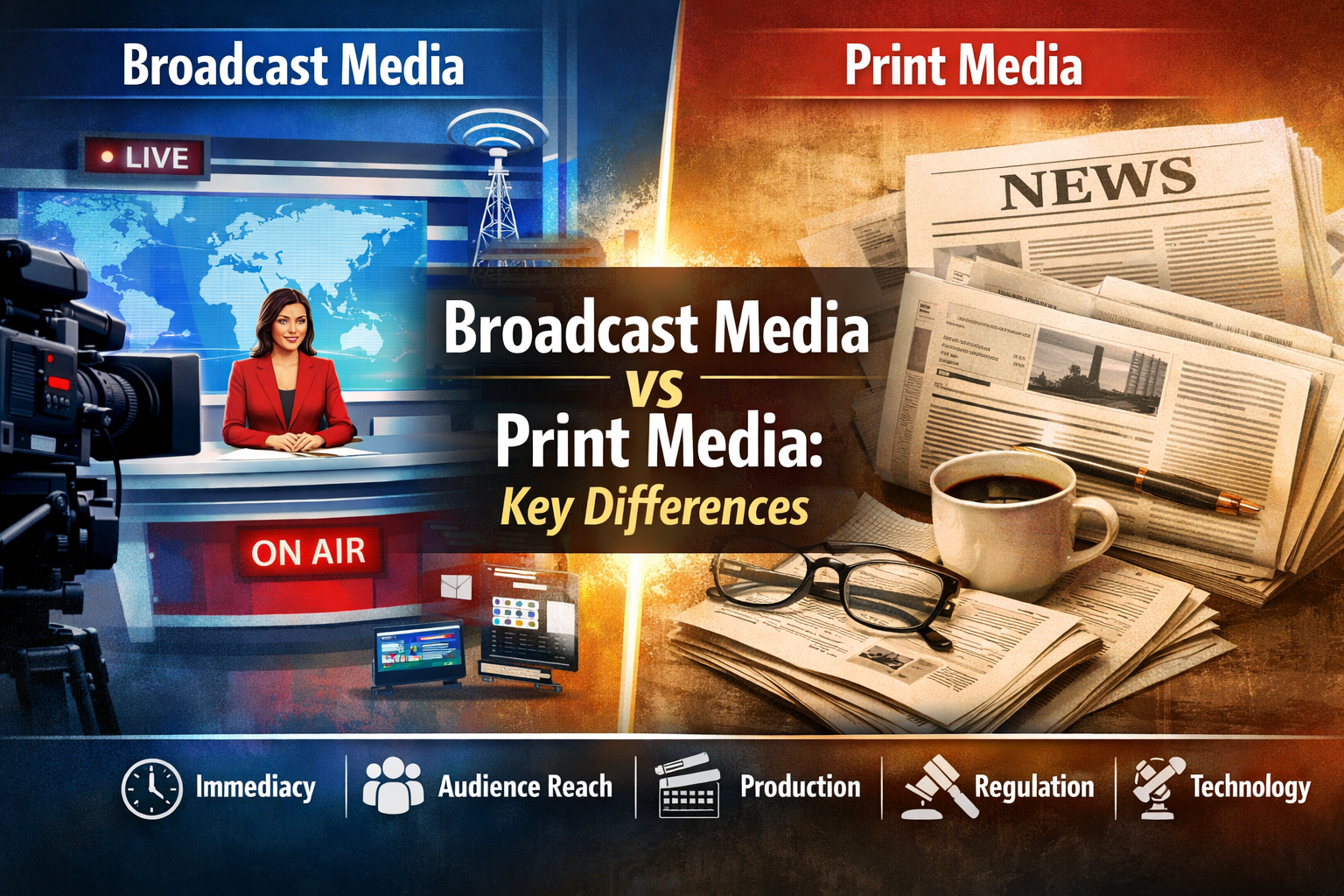
In order to establish a more ground-level context, readers could consider additional interpretation of the distinctions between broadcast and print media, which points to existing differences in the patterns of dissemination.
This paper discusses the operation of the broadcast media in time-constrained systems of transmission against the print media, relying on the static or archived mode of transmission. The analysis analyzes variations in the areas of production processes, sensory communication, regulation, dependence on technology, and interaction with the audience.
2.0 Literature Review
2.1 The historical background of the print media
The invention of the printing press in the fifteenth century led to the emergence of print media since the media facilitated the standard reproduction of texts (Eisenstein, 1980). The newspapers were the key to the democratic engagement that became instrumental in informed citizenship and political discourse (Habermas, 1989). The scholars highlight the advantages of print journalism in permanency, editorial examination and analysis reporting.
According to McQuail (2010), print media fosters contemplative reading whereby the audience can re-read the content and process the information at their own pace. This permanence is what differentiates print from short-lived broadcast communication.
2.2 The development of Broadcast media
The twentieth century broadcast media were created in the form of radio and television technology. The mass communication that had previously been achieved by print distribution was now possible with broadcasting, involving simultaneous communication of the mass audiences by use of electromagnetic signals (Sterling and Kittross, 2002).
According to Postman (1985), television transformed the discourse of the population as it became more visual and more emotional in its approach. Broadcast journalism developed into immediacy, live broadcasting, and immediate engagement with the audience.
2.3 Media Convergence Debate
Digital technology points to convergence of media platforms as pointed out by modern scholars (Jenkins, 2006). Nevertheless, although there is overlapping distribution channels, structural variations are still present in production logic, viewer perception and style of telling stories.
3.0 Theoretical Foundations and Conceptual Review
3.1 Concept of Broadcast Media
Broadcast media The communication systems that deliver audio or audiovisual messages through electronic signals to scattered audiences at the same time are called broadcast media. Major features are:
- Real-time transmission
- Continuous scheduling
- Signal dependency
- Audio-visual storytelling
Broadcast communication is essentially time-based; the content exists mostly when it is being broadcast.
3.2 Concept of Print Media
Print media entails the distribution of written and visual information via the physically printed or immobile electronic media like magazines, newspapers and journals. Its characteristic features are:
- Permanence
- Editorial layering
- Structured layout design
- Asynchronous consumption
In contrast to broadcasting, the content of print is available many years after it was published.
4.0 Theoretical Review
4.1 Media Richness Theory
Communication effectiveness is explained by Media Richness Theory (Daft and Lengel, 1986) in terms of the capacity of a medium to express a number of cues. The higher rank of broadcast media is facilitated by audio visual factors, tone and immediacy whereas print offers less sensorial qualities, but more clarity with complex information.
4.2 Uses and Gratifications Theory
According to the Uses and Gratifications Theory (Blumler and Katz, 1974), the audience is supposed to have a choice of media depending on its needs. Broadcast media meets the needs of entertainment and immediacy whereas the print meets the need of informational depth and thinking.
4.3 Agenda-Setting Theory
The setting of an agenda theory (McCombs and Shaw, 1972) has a dissimilar use in the media. The broadcast news influences the everyday attention of the people by the live updates, whereas the analysis of the issues is strengthened by the print.
5.0 Methodology
The research is conducted using qualitative analytical approach of reviewing secondary data and conceptual comparing. Academic literature, theory texts of media and communication studies were reviewed to provide structural differences between broadcast and print systems.
The comparative framework was centered around six variables of analysis:
- Immediacy
- Audience reach
- Sensory engagement
- Production processes
- Regulatory frameworks
- Technological dependency
6.0 Findings
6.1. Immediacy and Time Sensitivity
The broadcast media are bound by time. News has to correspond with planned programming or a live broadcast. Breaking events are reported immediately and in most cases without much time to have further verification.
Print media, on the other hand, permits latent publication cycles. This is an advantage to the journalists because their editorial review process is lengthy, allowing deeper investigation and more contextual reporting.
6.2 Reach and Accessibility to the Audience
Radio and television reach millions of people at a time and are very important means of communication in the country. Print distribution relies on circulation patterns or online downloads that might restrict immediate access.
Print, however, has permanence; the reader can read articles forever.
6.3 Sensory Interactions: Audio-Visual and Textual Communication
Broadcast media, through the combination of sound, images, movement and narration, contribute to immersion. Facial expression, background sound, and live footage make emotional storytelling more effective.
Print media is based on textual analysis and inanimate visuals. Although it is less rich in sensory input, this type stimulates critical thinking and better understanding.
6.4 Production Processes
Broadcast production involves the coordination of technical teams such as:
- Camera operators
- Audio engineers
- Producers
- Transmission technicians
The contents should be able to meet the technical timing requirements.
Print production goes through editorial processes that include:
- Reporting
- Copy editing
- Page layout design
- Either printing or online publishing.
Speed is inferior to accuracy and clarity.
6.5 Regulatory Frameworks
The broadcast media is usually highly controlled by the government since the spectrum frequencies are scarce common resources. There is strict control of licensing, timing laws on content and ethics in broadcasting.
Print media has a relatively greater editorial freedom, but is covered by libel and press laws.
6.6 Technological Dependency
Broadcast systems require extensive infrastructure like transmitters, satellites and power that is not intermittent. Instant communication is stopped by a technical breakdown.
Print media has been relatively tough; as soon as it is printed or uploaded online, it will still exist even without a signal.
7.0 Discussion
The results indicate that the journalistic practice is rather structurally dominated by the technological architecture. Broadcast journalism is quick; it seeks to entertain readers and listeners and values the efficiency of reporting more than analytical reportage. Print journalism, on the other hand, favors accuracy, interpretation, and permanence.
The ethical decision-making is affected by these structural differences. In the case of broadcast journalists, the decision has to be struck between immediacy and verification in the face of a tight time constraint. Print journalists work in slower cycles, which give time to fact-checking and editorial contemplation.
Digital convergence has erased borders, but operational differences can still be seen. Broadcast-like video content is being incorporated into online news sites more often than traditional text articles, which represent the development of hybrid media.
8.0 Conclusion
Broadcast and print media are complementary and structurally different systems of mass communication. Broadcast media works based on time-constrained and signal-based dissemination that focuses on immediacy and sensual stimulation. Print media is based on the use of static distribution by focusing on permanence, depth, and contemplation of consumption.
Although digital convergence is a phenomenon, the various media have different operational, technological, and ethical needs. By understanding these differences, one can create media more effectively, regulate it, and understand the audience in the modern world of communication.
References
Blumler, J. G., & Katz, E. (1974). The uses of mass communications. Sage.
Daft, R. L., & Lengel, R. H. (1986). Organizational information requirements and media richness. Management Science, 32(5), 554–571.
Eisenstein, E. L. (1980). The printing press as an agent of change. Cambridge University Press.
Habermas, J. (1989). The structural transformation of the public sphere. MIT Press.
Jenkins, H. (2006). Convergence culture: Where old and new media collide. NYU Press.
McCombs, M., & Shaw, D. (1972). The agenda-setting function of mass media. Public Opinion Quarterly, 36(2), 176–187.
McQuail, D. (2010). McQuail’s mass communication theory (6th ed.). Sage.
Postman, N. (1985). Amusing ourselves to death. Penguin.
Sterling, C., & Kittross, J. (2002). Stay tuned: A history of American broadcasting. Lawrence Erlbaum.



Thank you I have just been searching for information approximately this topic for a while and yours is the best I have found out so far However what in regards to the bottom line Are you certain concerning the supply