Introduction
Accounting is said to be the language of business. It captures, interprets and disseminates financial data which informs decision making in both large and small organizations. Nevertheless, accounting is not one and the same subject. It is composed of several specialized areas, each of which was created to address certain informational, managerial, and regulatory demands. It is also important to know the branches of accounting by the students, professionals, entrepreneurs, and policy makers who need to use the right financial information to make wise decisions.
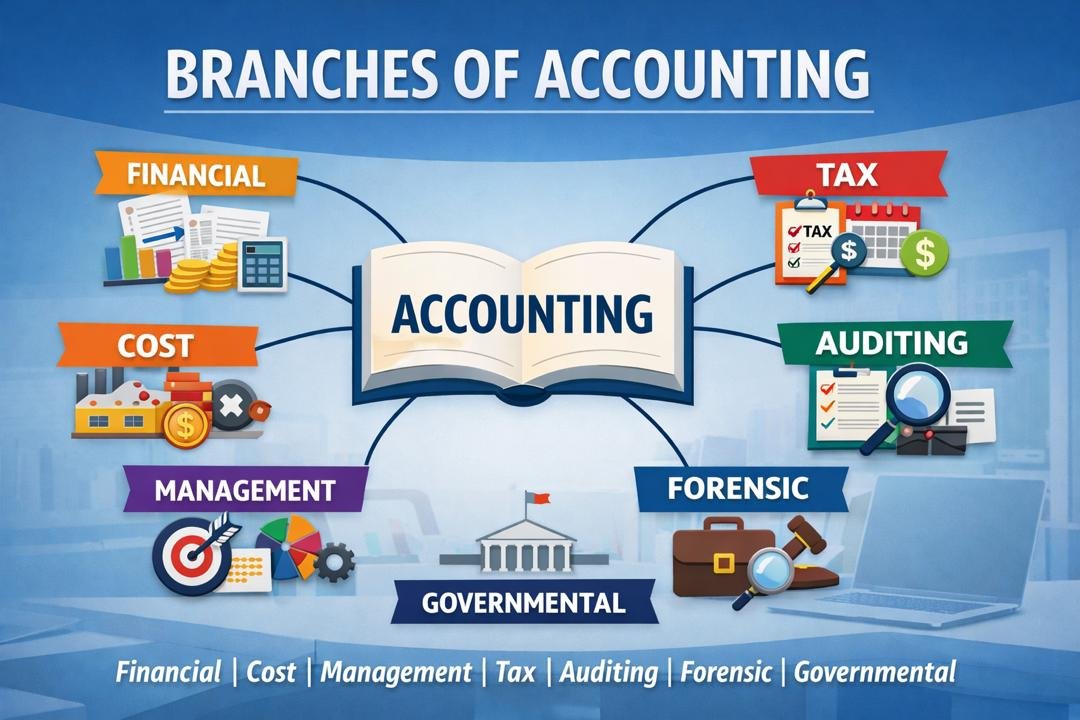
This article will discuss the key branches of accounting which include financial accounting, cost accounting, management accounting, tax accounting, auditing, forensic accounting and governmental accounting. The branches each have their unique focus, distinct users and unique methodologies, but each is aimed at enhancing transparency, efficiency and compliance within an organization.
Understanding the Branches of Accounting
Branches of accounting are the special areas of accounting profession. Although their purpose has some similarities in accuracy, consistency, and reliability, the purpose of each branch and their target audience is distinct. Others are more interested in external reporting and regulatory compliance whilst others are interested in internal decision making and strategic planning.
In combination, these branches guarantee the financial information recording, analysis, reporting, and protection.
1. Financial Accounting
Definition and Focus
Financial accounting is a sub-discipline of accounting, which involves the recording, summarization, and reporting of financial transactions of an organization in a given period of time. It also generates standardized financial statements that give a clear picture on the financial performance and position of the organization.
Key Outputs
Financial accounting generates:
- Income Statement (Profit and Loss Account)
- Balance Sheet (Statement of Financial Position).
- Statement of Cash Flows
- Statement of Change in Equity.
Such reports are usually prepared as per the established accounting principles like International Financial Reporting Standards (IFRS) which is issued by International Accounting Standards Board or Generally Accepted Accounting Principles (GAAP).
Users
Financial accounting is mostly used by external users, such as:
- Investors
- Creditors and lenders
- Regulatory authorities
- Shareholders
- Financial analysts
Methodology
Financial accounting adheres to the accounting principles and standards in order to bring the consistency and comparability. It operates the system of the book keeping based on the double entry and provides stress on the past. This is aimed at transparency and accountability so that the stakeholders are able to evaluate the financial health of the organization.
2. Cost Accounting
Definition and Focus
Cost accounting is concerned with calculating, managing, and examining the expenses of evidence of the manufacture of goods or services. It is prevalent in the manufacturing and production settings, however, it can be used in service industries as well.
Key Objectives
- Price decisions on product and service.
- Cost management and cost minimization.
- Inventory valuation
- Pricing decisions
- Budget preparation
Users
The main purpose of cost accounting is to serve the internal management. Cost information is used by managers to:
- Enhance the efficiency of operations.
- Set competitive prices
- Eliminate waste
- Enhance profitability
Methodology
Cost accounting involves the use of special methods like:
- Job costing
- Process costing
- Standard costing
- Activity-based costing (ABC)
- Marginal costing
Cost accounting does not have rigid external standards as the financial accounting. It is adaptable and it will suit the internal needs of the organization.
3. Management Accounting
Definition and Focus
Management accounting (sometimes known as managerial accounting) is the presentation of both non-financial and financial data to managers to aid in managerial planning, control, and decision-making. It extends beyond historical data and tends to look into the future projections.
Key Functions
- Budgeting and forecasting
- Performance evaluation
- Variance analysis
- Break-even analysis
- Strategic planning
Users
The main users are the internal managers on different levels:
- Top management
- Departmental managers
- Operations managers
Methodology
Management accounting brings together the information of financial and cost accounting and uses tools of analysis, including:
- Ratio analysis
- Cost-volume-profit analysis
- Techniques of capital budgeting.
- Key Performance Indicators (KPIs).
It is dynamic and prospective with focus on relevancy and timeliness rather than focus on accounting standards.
4. Tax Accounting
Definition and Focus
Tax accounting involves the preparation, analysis and filing of tax returns and other documents related to taxes. It not only makes sure that the organization and businesses comply with the tax laws and regulations, but also assists the organizations and individuals in reducing their tax liabilities as stipulated by law.
Key Functions
- Preparing tax returns
- Tax planning
- Abidance by tax laws.
- Offering tax saving tips.
- Managing tax audits
Users
Tax accounting serves:
- Government tax authorities
- Businesses
- Individuals
- Corporate management
Methodology
Tax accounting is done in tax laws and regulations that are set forth by the government agencies. In Nigeria, the Federal Inland Revenue Service regulates the tax practices.
Tax accounting is a discipline that is enforced by tax laws unlike financial accounting which can be based on IFRS. The differences between accounting profit and taxable profit is usually caused by different rules of accounting recognition of income and deduction of expenses.
5. Auditing
Definition and Focus
The independent audit of financial statements is the process of establishing whether the financial statements reflect a true and fair picture of the financial position of an organization. It increases credibility and creates the trust in the stakeholders.
Types of Audits
- Internal audit
- External audit
- Compliance audit
- Operational audit
Users
Auditing benefits:
- Shareholders
- Investors
- Regulatory bodies
- Creditors
- Management
Methodology
Auditors test financial statements, internal controls and accounting records. Their sources of evidence are:
- Inspection
- Observation
- Inquiry
- Confirmation
- Analytical procedures
The independent firms which are usually consulted to carry out external audits include Deloitte and PwC.
Auditing helps to ensure that financial reporting is in line with the accounting standards as well as minimizes the possibility of fraud or misrepresentations.
6. Forensic Accounting
Definition and Focus
Forensic accounting is an accounting skill that involves auditing, investigating, and analyzing financial data to detect fraud, embezzlement or lawsuits. It is commonly applied in criminal and court investigations.
Key Functions
- Fraud investigation
- Litigation support
- Resolution of financial disputes.
- Asset tracing
- Expert witness testimony
Users
Forensic accounting serves:
- Law enforcement agencies
- Courts
- Lawyers
- Corporations
- Insurance companies
Methodology
Forensic accountants examine financial information in order to identify anomalies. They use:
- Data analysis techniques
- Interview methods
- Digital forensic tools
- Reconstruction techniques that are financial.
This division has gained more significance in fighting the financial crimes, cyber fraud as well as misconduct in corporations.
7. Governmental Accounting
Definition and Focus
Governmental accounting deals with the process of recording and reporting of financial activities in the government. It will make sure that there is accountability when it comes to the administration of state funds.
Objectives
- Budget control
- Fund accounting
- Public spending: Transparency.
- Adherence to the legislation of the public sector.
Users
Governmental accounting users are:
- Government officials
- Citizens
- Oversight agencies
- International organizations
Methodology
Fund accounting is commonly employed in governmental accounting with resources being grouped by intended purposes. It lies more on accountability and compliance of its budget as opposed to measuring its profits.
Depending on the public sector standards may vary between the standards in the private sector with a focus on accountability and stewardship.
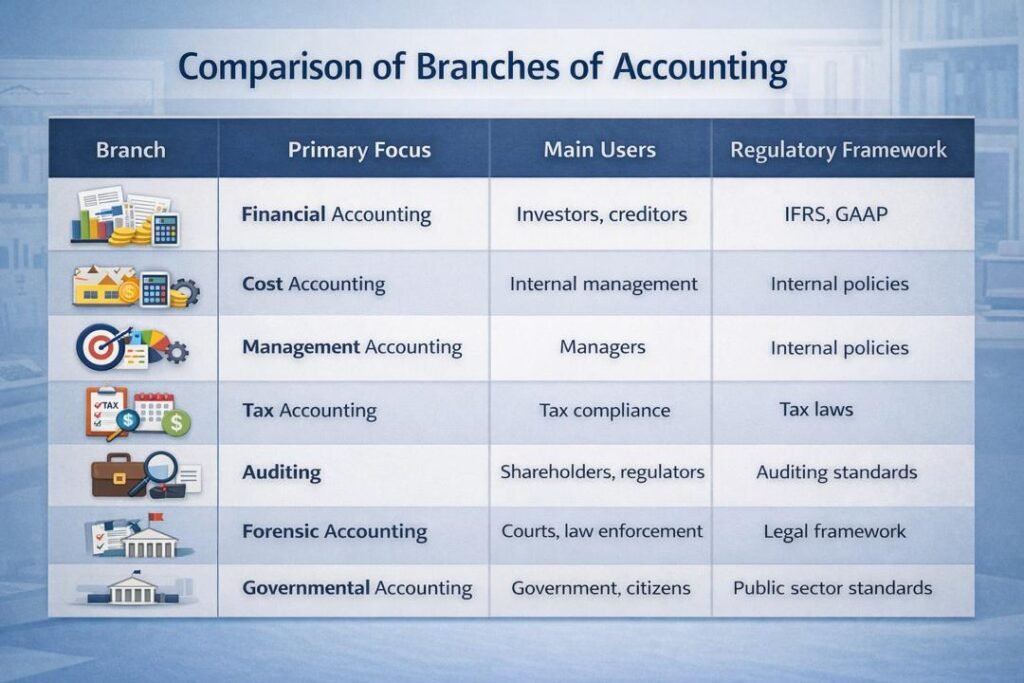
Comparative Analysis of the Branches
These branches are different in their focus and methodology, but they are similar in the following aspects:
| Branch | Primary Focus | Main Users | Regulatory Framework |
| Financial Accounting | External reporting | Investors, creditors | IFRS, GAAP |
| Cost Accounting | Cost control | Internal management | Internal policies |
| Management Accounting | Decision-making | Managers | Internal policies |
| Tax Accounting | Tax compliance | Government, businesses | Tax laws |
| Auditing | Verification | Shareholders, regulators | Auditing standards |
| Forensic Accounting | Fraud investigation | Courts, law enforcement | Legal framework |
| Governmental Accounting | Public accountability | Government, citizens | Public sector standards |
How the Branches Collectively Support Organizational Performance
Enhancing Decision-Making
The information in management and cost accounting is detailed and can be used in strategic and planning decisions. Financial accounting provides a general state of financial health which is used to make investment and financing choices.
Ensuring Regulatory Compliance
Tax accounting and tax auditing help in making sure that organizations meet the laws and regulations. Failure to comply may result in punishments, reputations, and legal repercussions.
Ensuring Transparency and Accountability
Financial accounting and audit supports trust through presenting the correct and confirmed information to the stakeholders. Government accounting ensures that there is responsible expenditure of government funds.
Identifying and Eliminating Fraud
Forensic auditing and accounting are important in detecting and averting financial misconduct. This consolidates the corporate governance and safeguards assets.
Investing in Strategic Growth
The data of other branches is combined to support performance improvement, long-term planning, and risk management in management accounting.
The Interrelationship between the Branches
The accounting branches do not work individually. They are interconnected:
- Financial accounting offers base information that is applied in management and cost accounting.
- Cost accounting occurs as input to the management accounting in budgeting and price making.
- Financial accounting assesses its outcomes using auditing.
- Taxable income uses financial records to calculate tax accounting.
- Abnormalities that have been realized in the process of audit may be investigated to forensic accounting.
- Governmental accounting is used to make sure that financial management of the people is in line with the policies and budgets.
This interrelationship system will be a detailed accounting system to cover the operational, strategic, and regulatory requirements.
Conclusion
The branches of accounting are the specialized and at the same time, the interconnected fields which together guarantee the proper operations of institutions. Financial accounting is concerned with the reporting of the standardized external externality and cost and management accounting aid in making the decisions within the company and in the effectiveness of the functioning. Tax accounting, auditing, forensic accounting and governmental accounting helps to ensure compliance with tax laws, increase credibility, fight fraud and protect the resources of the population respectively.
All these branches create a solid structure that enhances transparency, accountability, and regulatory compliance and strategic growth. This knowledge of their unique roles and methodology can increase the level of academic knowledge and prepare professionals to play an important role in the success of the organization.
With the growing complexity around the business environment, it is only when one manages to master the different branches of accounting that one will be in a position to sustain performance, have compliance, and build confidence of the stakeholders.
Get more well researched information about the branches of accounting here.