Abstract
Production of newspapers is a team effort between the editorial judgment, copy preparation, and visual design, so as to convert the raw information into readable and entertaining journalism. This paper looks at the nature of editing and page layout as being interdependent processes and not discrete tasks. The paper is based on practices of newsrooms and communication theory exploring the role of editorial decision-making in determining visual hierarchy, the process of reader navigation, and information hierarchy. In the discussion, collaboration between editors, designers, reporters and production personnel is noted to be a key ingredient towards the attainment of clarity, credibility and interest to the readers. Results indicate that successful newspapers are a result of synchronized processes in which the linguistic and visual structures are synchronized and the expectations of the audience are met. The article concludes that editing and design reinforce good storytelling and increase the understanding of the audience in contemporary journalism.
Keywords: printing of newspapers, copywriting, page layout, newsroom cooperation, visual communication, presentation of news.
Introduction
Production of newspapers goes way beyond the writing and printing of news. Every published page has behind it a process of coordination in which the editors polish the content, and the designers are the ones who forge the perception of the readers with visual content. Accuracy, clarity and conformity to the norms of journalism are guaranteed through editing, whereas readability, hierarchy and beauty are dictated by design. These processes form meaning and direct interpretation by the audience.
The correlation between editorial and design judgement is particularly critical to the successful news presentation, where content and layout are an integrated communications mechanism and not parts of one. Considering that a newspaper published today relies on cooperation between the professionals of the newsroom, it is obvious that the newspaper should not only be accurate but also readable and interesting.
This paper discusses the interaction between editing, copy preparation, and page layout within the newsroom processes and the coordination of work between teams in the newsroom as well as how these processes lead to success in journalism.
Literature Review
The changing connection between the editorial practice and visual communication is the subject of scholarly discourse on newspaper production. Harrower (2012) states that traditional editing involved grammar, factual checking and adherence to the house style, but modern journalism has necessitated editors to appreciate visual narrative in content editing. In the same spirit, Garcia (2017) claims that newspaper design is journalism on its own since layout choices determine the way a reader gives precedence to information.
Media studies research has shown that readers do not read news in a linear manner. On the contrary, they read headlines, pictures, captions, and text before reading entire articles (McQuail, 2010). This scanning pattern implies that editorial clarity should be in line with visual cues developed by design. Barnhurst and Nerone (2001) also add that institutional credibility is also expressed through page arrangement since organized layouts imply an element of professionalism and reliability.
New technology has made this relationship stronger. Research indicates that editorial-design processes enhance understanding and retention of readers, particularly when the editorial purpose is supported through headlines, images, and location of the story (Franklin, 2014). Therefore, newsroom cooperation has taken centre-stage in the modern news production.
Conceptual Review: Editing, Preparation of Copies and Layout
Editing as Content Mining
Editing makes sure that the content of news is professional in terms of accuracy, fairness, as well as being clear. Copy editors clean up grammar, check facts, ensure that there is consistency, and control narrative flow. Editing, however, is also a matter of prioritization, when it comes to deciding what information is worthy of attention and how narratives should be connected to each other in a publication.
Transitional Work: Permitting Copy Preparation
Copy preparation is a transition between writing and design. At this phase, editors get the final headlines, subheadings, captions, pull quotes and length of the story finalized. These factors have a direct effect on layout opportunities since layout designers use structured content to produce a balanced page.
As an illustration, column width depends on headline length, whereas the trimming of the stories can leave space to fit photographs or infographics. Therefore, copy preparation is a negotiation between the editorial meaning and space constraints.
Page Layout as a Visual Communication
Page layout is the method of visual organization of information using typography, spacing, images and alignment. The principles of design, e.g. hierarchy, contrast, and balance, allow readers to find the relevant stories in a short time. Garcia (2017) argues that layout makes editorial priorities visible, and the readers can see which stories are the most important.
Theoretical Framework
The visual communication theory and the gatekeeping theory are the main sources of this study.
According to the visual communication theory, meaning is as a result of the interaction between the text and the visual structure. Typography, positioning of images and spacing will have as much effect on interpretation as the words themselves. In newspapers, design has been used to convey the perception of urgency, credibility, and relevance to the readers.
The gatekeeping theory is used to describe the process by which the editors influence the process of selection and presentation of news. Not only do editors decide what stories are published, but they also decide how visible they are going to become. Together with design choices, gatekeeping goes beyond content selection to visual emphasis, to influence the perception of the audience.
Combined, these theories show that editing and design do not operate separately in creating meaning of news, but instead, they work together.
Methodological Approach
The analytical method used in this article is qualitative, relying on the studies of the workflow in the newsroom and the proven journalism scholarship. Scholarly literature and professional editing manuals were reviewed, and newsroom models of practice were identified to reveal the general trends in editorial-design cooperation. The effect of editorial decisions on layout consequences and audience interest was assessed with the help of a comparative analysis.
Findings
Visual Hierarchy is created through editorial decisions
The placement instructions, like the lead stories or front-page features, are determined by the editors based on the importance of the story. These priorities are then reduced to visual hierarchy by designers in terms of headline size, image prominence, and positioning. Layout, in the absence of editorial direction, has no communicative direction.
Design has an impact on editorial writing
The constraints of design would tend to influence the finalization of the copy by the editors. The lack of space can necessitate brief headlines or reduced narration. On the other hand, access to high-quality visuals can promote increased coverage or feature style presentation.
Cooperation enhances Navigation by the reader
In newsrooms where there is communication between the editors and designers, easy-to-follow pages are created by the designers. Co-ordinated application of headlines, subheads and visual cues assists audiences to scan and get information effectively.
Working in a team Minimizes production mistakes
Production workflows enable the reduction of inconsistencies, including captions that do not match, layout asymmetry, or deceptive visual focus. The cooperation makes both textual and visual elements accurate.
Discussion
The results confirm that editing and design are non-autonomous elements of the newspaper production. The meaning is constructed by editorial teams using language and news judgment, and strengthened by the designers using visuals. Physical separation of these positions exposes the newspapers to confusion among readers, or failure to impact storytelling.
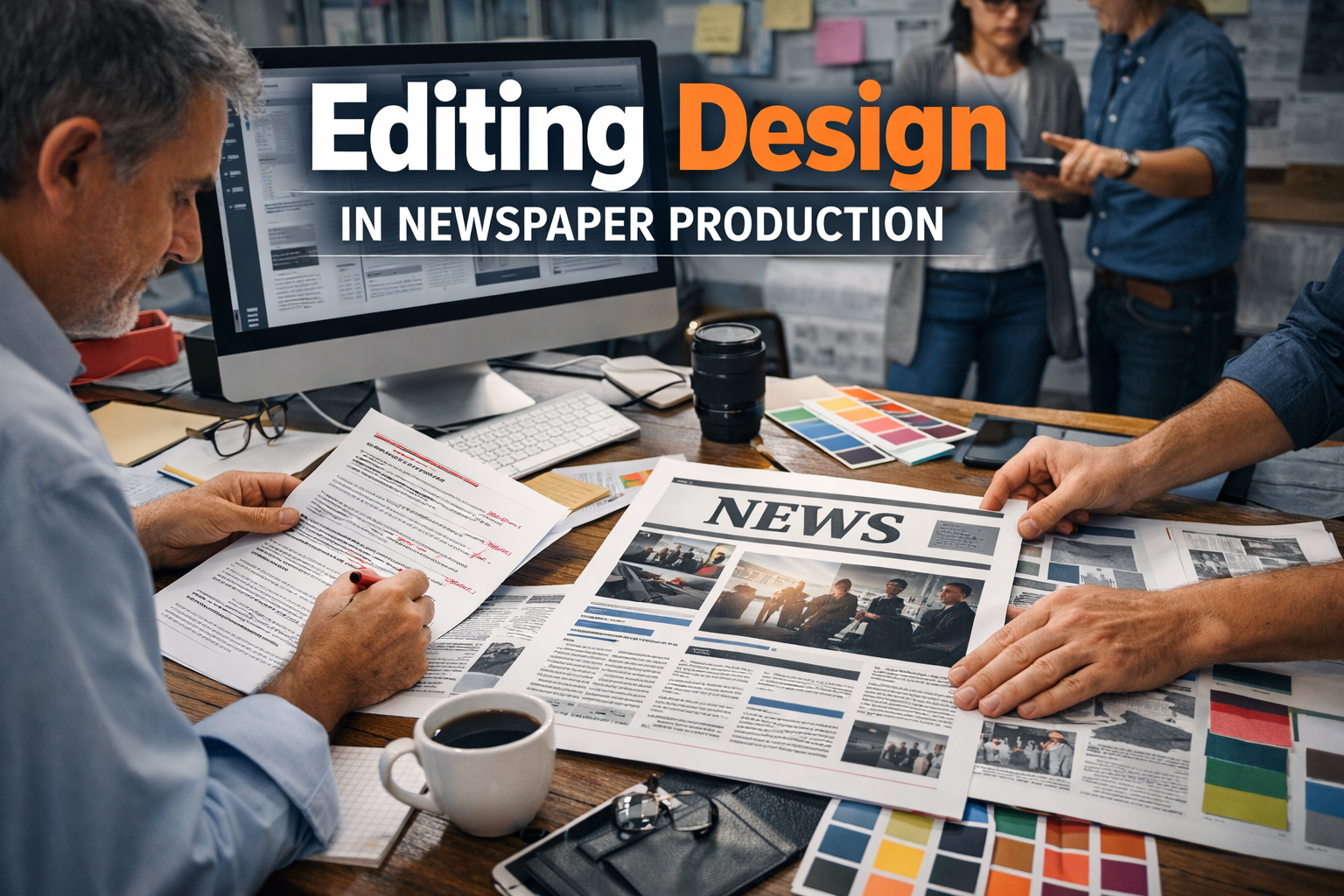
The current newsroom setting is more of a collaborative planning session, instead of an editorial strategy versus a visual planning session, wherein the editors and designers plan on how to place information in a story and how to visualize it. This collaboration brings the journalistic objectives in line with the expectations of the audience, and this coherence is seen throughout the pages.
Moreover, the credibility is supported by integrated production processes. Arranged designs and readability are linked to reliable journalism for the readers. In this way, the visual presentation is an expansion of editorial ethics, which enhances transparency and professionalism.
The integration has also been enhanced by technological changes. Real-time collaborations and digital layout software make it possible to view the impact of textual changes on design in real-time. The change has altered the culture of the newsroom from a sequential production to a simultaneous cooperation.
Conclusion
The components of editing and design are necessary in the production of the newspaper. Editing makes sure that it is accurate and has a clear narrative, whereas the design helps transfer editorial priorities into visual expression, which directs the attention of readers. The relationship between these functions proves that journalism is linguistic and visual.
The analysis indicates that both editors, designers and production personnel working together increase the readability of the work, minimize the amount of errors and improve the connection with the audience. The newspapers are coherent when the editorial judgment and visual organization work in balance with each other. With journalism trending in all directions in print and electronic media, coordinated newsroom work will still be the focal point of providing convincing and reliable news.
Finally, the creation of successful newspapers cannot be done by just effective writing or beautiful design, but by a conscious combination of both processes into one communication campaign.