Abstract
Complex and effective communication systems existed among indigenous African societies before they came into contact with the colonists. These systems were oral, symbolic, indigenous media and institutional channels incorporated in social, political and religious organizations. But, with the introduction of colonialism to Africa, drastic changes were made to these systems by introducing foreign languages, Western forms of media and administrative systems of communication. This paper will explore the effects the colonial rule had on the communication systems of indigenous African by looking at the ways the colonialists stifled, altered, or replaced the established communication systems. It also examines how African societies were able to adjust to these developments and managed to preserve aspects of their native communication culture. The study also provides an understanding of the tenacity of African communication systems and their persistence in postcolonial Africa using a qualitative, historical approach.
Keywords: Traditional African Communication Systems; Colonialism; Indigenous Media; Oral Communication; African Cultural Change.
1. Introduction
Prior to the European colonialists, African communities had highly organized and culturally based systems of communications used to govern, regulate socially, educate and provide spirituality. These systems were very entrenched in oral tradition and social intercourse. Communication was not only a source of exchange of information but a process of perpetuating social integration, conveying values, and political power.
The deepening of colonialism in Africa that began in the late nineteenth century radically changed the traditional African communication systems in the area. Colonial powers in Europe presented the western languages, print media and bureaucratic communicative systems which tended to sideline or undervalue the native forms of expression. Introduction of external communication systems upset the old channels of information and reevaluated the control of communication.
This paper critically looks at the impact of colonialism on the pre-existing African communication systems. It evaluates how far the traditional communication practices were repressed, converted or modified under the influence of colonialism. Special emphasis is put on such aspects as the introduction of Western media, colonial languages and the system of administrative communication, and the preservation and adjustment of native practices. In order to put this discussion in a certain context, we draw on the academic studies of Traditional African Communication Systems in African communities.
2. Literature Review
In the literature on African communication systems, scholars focus on the complexity and functionality of these systems before the colonialists came in. According to researchers like Ugboajah (1985) and Wilson (1998), the traditional African system of communication is argued to have been participatory, community-based, and embedded in their cultural systems. Such systems consisted of town criers, market communication, drumming, symbols, storytelling, proverbs and ritual performances.
According to research carried out on colonial communication policies, colonial governments actively favored western forms of communication as a way of consolidating power. As suggested by Schramm (1964), the media of communication utilized by the colonial governments such as print media, radio, and official gazettes was used to fulfill the needs of administration and ideology. The informal modes of communication that were used by the Indigenous people were often ignored as being primitive or useless, hence they were not included in the formal structures of governance.
Subsequently, scholarship puts emphasis on African agency to confront the colonial disturbance. According to researchers, indigenous communication systems never vanished but they were localized to suit the new realities. Oral traditions were still operating concurrently with the colonial media, usually as a substitute form of resistance and cultural survival. The paper contributes to this literature by offering a narrow evaluation of disorder and adjustment.
3. Theoretical Framework
The research paper is based on the Cultural Imperialism Theory and Communication Ecology Theory. The Cultural Imperialism Theory is used to understand the process where dominant cultures subject the subordinate societies to their systems of cultural and communicative practices, which in most cases results in the erosion of the indigenous cultures. Within the African colonial setting, media and European languages were to be superior, and the native systems were excluded in the margins.
The Communication Ecology Theory, on the other hand, considers communication systems to be integrated environments in which various forms exist and interact with each other. The framework can be applied in thinking about how indigenous African communication systems engaged with colonial media, causing the emergence of hybrid forms instead of utter displacement.
Put collectively, these theories offer a prism with which one can analyze the oppressive nature of colonialism as well as the resistance of African traditions of communication.
4. Methodology
The research takes a qualitative and historical research approach. The secondary sources such as academic books, journal articles, historical documents, and cultural studies of African communication systems were used to draw data. Patterns in the communication policies and responses of indigenous people toward colonialism were identified through content analysis.
In this way, one can gain a profound insight into communication practices in the history and cultural context. It is not about statistical measurement but about the interpretation of recorded accounts of experiences in various African societies.
5. Analysis and Findings
5.1 Indigenous African Communication Systems Precolonial
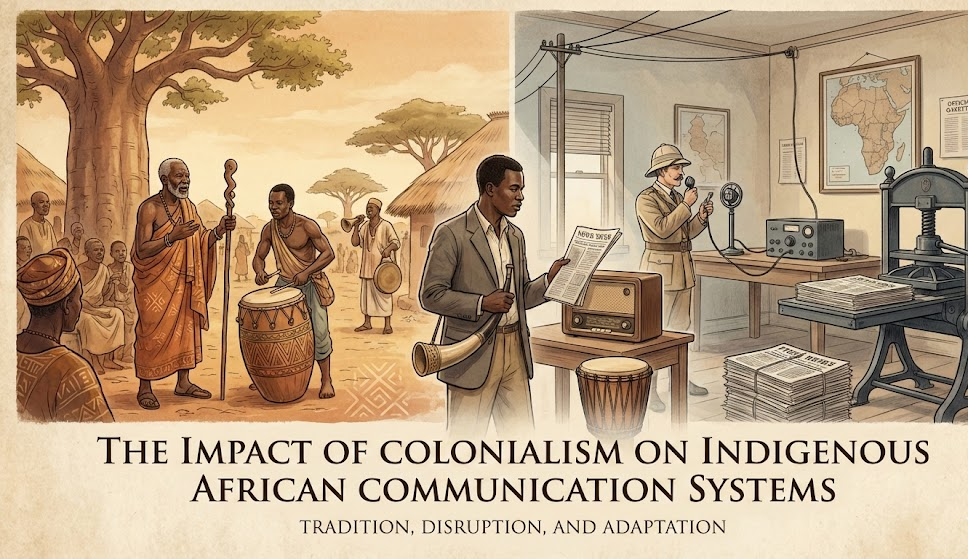
Before the colonialists arrived, African communities had their own native means of communication, which were strongly associated with social structure. The rulers disseminated information to the community through town criers, and decision-making occurred in the council of elders. Drums, horns, and gongs were used to pass messages over a long distance and were usually based on a coded rhythm that could be understood by members of the community.
Markets were significant communication centers especially to the women who exchanged news, social norms, and economic information in these areas. The oral literature like the folktales, proverbs and praise poetry was very important in the education and moral teaching.
5.2 Colonial Interruption of Indigenous Communication
Foreign languages introduced by colonial regimes, like English, French, and Portuguese were used as the official language of communication. These languages became requirements for education, authority and economic involvement, marginalizing native languages.
Western media like newspapers and radio, were established with the main aim of serving colonial interests. These media were not very accessible and did not tend to include the views of the indigenous. The conventional communication routes were pushed to the background and, in certain instances, discouraged by the colonialists who aimed at restricting information flow.
5.3 Adaptation and Change of the Communication Practice
With these upheavals, indigenous African systems of communication proved to be resilient. The old leaders still resorted to oral communication in local governments. There was still drumming and symbolic communication, especially in the countryside.
6. Discussion
The results show that colonialism changed the communication situation in Africa to a great extent but did not change native systems completely. In lieu, there was a complicated interaction between traditional and Western forms of communication. Policies of colonial communication were more indicative of the overall power relationships, which strengthened political dominance and culture.
Nevertheless, African communities took agency because they maintained and transformed their methods of communication. The presence of indigenous and colonial structures formed hybrid communication spaces that are still used to define modern African media and cultural expression.
7. Conclusion
The effect of colonialism on African communication systems was immense and interfered with the traditional practices of the indigenous people by introducing alien structures. However, these systems were very resilient. As much as the colonial rule marginalized the traditional communication channels, it could not do away with them completely.
The African and indigenous communication systems changed with the changing conditions, retaining their cultural identity and enabling them to fight colonial domination. The study of this historical encounter can offer a great deal of insight into the current African communication patterns and indicate how much value indigenous knowledge systems will always hold.
Also, Africans localized colonial media to suit the locals. This was then promoted through newspapers and radio broadcasts to promote the nationalist movements and cultural expression. The indigenous languages started to emerge in print and broadcast media, particularly in the later colonial and the postcolonial times.
References
Schramm, W. (1964). Mass media and national development. Stanford University Press.
Ugboajah, F. O. (1985). Mass communication, culture and society in West Africa. Hans Zell Publishers.
Wilson, D. (1998). Traditional media in African societies. Africa Media Review, 12(2), 45–58.



This is a well-structured and insightful study that clearly highlights the depth and resilience of indigenous African communication systems. The way you connect colonial influence with cultural adaptation is especially compelling, showing how traditions were not erased but transformed over time. The balance between theory, history, and analysis makes the paper both informative and engaging. Just like in fields such as Construction estimating services Texas, where precision and context matter, your work demonstrates how understanding historical frameworks is key to interpreting modern systems. Excellent research and presentation overall.