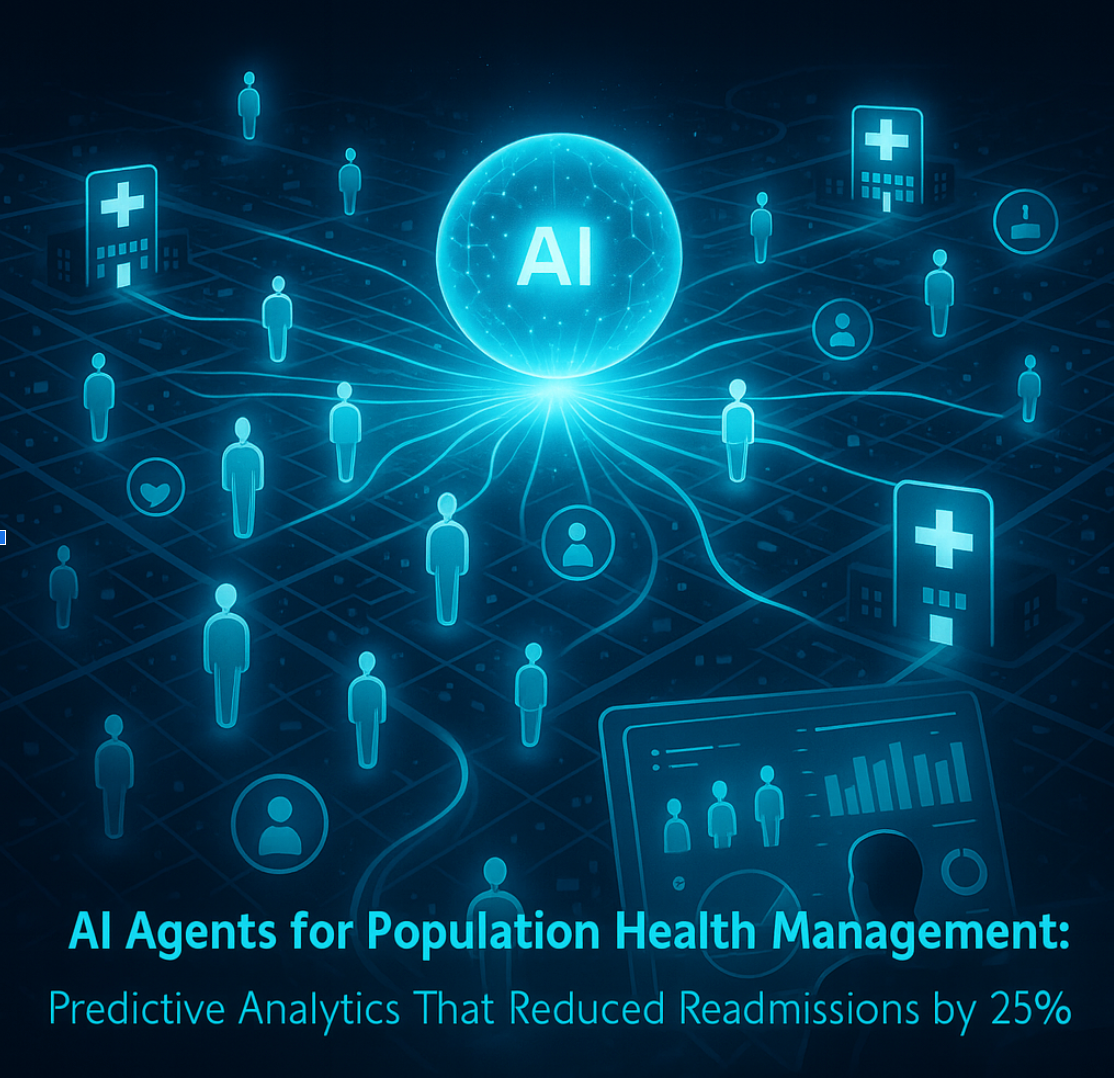
The enormous financial and clinical stakes of preventable hospital readmissions—a $26 billion problem compounded by regulatory penalties—are the direct result of a fundamental data latency issue. Traditional analytics have left care teams to navigate the future by looking in a rearview mirror, offering fragmented, retrospective data that is tragically out of sync with the pace of patient care. A paradigm shift from this reactive posture to proactive prevention is now possible, driven by a new class of analytics that operates in real-time to reveal risks before they materialize. By empowering providers with this decisive foresight, Logicon’s population health solutions are proving the model, cutting readmission rates by up to 25% and paving the way for a more sustainable and effective care ecosystem.
2. Understanding Population Health AI Solutions
At its core, Logicon’s approach constructs a holistic, real-time patient view by weaving together a rich mosaic of information. We move far beyond static reports by integrating previously disconnected data streams, including clinical histories, claims, social factors, and even data from personal wearables.
By constructing a holistic, 360-degree view of each individual, our process reveals the faint, often-overlooked signals that indicate an escalating health risk. This provides care teams with a powerful new form of clinical foresight, equipping them to shift from reactive treatment to proactive prevention by intervening long before a costly health event unfolds.
3. From Data to Decision: How Predictive Analytics Drive Better Outcomes
To break this cycle, throwing more resources at the problem isn’t the answer. The real solution lies in clarity.
Your care teams are already navigating a sea of clinical data, searching for the subtle signs that a patient is heading for a crisis. Our platform doesn’t just give them more data; it gives them direction. It sifts through the noise to find the critical signals, translating overwhelming information into a clear, forward-looking view of patient risk.
This enables your clinicians to move from a reactive to a proactive footing. Instead of piecing together a patient’s history after a decline, they are equipped to anticipate it. Our methodology makes this possible through four interconnected functions:
- Data Ingestion and Harmonization: The platform first pulls data from dozens of sources, including EHRs such as Epic and Cerner, claims systems, lab databases, SDOH feeds, and IoT devices. Logicon’s interoperability engine normalizes this data, translating it into a single, standardized format that allows for cohesive analysis.
- Model Training and Risk Identification: Using advanced machine learning, the platform trains predictive models on this harmonized data. These models are trained to identify the complex, multi-factor correlations that signal a high risk of readmission. This goes far beyond simple indicators, as it spots subtle patterns across medication adherence, recent lab results, mobility decline, and even social isolation markers.
- Continuous Risk Analysis and Stratification:A care team can’t watch every patient at once. This system does it for them. It constantly sifts through all the incoming patient data—from monitors, apps, and records—to figure out who is most at risk at any given moment. It then sorts every patient into a high, medium, or low-risk group, so the team can see at a glance who needs a closer look.
But it’s what happens next that’s key. If a patient moves into that high-risk group, the system automatically kicks off the next step. Instead of just being a passive warning, it can be set to tell a specific care manager, “This patient needs you now,” recommend a telehealth call, or send useful tips straight to the patient’s device. It turns a warning into a concrete plan.
Instead of waiting for a patient to get sick, we look for the signs that they might get sick. The system is designed to flag these early changes, giving the clinical team a chance to step in before a situation gets worse. It lets them put their energy in the right place, at the right time.
5. Case Study: How 3 Hospitals Reduced Readmissions
It doesn’t matter if it’s a large hospital system or a small local clinic—we’re seeing the same thing happen everywhere: readmission numbers are dropping.
But don’t just take our word for it. The best way to see the impact is to look at the results yourself. The examples below show what our partners have been able to achieve.
1. Urban Academic Medical Center (U.S.)
- Challenge:
A top-tier academic medical center was facing a revolving door of readmissions for its most vulnerable heart failure patients. They had a team of dedicated care coordinators, but the team was fighting a losing battle. Buried in manual chart reviews and disconnected data, they were always one step behind, reacting to a crisis instead of preventing one. - Solution:
The turning point was embedding Logicon’s platform directly into their Epic EHR. The endless hunt for information across siloed systems stopped. In its place, the care team had a unified command center for every post-discharge patient. For the first time, they could see the whole story as it unfolded, not just scattered chapters after the fact.
The platform continuously wove together crucial, previously disconnected clues: a patient’s daily weight from a smart scale, a missed medication refill, or a subtle shift in lab results. Instead of seeing isolated data points, the team could now see a developing story—and intervene before that story took a wrong turn.
- Outcome: The impact was precise and swift. Within just six months, the 30-day readmission rate for this group of patients decreased by 25%.
2. Regional Health Network (U.K.)
- Challenge: An NHS trust in the UK had a fundamental problem. Its job was to care for the local community, but its own buildings couldn’t share information. Every hospital, every clinic, was on a totally different computer system.
- Solution: The trust used Logicon’s platform to implement an interoperability layer that unified patient data from all its facilities. On top of this unified data foundation, the platform’s analytical engine was applied to identify patients at high risk for post-surgical complications—a major driver of readmission reduction technology.
- Outcome: For the first time, everyone involved in a patient’s journey—from the hospital to their local clinic—was looking at the same map. This shared clarity eliminated 40% of the administrative friction that used to slow down discharges. The result was a seamless handoff, where patients felt continuously cared for and their next provider was prepared from day one.
3. Multi-Hospital System (Asia-Pacific)
- Challenge: A large health group spread across multiple countries needed a scalable way to manage its vast and growing diabetic population. Identifying patients at high risk of complications leading to hospitalization was a manual, resource-intensive process with low accuracy.
- Solution: Our old method was a waste of time. Everyone got the same reminder, and most people just ignored it. We needed to figure out who really needed our attention.
We used Logicon to sort through the chaos. It took all our patient data—records, backgrounds, you name it—and automatically clustered people into clear risk groups. It basically told us, “Here are the people you need to worry about, and here’s why.”
Huge difference. Instead of one generic blast, we could send a quick, personal text to a patient about their blood sugar. We could ping another group to make sure they were taking their meds. It was simple, direct, and people actually paid attention.
- Outcome: When we saw a 22% drop in diabetes readmissions in the first year, we had to figure out why. The answer wasn’t some complex new treatment. It was much, much simpler.
We had started sending patients a basic reminder before their follow-up appointments. That one small change led to a 35% jump in people actually showing up. That appointment is everything. It’s the moment a clinician can see how a patient is really doing, and it’s the difference between someone staying on their recovery plan and getting lost in the system. It proved to us that sometimes the most powerful intervention isn’t a new drug—it’s just closing the loop.
6. Inside Logicon’s Healthcare Analytics Framework
Logicon’s framework of the predictive analytics platform is built on several core components designed to provide end-to-end visibility and control over population health initiatives.
So, how does it all work? Well, the brains of the operation is a predictive engine that we’ve taught using mountains of real-world health data. It’s learned to spot the incredibly subtle patterns that show up right before a patient’s health takes a turn with conditions like sepsis, heart failure, or diabetes. And it’s not static—it’s always learning and getting more accurate.
But just knowing isn’t enough. The system also acts as a 24/7 lookout, watching all the incoming patient information in real time. The moment it sees a signal that the engine has flagged as a risk, it immediately sends a heads-up directly to the right nurse or doctor. This way, a critical warning sign never gets lost in the noise.
It’s not enough to just predict a problem. The whole point is to give teams the clarity they need to actually do something about it.
7. Measurable ROI: The Business and Clinical Value of Population Health AI
For healthcare executives and data leaders, an investment in population health AI solutions must deliver a clear and quantifiable return.
You know, looking back, our whole goal was just to help people stay healthier so they wouldn’t end up back in the hospital. And we really saw that happen.
Fewer ER visits. That was the big one.
All those late-night emergencies just started to fade away because we were finally getting ahead of the crisis. We weren’t just reacting anymore.
You saw it in the patients, too. They were at home, they were managing, and they just seemed… calmer. More in control. That right there, that’s the win.
What really surprised me, though, was how people reacted. When the advice they got was specific to them, not just some generic leaflet you’d toss in the bin, it was like a switch flipped. They started to lean in, to actually participate in their own care. They listened, they asked questions, they stuck with it.
And the funny thing is, when you focus entirely on doing right by your patients, the business side of things almost takes care of itself.
8. Predictive AI in Population Health 2.0
For years, the central question in population health has been, “Who is at risk?” Predictive AI has helped us answer that with increasing accuracy. But the next wave of innovation asks a far more powerful question: “What is the best action to take, right now?”
We are moving beyond simply forecasting a crisis to actively prescribing the most effective path away from it. Soon, our systems will be able to analyze a patient’s unique situation and recommend the precise intervention most likely to succeed—turning insight into a clear, actionable plan.
9. Conclusion
Hospital leaders are often told they must choose: innovate or remain secure. Move forward or stay fiscally responsible. We believe this is a false choice.
Our platform is designed on the principle that world-class innovation and ironclad security are not opposing forces; they are partners. The 25% reduction in readmissions is more than a metric.
The future of medicine won’t be defined by who has the most data, but by who has the most clarity. By weaving this clarity directly into the daily life of your clinical teams, we help you move beyond reacting to crises and begin preventing them.
Let us show you how Logicon can help you predict, prevent, and perform—without compromise.
Discover how the Logicon healthcare analytics platform empowers hospitals to predict, prevent, and perform better—securely and at scale.