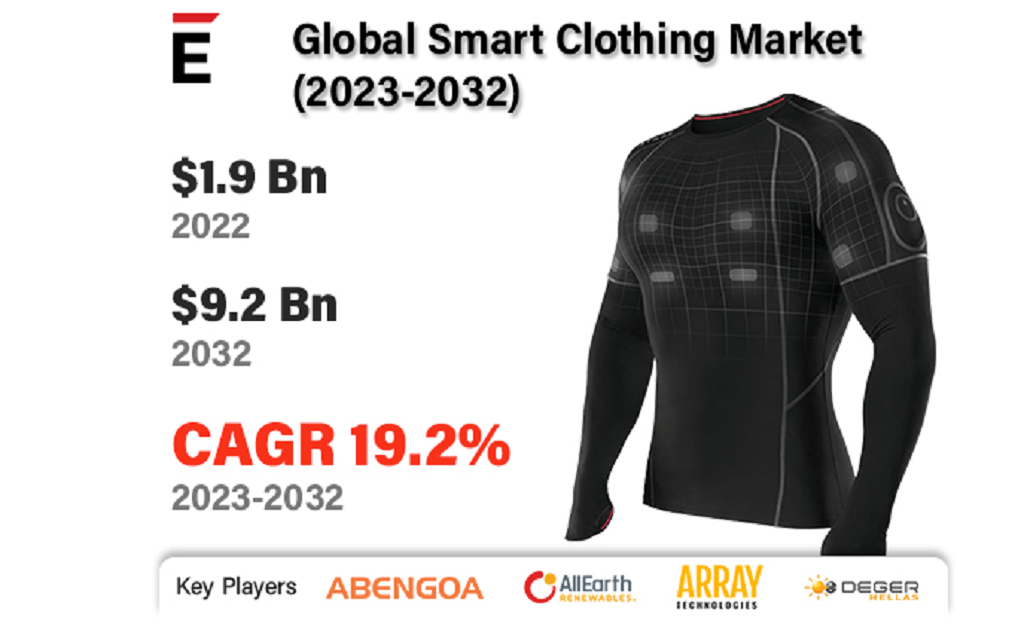
The clothing industry is in a constant state of transformation, regularly embracing diverse styles and incorporating cutting-edge technologies. The clothing sector is no exception in our contemporary world, where everything is progressively adopting “smart” features. According to a recent study by Extrapolate, the smart clothing market is anticipated to accrue a valuation of $9.2 billion by 2032.
A promising future for clothing and fashion has been on the horizon for over ten years. We could be wearing health-tracking apparel soon because of smart clothes with sensors and next-generation fabrics. These concepts are not exclusive to startups. Even businesses like Under Armour and Levi’s have dabbled in the concept of fitness equipment that tracks your vitals and movement while you go about your day.
What is Smart Clothing?
Smart clothes, often known as high-tech clothing or electronic textiles (e-textiles), are garments integrated with technology to extend their functionality beyond traditional use. Some incorporate advanced textiles with interwoven circuitry, while others utilize sensors and additional hardware for smart features. Many e-textiles can connect to a secondary device through Bluetooth or Wi-Fi, although wireless connectivity is not essential for categorizing a garment as smart clothing.
The swift integration of e-textiles, often fueled by technological advancements and digitalization, contributes to the strategic goals and ultimate success of next-generation smart wearables.
How Does Smart Clothing Work?
Smart clothing integrates technology directly into the fabric to provide a wide array of functionalities and benefits. This is achieved through the use of high-tech fabrics with integrated circuitry, sensors, and hardware, which make the garments “smart”. As a result, smart clothes can offer diverse features such as color-changing capabilities, sunlight blocking, data collection, vibration emission, and message display. Embedded technology, including biofeedback sensors, remote controls, GPS, and haptic feedback, enables smart clothing to collect and display data related to physical activity and body metrics.
Some smart clothing pieces are designed to connect with external apps or software using Bluetooth or Wi-Fi, enabling users to interact with various services without relying on their phones. Looking ahead, future innovations in e-textiles may include fabric capable of producing clean energy, replacing animal-origin materials, and generating electricity from the temperature difference between the human body and the surrounding environment.
How Does Smart Clothing Impact The Economy?
Smart clothing stands out as one of the most compelling options on the market, offering not only a fashionable appeal but also advanced connectivity and enhanced user experiences. These innovative garments go beyond aesthetics, providing the capability to track and monitor various aspects of the body, including health concerns.
The impact of smart clothing on the African economy is multifaceted, influenced by various factors within the textile and clothing industries. While there is potential for driving industrial growth and development, challenges arise from the influx of second-hand clothing from the West, which has both contributed to the creative clothing economy and posed obstacles to the growth of local textile manufacturing and the overall economy.
The development of the textile industry in Africa has the potential to generate national revenues through taxes, create jobs, and reduce dependency on aid. Fashion design in Africa has encouraged economic development by providing opportunities for talented designers to sell their products domestically and internationally, highlighting the economic opportunities created by the fashion industry for individuals in poverty-stricken areas. Additionally, Africa is bursting with talent when it comes to haute couture, crafts, and apparel. Over the next ten years, a 42% growth is anticipated in the demand for African haute couture.
How Are African Nations Embracing The Evolution Of Clothing Trends?
African nations are actively seeking an extension of the African Growth and Opportunity Act (AGOA) beyond its scheduled expiration in 2025. AGOA, enacted in 2000 to enhance trade and investment ties between the U.S. and sub-Saharan Africa, has played a significant role in fostering improved relationships in trade and investment. Certain countries including Kenya, Mauritius, Ghana, Lesotho, Ethiopia, and Madagascar, have experienced notable increases in textile and apparel exports under AGOA. For instance, Kenya’s apparel sales have risen from $55 million in 2001 to $603 million in 2022, constituting 66.6 percent of its total exports to the U.S. Similarly, Ghana’s exports to the U.S. have grown from $206 million in 2000 to $2.76 billion in 2022, with 26% of this trade attributed to AGOA. Ethiopia has also witnessed steady growth in textile and garment exports, reaching 69% from 2014 to 2023. Thebe Magugu is one of the top African brands involved in the production of smart cloth.
Is Africa Ready for Smart Clothing?
Africa’s readiness for e-textiles is shaped by diverse factors. The continent’s clothing and fashion industry boasts a rich array of styles, blending traditional African attire with modern influences. However, challenges related to basic human needs like safety, security, food, shelter, and clothing must be addressed before urban areas in sub-Saharan Africa can fully embrace smart city initiatives. Additionally, the prevalence of secondhand clothing from the West has impacted the African fashion market, prompting some East African countries to phase out imports to support local textile industries.
Despite these challenges, there are promising signs of innovation and collaboration among designer brands, clothing manufacturers, and technology companies in creating new smart wearables. This suggests a growing interest and potential for the adoption of smart clothing in the Middle East and Africa, even as socio-economic factors pose obstacles to widespread acceptance. According to UNESCO, the textile and clothing sector in Africa possesses strategic advantages, ranking as the second-largest employer after agriculture and generating additional jobs. This underscores the industry’s potential to contribute to economic growth and development.
Stitching the Future of Smart Clothing
Smart clothing in Africa holds substantial growth potential due to its innovative designs, its broad scope of application and benefits in healthcare, and economic growth in the region. The current annual exports from the continent’s fashion industry were valued at $15.5 billion in 2023. According to UNESCO Director-General Audrey Azoulay, with the appropriate investment and infrastructure, these earnings could potentially triple over the next decade. Launched in Nigeria’s economic hub, Lagos, UNESCO’s inaugural report on fashion in Africa emphasizes the industry’s growth prospects. The continent’s massive youth population, expected to double by 2050, highlights the role of the fashion sector as a powerful tool for promoting cultural diversity and empowering young people and women. The future of e-textiles in Africa is positioned for a noteworthy and influential trajectory, marked by a strategic emphasis on sustainability, adaptability, and technology integration.
Author Details
This article was contributed by Aparna M.A, you can contact her here:
https://www.linkedin.com/in/aparna-m-a-9b59451b0/
Bio: Aparna is an enthralling and compelling storyteller with deep knowledge and expertise in creating analytical, research-depth content. She is a passionate content creator who focuses on B2B content that simplifies and resonates with readers across several sectors, including automotive, marketing, technology, and more. She understands the importance of researching and tailoring content that connects with the audience.
If not writing, she can be found in the cracks of novels and crime series, plotting the next word scrupulously.