is one of the ironies of life that business connotes different things and
meanings to different people. It actually rests on the crest of how people see
or look at business. Having understood business and what it entails, it will be
interesting to appreciate from what perspective people attempt to understand
business. In spite of all that
have been discussed, scholars, practitioners and
observers of business often look at business from three basic prospects.
include:
The Narrow Perspective
The modern/dynamic Perspective
The global perspective
narrow perspective: People in this perspective look at business from buying and
selling points of view and mainly in subsistence light. Thus, a family whose
head is a blacksmith views business from his iron smiting and hearth activities
which enables him to fashion out knives, cutlass and the like for the benefit
of his home use and that of his customers. Thus father and son work the hearth
with fire, hammer and fabricate tools for some economic purpose. And hence
mother and daughter engage in selling at the local market. The proceeds of
sales are used to take care of the family needs.
the fabric maker and weaver of Akwocha garment
assembles the primitive sticks, tools and weaving gadget together with thread
and cotton, crafts out a colourful clothe for festival and other special
occasions. Much skill, personal energy, and endurance are employed to get this
directly to the final consumer.
this perspective recognizes homestead, craft and subsistence economy and is
basically obtained in African local communities where the economy is powered by
a collection of these skilled people with assorted craft and skill. Here the
investors and workers (employees) are one and same people.
Iyanda (1988) says it consisted of inventors, its customers and
employees, and that it was an age of Laissez – faire

and social changes are the twin factors responsible for business growth and
development. As man could not afford to be change resistant, business
requirements and changes grew and man has to shift positions in response to
these dynamics of social existence.
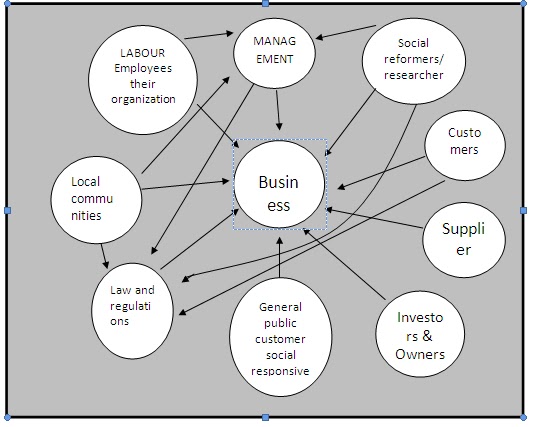
gave vent to the dynamic perspective of business. Scholars, business persons
are poised to look at modern business as dynamic, systematic and therefore
interdependent and interrelated. This perspective recognizes the holistic poise
of business believing that actors in modern business have to cooperate,
integrate and rely on one another’s specialized skills for survival and growth.
holistic manner of looking at business contributes that the organization is
“one whole” and consist of compartment and components in the mode of
departments, each specializing in an assigned task; the output of one
department becomes the input of the other. And because they operate in a system
network fashion, no one department can co-exist or succeed alone without the
other. A breakdown of one unit would adversely affect the performance of the
other chains of units and thus crash the organization’s operations.
holistic view is therefore objective directed and driven. A breach in one unit
will cause overall object6ives and goals to be frustrated. A good example lies
in this scenario. The failure of the supplier of raw materials to the business
production factory would paralyze production. There will be no goods
manufactured for the market and meeting creditors’ requirement responsibly as
at when due will be impossible.
perspective recognizes societal change and dependency on business institution
as employer, innovators, neighbour as catalyst for social change and
advancement of culture. Hence business becomes a social institution,
interesting with other elements of the social environment i.e. religious,
economic, political, legal and cultural. Iyanda (1988) finally anchors this
perspective thus “As scientific and technological knowledge grew, new interest
developed and new institutions emerged to protect such interest. With
technology, business becomes bigger and more remote from its customers.”
business from the point of view of the whole world as a potential market where
those that have huge and investible funds and technology can play. It is a
popular parlance in global business that capital has no conscience, it only
goes where it can be best protected, secured with the surety of maximizing the
wealth of its owners.
perspective takes into consideration trade across national and continental
borders. It looks for untapped resources and market that have potential for
development of international organizations (TNC) are in dire need of economics
to play in where they can bring in excess capital, machines and expertise to
establish very rewarding organization
local companies in Nigeria intending to go foreign, it has been touted in
various for a that strong business culture, information technology and sound
knowledge of ones business are the triple strength and capability to overcome
local environment factors (internal and external forces) of that nation, and in
addition, taking into consideration, the external constraints of the country
where they intend to invest and do business. The culture, custom, language,
practices, technology, moral, physical environments and attitudes etc, must be
taken into consideration. In addition to the above, the investor must
understand the legal, political requirement in those countries and try to
comply with them fully.
The world as a global village is a world of information, Data and
knowledge (IDK) sharing. Knowledge has multiplied on the face of the earth and
virtual knowledge (borderless knowledge) is the in- thing. This no doubt
presents a lot of opportunities to global players in their attempt to create value
and maximize profit in any area of the globe where they operate. A prudent
investor has to have capacity to adopt and adapt new technologies, understand
language and social cultural requirements, norms, taboos, politics/legal
requirements etc of the country where he wants to
invest. He must scan his environment, have strategic vision and perform a
through SWOT analysis in order to develop a sound and workable competitive
strategy.