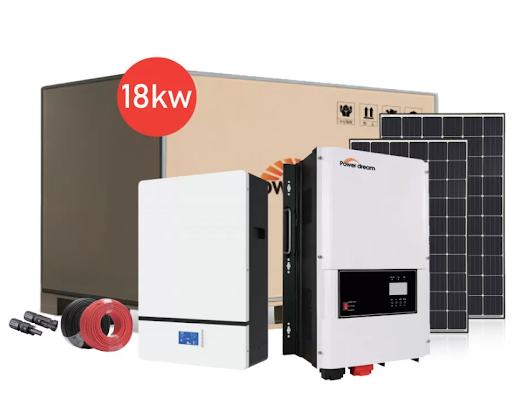
A fact that often surprises customers is that most electronic equipment failures in off-grid environments are not caused by insufficient power, but by voltage instability. PowerDream’s long-term field data shows that over 60% of equipment failure complaints in off-grid projects stem from voltage fluctuations, not insufficient system capacity. Therefore, when engineers evaluate an 18 kWh solar system, they focus not only on energy capacity but also on power quality.
An 18 kWh solar system is typically designed to support modern homes, remote farms, clinics, and small commercial establishments that run sensitive electronic devices such as computers, communication equipment, medical devices, and smart appliances. These devices require a stable voltage and frequency. Even minor fluctuations can shorten their lifespan or cause immediate failure. In off-grid solar systems, voltage regulation is particularly crucial because they operate independently of the public grid.
Voltage Fluctuations in 18 kWh Solar System
Voltage fluctuation refers to variations in the output voltage that deviate from the nominal value over short periods. In an 18 kWh solar system, these fluctuations can occur during rapid load changes, battery charging transitions, or variations in solar input. Unlike grid-tied systems, off-grid solar systems must handle these dynamic changes independently, without grid support.
The main sources of voltage fluctuations include inverter response time, battery charge level, and load characteristics. For example, a sudden start of a high-power appliance can cause a momentary voltage drop in the system. Similarly, voltage characteristics change when the battery is near full charge or deep discharge. Without proper control logic, these variations can lead to system instability. Sensitive electronic devices are particularly susceptible to such voltage fluctuations. Microprocessors, power supplies, and control boards are designed to operate within very narrow voltage ranges. Repeated exposure to unstable voltage can lead to data corruption, overheating, or permanent damage.
18 kWh Solar System Inverter Design: Mitigating Voltage Instability
The inverter is a core component of any 18 kWh solar system, especially in off-grid applications. Its role extends far beyond simple DC-to-AC conversion. A high-quality inverter actively regulates voltage, frequency, and waveform quality to ensure compatibility with sensitive electronic devices.
In PowerDream’soff grid solar kits, we utilize inverters equipped with advanced digital signal processing and fast-response control algorithms. These characteristics allow the inverter to respond to load changes within milliseconds, minimizing voltage fluctuations. Pure sine wave output is another crucial factor. Equipment designed for grid-tied power requires a clean, stable sine wave; any distortion increases stress on internal components. Another key aspect is the inverter’s overload capacity. When the system experiences brief surge currents—for example, when a motor or compressor starts—a robust inverter can absorb the surge without causing voltage instability.
Utilizing Battery Storage for Voltage Stabilization
In an 18 kWh solar system, batteries play a crucial role in voltage stability. In off-grid solar systems, batteries act as both energy storage and a voltage buffer, absorbing fluctuations between power generation and consumption. The type, capacity, and configuration of the batteries directly impact system stability.
Lithium batteries, especially LiFePO₄ batteries, offer superior voltage stability compared to traditional lead-acid batteries. Their flatter discharge curve allows the system to maintain a stable voltage over a wider range of charge states. This characteristic makes them ideal for powering sensitive electronic equipment. Equally important is the integration of a Battery Management System (BMS). A well-designed BMS monitors battery voltage, temperature, and current in real time, preventing imbalances that could lead to system voltage instability. In an 18 kWh solar system, coordinated communication between the BMS and the inverter ensures smooth transitions during charging and discharging cycles.
Reducing Voltage Stress on Sensitive Equipment
Voltage stability is not solely achieved through hardware. Load management strategies significantly impact the performance of an 18 kWh solar system in practical applications. In off-grid solar systems, intelligently controlling when and how equipment consumes power can dramatically reduce voltage fluctuations.
One effective method is load prioritization. Critical sensitive equipment (such as servers, communication equipment, or medical devices) is assigned to priority circuits. Less critical loads can be delayed or temporarily disconnected during peak demand periods. This ensures voltage stability is maintained where it is most necessary. Soft-start technology also plays a vital role. Appliances equipped with soft-start features consume power gradually rather than abruptly, reducing voltage dips. For users with mixed loads, it is often recommended to use dedicated circuits for sensitive electronics, protected by voltage regulators or uninterruptible power supplies (UPS).
System Monitoring: Prevention is Better Than Cure
These tools provide real-time insight into voltage fluctuations, allowing for the identification and proactive resolution of potential problems. This visibility is crucial for off-grid solar systems, as problems can escalate quickly without the support of an external power grid.
The PowerDream system integrates a remote monitoring platform that tracks voltage, frequency, battery status, and load distribution. When parameters approach critical thresholds, the system sends alerts to users and the service team. This data-driven approach enables preventative maintenance rather than reactive repairs. Advanced control logic also allows the system to adapt dynamically. For example, if voltage instability is detected, the system can temporarily limit non-essential loads or adjust inverter output settings. Over time, these fine-tuning adjustments significantly improve reliability and extend equipment lifespan.
Clean, Stable Power is the True Measure of Reliability
An 18 kWh solar system is more than just a simple combination of solar panels, batteries, and electronics. It’s a carefully designed, balanced ecosystem engineered to deliver clean, stable power under a wide range of conditions. For users who rely on sensitive electronic equipment, voltage stability is not a luxury but a necessity. The PowerDream off-grid solar kit combines high-quality inverters, properly sized batteries, intelligent load management, and advanced monitoring technology to address voltage fluctuations comprehensively. The result is a system that protects equipment, enhances productivity, and provides long-term stable operation.