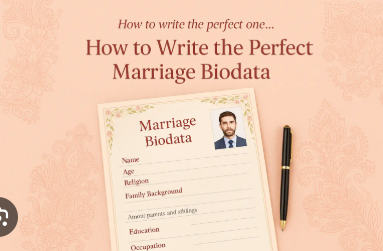
Let’s talk about something that makes many people nervous: creating a matrimonial biodata. If you’re stepping into the world of arranged marriages or even just a more formal search for a life partner, you’ve probably heard about it. Think of it as your personal profile, a document that introduces you and your family to potential matches. It’s more than just a form—it’s often the very first impression you make.
Getting it right can feel overwhelming. What should you include? How do you make it look good without being a designer? This guide will walk you through everything in simple, clear steps, and show you how a good marriage biodata maker can take the stress out of the process.
Why Does a Biodata for Marriage Matter So Much?
In many cultures, especially across South Asia, the biodata for marriage is the cornerstone of the matchmaking process. Before families meet, before a first phone call, this document does the talking for you. A well-made biodata is clear, respectful, and professional. It shows you’ve put thought and care into your search for a partner. A confusing or messy one, unfortunately, might mean a great match passes you by without a second look.
A good biodata does two main things:
- It presents the facts clearly (your education, career, family background).
- It gives a glimpse of your personality (your values, interests, and aspirations).
Breaking Down the Biodata: What Goes Inside?
Creating a strong profile doesn’t mean writing a novel. It means presenting key information in an organized, easy-to-read way. Here are the essential sections every good matrimonial biodata should have:
1. Personal Details: The Basics
This is your introduction. Start with your full name, date of birth, and a recent, friendly photograph. A clear, smiling photo where your face is well-lit makes a world of difference. Also include details like your height, marital status (if unmarried, divorced, etc.), and any religious or community identifiers important to your family.
2. Professional and Educational Background
This section is like the career part of a resume, but with a personal touch. List your highest educational degree, the university you attended, and your current job role and company. If you have a promising career path or specific professional achievements, it’s okay to mention them briefly.
3. Family Background
In many cultures, marriage is as much about families coming together as it is about two individuals. This part briefly introduces your family. Include your parents’ names and professions, the number of siblings you have, and a line or two about your family’s values and lifestyle (e.g., “We are a close-knit, nuclear family that values education and community service”).
4. Lifestyle and Partner Preferences
This is where your personality shines through. What are your hobbies? Do you love hiking, reading, or cooking? Mention them. Also, it’s helpful to briefly state what you are looking for in a partner. Be positive and open. Instead of “I don’t want someone who smokes,” try “I am looking for a health-conscious partner.” This keeps the tone optimistic.
5. Contact Information
Usually, this involves providing a parent’s or a family elder’s contact number for the initial conversation. This maintains a layer of formality and safety, which many families appreciate.
The Modern Solution: Using a Marriage Biodata Maker
Now, knowing what to write is one thing. Actually designing the document, choosing fonts, aligning sections, and getting the format perfect is a whole other challenge. This is where technology comes to the rescue.
A free marriage biodata maker, like the one available at Matrimonial Biodata, is designed to solve these exact problems. Imagine a tool where you just focus on typing your information, and it takes care of the design, layout, and formatting for you. You don’t need to be an expert in graphic design software.
Here’s how such a tool typically makes your life easier:
- No Design Headaches: You get to choose from many professionally designed templates. Whether you want a modern look, a traditional style with cultural motifs, or something simple and elegant, the options are there. You just pick one that feels like “you.”
- Fill-in-the-Blanks Simplicity: The tool provides a straightforward form—just like filling out an online survey. You type your details into labeled boxes for “Name,” “Education,” “Family,” etc. There’s no worrying about text alignment or photo placement.
- See It As You Build It: Most good tools have a live preview. As you type your information on one side of the screen, you can see it instantly appear in the chosen template on the other side. This real-time editing lets you make sure everything looks perfect before you finalize it.
- Privacy You Can Trust: A major concern when creating such a personal document online is privacy. Everything is processed securely in your own browser, giving you complete control.
- Instant, Shareable Results: Once you’re happy with your biodata, you can download it as a polished PDF file with a single click. This PDF is easy to print for family meetings, attach to an email, or share on messaging apps like WhatsApp. It’s ready to go.
Step-by-Step: Creating Your Biodata Without Stress
Let’s walk through a simple process you can follow, especially if you use an online maker:
Step 1: Gather Your Information First.
Before you even open a website, sit down with a notebook. Jot down all the details for each section we discussed above. Having it all in one place first will make the online process super fast.
Step 2: Choose a Template That Speaks for You.
Browse the template gallery. Do you feel a connection to a clean and minimal design, or one with traditional artistic borders? Select the one that best represents your personality. Remember, the template is just a frame; you are the picture.
Step 3: Input Your Details with Care.
Start filling the form. Be honest and accurate. Copy the information from your notes. Take your time in the “About Me” or “Hobbies” section to write a few genuine sentences.
Step 4: Review and Refine.
This is the most important step. Read every single word on the preview. Check for typos, especially in dates and names. Ask yourself: “If I were receiving this biodata, would I get a clear, positive sense of this person?” It can be very helpful to have a sibling or a close friend look it over for a fresh perspective.
Step 5: Download and Share Confidently.
Once you’re 100% satisfied, hit download. Save the PDF file with a clear name, like “YourName_Marriage_Biodata.” Now, you have a professional document ready to start your journey.
Final Thoughts: Your Biodata, Your Story
Creating a matrimonial biodata is not about creating a perfect, fictional version of yourself. It’s about presenting the real, wonderful you in a clear and respectful manner. It’s the first chapter of your story that you share with a potential partner.
By using a dedicated marriage biodata maker, you remove the technical barriers and can focus on what truly matters—presenting yourself authentically. A free marriage biodata maker democratizes this process, giving everyone access to beautiful design and organization, regardless of their computer skills.
So, take a deep breath, gather your thoughts, and start creating. Your thoughtful, well-crafted biodata is the first, and one of the most important, steps you’ll take on the path to finding your life partner.