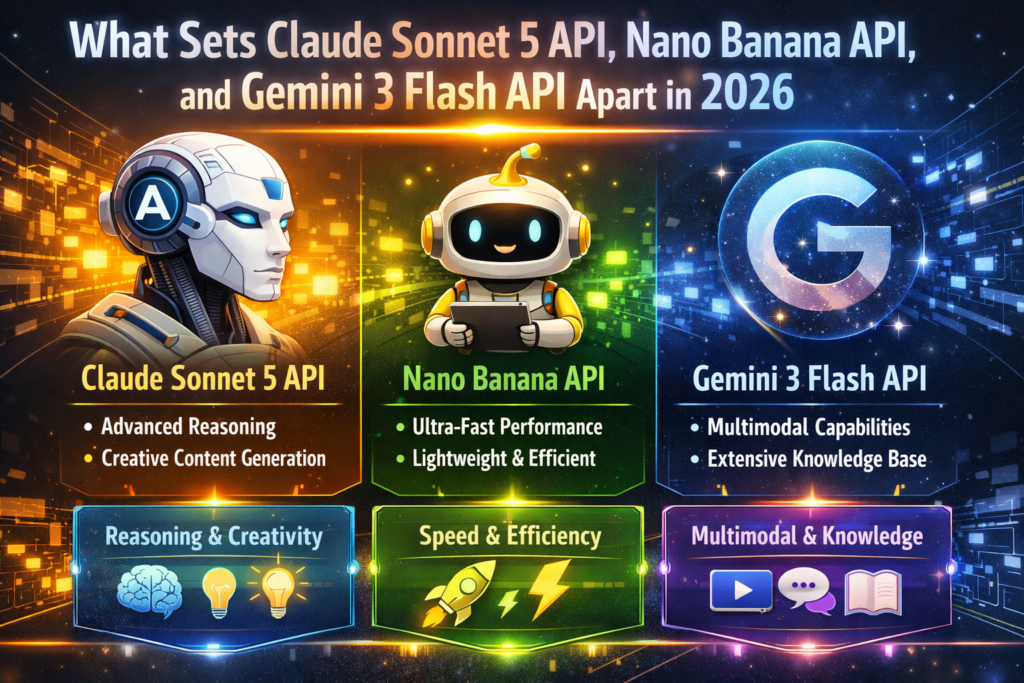
In 2026, the API landscape for advanced language and multimodal models has matured in a way that rewards clarity, specialization, and real world performance. As someone who has spent years analyzing how digital products gain visibility and trust, I see these APIs not as abstract technologies but as tools that directly shape user experience, scalability, and long term growth. Among the many options available, Claude Sonnet 5 API, Nano Banana API, and Gemini 3 Flash API continue to stand out for very different reasons. Each one reflects a unique philosophy about speed, intelligence, and adaptability, and understanding those differences helps teams make smarter technical and strategic decisions.
The evolving expectations around modern APIs
Developers and product teams in 2026 expect more than raw output quality. They look for APIs that integrate smoothly, respond predictably, and scale without friction. Reliability, transparency in pricing, and flexibility across use cases now matter as much as intelligence itself. From my perspective, the APIs that perform best are those that align with how people actually build and iterate products today.
What makes this comparison interesting is that these three APIs do not compete on identical ground. Instead, each one excels in a specific direction, which is why they are often discussed together.
Claude Sonnet 5 API and its focus on thoughtful intelligence
Claude Sonnet 5 API has earned its reputation by prioritizing depth, nuance, and safe reasoning. It is designed for teams that need more than surface level responses. In practice, this means it handles long context windows gracefully and maintains coherence even when dealing with layered instructions.
From a strategic content and platform standpoint, this API shines in environments where trust and clarity are essential. Legal tools, research platforms, and knowledge heavy applications often benefit from its balanced tone and careful handling of sensitive queries. It does not rush to produce flashy outputs. Instead, it focuses on consistency and interpretability, which is increasingly valuable in regulated industries.
Another strength lies in how it manages conversational memory. Claude Sonnet 5 API can follow extended interactions without losing track of intent, making it ideal for support systems and advanced assistants. This creates a smoother experience for end users and reduces friction across sessions.
Where Claude Sonnet 5 API fits best
Based on how teams deploy it today, this API is particularly effective for:
- Long form analysis and structured reasoning
- Customer support tools that require empathy and accuracy
- Research platforms dealing with complex documents
- Applications where safety and predictability matter
These strengths explain why it is often chosen for enterprise level solutions rather than lightweight consumer apps.
Nano Banana API and the power of speed and efficiency
Nano Banana API takes a very different approach. Its core philosophy centers on performance, minimal latency, and cost efficiency. In 2026, when users expect instant responses, this focus is not just appealing, it is often necessary.
What sets Nano Banana API apart is how well it performs in high volume environments. It is optimized for rapid inference and streamlined outputs, which makes it a strong choice for chat widgets, real time recommendations, and interactive features that live inside fast moving platforms.
From an optimization standpoint, speed directly affects engagement. Delays, even minor ones, can disrupt user flow. Nano Banana API addresses this by sacrificing unnecessary complexity in favor of responsiveness. The result is an API that feels lightweight but purposeful.
Practical advantages of Nano Banana API
In real deployments, this API often excels in scenarios such as:
- Live chat and messaging tools
- Mobile applications with limited resources
- High traffic platforms that need predictable costs
- Simple content generation at scale
While it may not match the deep reasoning of more expansive models, Nano Banana API delivers exactly what many products need: fast, reliable interaction without overhead.
Gemini 3 Flash API and its multimodal strength
Gemini 3 Flash API represents a balance between intelligence and agility, with a strong emphasis on multimodal capability. In 2026, applications will rarely rely on text alone. Images, audio, and structured data are now part of everyday workflows, and this is where Gemini 3 Flash API truly stands out.
Its ability to process and connect multiple input types allows developers to build richer experiences. From analyzing visual content to responding with contextual awareness, it supports use cases that feel more human and intuitive.
Another notable aspect is how it handles bursts of demand. Gemini 3 Flash API is designed to scale quickly without significant performance drops, making it suitable for campaigns, launches, and seasonal spikes.
Use cases where Gemini 3 Flash API shines
This API is particularly effective in areas like:
- Multimodal assistants and creative tools
- Visual analysis and interpretation
- Interactive learning platforms
- Media rich applications requiring fast responses
For teams looking to push beyond text based interaction, Gemini 3 Flash API offers a flexible foundation.
Comparing philosophy rather than features
Rather than asking which API is better, a more useful question is what each one is designed to optimize. Claude Sonnet 5 API values depth and trust. Nano Banana API values speed and efficiency. Gemini 3 Flash API values versatility and multimodal understanding.
From a growth perspective, aligning the API choice with product intent is critical. A mismatch can lead to wasted resources or user dissatisfaction, even if the technology itself is impressive.
Integration and long term scalability
Another important factor is how these APIs integrate into existing systems. Claude Sonnet 5 API often requires more thoughtful implementation due to its advanced capabilities, but it rewards that effort with stability. Nano Banana API integrates quickly and scales cheaply, which is attractive for startups and lean teams. Gemini 3 Flash API sits in the middle, offering flexibility without excessive complexity.
Over time, these differences influence maintenance costs, iteration speed, and the ability to adapt to new requirements.
Making the right choice in 2026
From my experience advising teams, the best results come from clarity. When teams understand their audience, workload, and growth plans, the choice becomes obvious. There is no universal answer, only a strategic fit.
Claude Sonnet 5 API, Nano Banana API, and Gemini 3 Flash API all represent mature, capable solutions. Their value lies not just in what they can do, but in how well they align with specific goals.
Final thoughts on the future of intelligent APIs
As the ecosystem continues to evolve, differentiation will matter more than raw capability. The APIs that succeed will be those that respect developer needs and user expectations. Whether the priority is thoughtful reasoning, instant responsiveness, or rich multimodal interaction, these three APIs show that the future is not about one dominant model, but about choosing the right tool for the right purpose.