
Residential proxies have become one of the most critical infrastructures for businesses that rely on stable, real-user IP access. From web data collection and localization testing to multi-account management and social media operations, the quality of residential proxy services directly affects success rates, costs, and long-term scalability.
However, not all residential proxy providers are built the same. Differences in proxy types, pricing logic, and service focus can lead to very different user experiences. This article focuses specifically on residential proxy comparison, breaking down what truly matters and highlighting how OKKProxy, ColaProxy, and NiuProxy address these needs—while also examining where established providers like IPRoyal may fall short for certain residential use cases.
Understanding Residential Proxy Types
Before comparing providers, it’s essential to understand the two main categories of residential proxies.
Dynamic Residential Proxies
Dynamic residential proxies rotate IP addresses automatically from a pool of real residential users. They are commonly used for:
• Web scraping and SERP monitoring
• Market research and price comparison
• Large-scale data collection requiring frequent IP changes
Rotation flexibility and IP pool size are critical factors here.
Static Residential (ISP) Proxies
Static residential proxies—also called ISP proxies—provide fixed IP addresses issued by Internet Service Providers. These are ideal for:
• Long-term sessions
• Account-based platforms
• Social media and e-commerce operations
Not all residential proxy providers offer both types, which immediately limits flexibility.
Key Criteria for Comparing Residential Proxy Providers
Residential Proxy Coverage and Flexibility
A strong residential proxy provider should offer:
• Both dynamic residential proxies and static ISP residential proxies
• Clear differentiation between use cases
• Optional access to mobile or datacenter proxies for edge scenarios
Providers that force users into a single residential model often create inefficiencies or unnecessary costs.
Residential Proxy Comparison: Provider Breakdown
OKKProxy: Flexible Residential Infrastructure Built for Scale
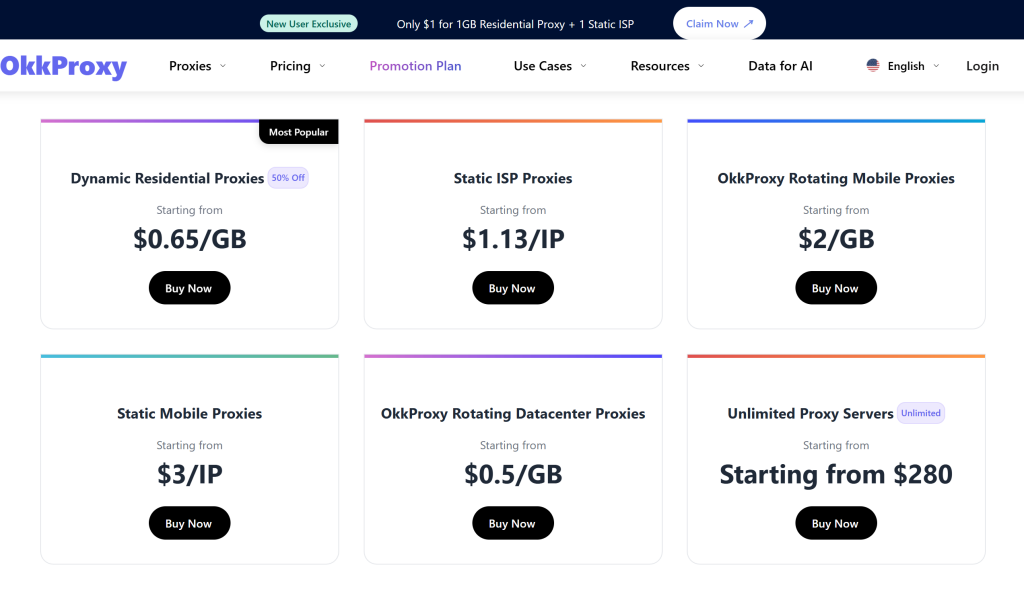
OKKProxy positions itself as a provider with a clear emphasis on residential proxy services, offering one of the more balanced product structures in the market.
Its residential proxy services include:
• Dynamic residential proxies for rotation-heavy workloads and scalable data access
• Static ISP residential proxies for long-term sessions and account-sensitive platforms
Beyond residential proxies, OKKProxy also offers mobile proxies and datacenter proxies, allowing users to expand workflows without switching providers.
From a pricing perspective, OKKProxy uses a clear bandwidth-based pricing model for residential traffic, paired with optional static IP plans. This makes cost forecasting easier and avoids forcing users into rigid bundles.
For teams running mixed residential use cases—such as scraping combined with account management—this separation between dynamic and static residential proxies significantly reduces operational friction.
ColaProxy: Broad Residential Coverage with Bundled Pricing
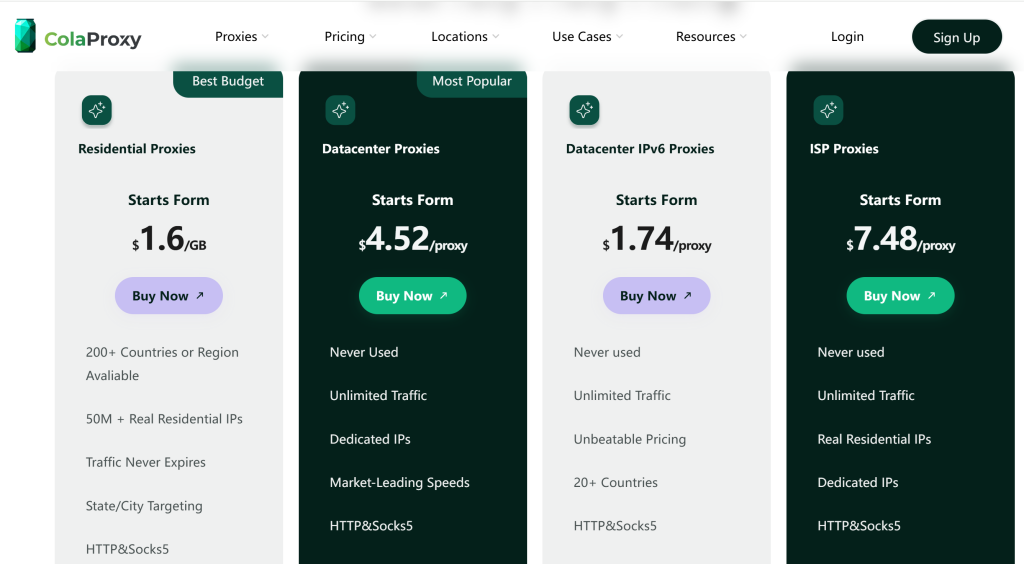
ColaProxy presents itself as a comprehensive proxy provider, offering residential proxies alongside mobile and datacenter options.
Its residential proxy services appeal to:
• Agencies managing multiple projects
• Users who prefer bundled feature sets
However, ColaProxy’s residential pricing tends to be bundle-oriented, which may be less efficient for users focused on a single primary residential use case. While coverage is broad, smaller teams may find it harder to fine-tune costs compared to bandwidth-based residential pricing models.
NiuProxy: Residential Proxies Optimized for TikTok
NiuProxy takes a more specialized approach to residential proxies, focusing primarily on TikTok-related operations, including scenarios such as live streaming, short-form video publishing, and other video-centric workflows that require stable residential IP environments.
Its residential proxy infrastructure is optimized for:
• TikTok account management
• Social media workflows requiring stable residential IPs
This specialization can be a strong advantage for TikTok-centric users. However, for broader residential proxy needs—such as data collection or multi-platform operations—NiuProxy offers less flexibility than providers like OKKProxy or ColaProxy.
IPRoyal: Where Residential Proxy Limitations Appear
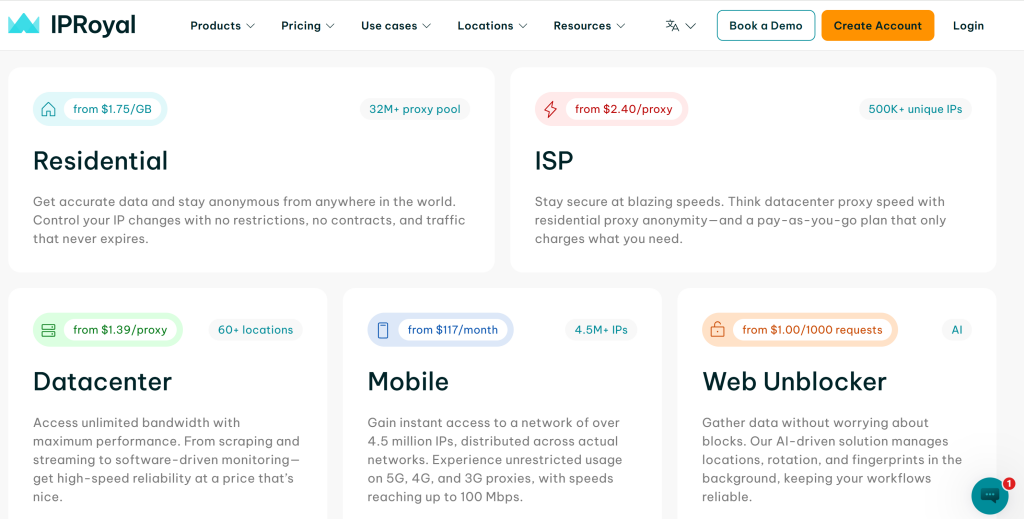
IPRoyal is a well-known name in the proxy space and offers residential proxy services with wide geographic coverage. However, when comparing residential proxies specifically, several limitations become apparent:
• Higher entry pricing for residential bandwidth plans
• Residential proxy features often become cost-efficient only at larger volumes
• Less flexibility for users who need both dynamic and static residential proxies without upgrading plans
For users with smaller or mixed residential workloads, IPRoyal’s pricing structure may feel less adaptable compared to providers offering clearer separation between residential proxy types.
Residential Proxy Pricing and Service Comparison
| Provider | Residential Proxy Types | Pricing Structure | Best Fit |
| OKKProxy | Dynamic + Static (ISP) | Flexible, bandwidth-based | Mixed residential use cases |
| ColaProxy | Residential-focused | Bundled plans | Agencies, multi-project users |
| NiuProxy | Residential (TikTok) | Platform-specific | TikTok operations |
| IPRoyal | Residential + ISP | Volume-oriented | Large-scale residential usage |
Frequently Asked Questions
What matters most when choosing a residential proxy provider?
Cost efficiency is often the deciding factor. Users should look beyond headline prices and evaluate how pricing is structured, whether costs scale predictably with usage, and if the provider avoids hidden fees or rigid bundles that lead to overpaying for unused resources.
Are cheaper residential proxies always better?
No. Low prices can come with limitations in IP quality, rotation control, or session stability.
Do I need both dynamic and static residential proxies?
If your workflow includes both data extraction and account-based platforms, having access to both reduces risk and simplifies operations.
Final Thoughts
When comparing residential proxy providers, the most important factors go beyond brand recognition. Flexibility, pricing clarity, and residential proxy specialization play a much bigger role in real-world performance.
Providers like OKKProxy, with clearly separated dynamic and static residential proxy offerings, demonstrate how infrastructure design and pricing transparency can better serve modern use cases. ColaProxy and NiuProxy each excel in specific residential scenarios, while IPRoyal remains more suitable for users operating at higher residential traffic volumes.
Ultimately, the best residential proxy provider is the one that aligns most closely with your actual workflows—not just your budget.