Data is becoming the backbone of the healthcare industry. You see, from care delivery to billings and reimbursements, every aspect of healthcare is today based on data.
Moreover, given the demands of value-based care delivery from patients, healthcare providers are turning to EHR software systems to deliver better care while keeping data at the center of everything.
However, amidst this transition, there is another trend that is catching the eyes of everyone in the healthcare industry. Prominent healthcare providers have been using legacy EHR platforms for a while now, and given their rigid infrastructure and architecture, they are trying to make a swift shift to custom EHR solutions.
This is one of the major reasons why many healthcare practices are redirecting their healthcare software investments to custom EHR software development. And this is the trend that has caught the attention of everyone in the healthcare industry.
However, there are also stats that show that custom EHR solution ventures have failed. But they are not to be completely. You see, the success of custom EHR software development depends on a lot of factors. To name a few, it involves aligning technology with that of your practice, having an EHR compliance strategy, and setting long-term business goals.
So, the success of your custom EHR solutions is a strategic investment and not an effort to just replace an old system.
On that note, in this blog, let’s see what you know about custom EHR software development and get clarity on whether you should build vs buy EHR.
Strategic Alignment: Defining the ‘WHY’
Custom EHR solutions have become a necessity for healthcare practices. However, strategic movement for your healthcare software investment is quite necessary in this case. Let’s see and get clarity on why a custom EHR solution has become a necessity.
- Identifying the Real Drivers: One of the major reasons why custom EHR solutions have become a favourable choice of healthcare providers is because of the inefficiencies caused by off-the-shelf EHRs. You see, these generic EHRs have been constantly related to increasing clinician burnout rates, data silos created in the system, scalability issues, and reimbursement pressures.
- Misaligned Features: While most of these off-the-shelf EHR software come with pre-defined features and functionalities, it becomes hard to understand which features are actually useful. A complaint by providers suggested that many features are available in the software but are rarely used. This is where you lose the competitive advantage with your EHR.
- Evaluating ROI Beyond License Costs: This is where most providers go wrong. You see, when evaluating the ROI of the software, usually the monthly subscription cost is considered. However, the hidden costs that are responsible for efficiency, data ownership, and flexibility are often ignored. This is why off-the-shelf EHR software seems to be a costly affair.
Compliance, Security & Interoperability Expectations
Cyber attacks on healthcare software systems are reportedly increasing with every passing day. Furthermore, given the ever-changing nature of the regulatory landscape, just having baseline compliance with HIPAA and other regulations is simply not enough. That is why you need to move towards modern cybersecurity measures and keep your audit ready so that you can track everything that is happening inside your system.
While you are planning to improve the security of your software, don’t miss the intricacies of interoperability. You see, plan for TEFC, FHIR, and other nationwide interoperability requirements and standards. Adherence to these standards will give your system the ability to connect and communicate with other disparate healthcare systems and share data effectively.
Last but not least, as a healthcare provider or leader, you need to take ownership of data and avoid any vendor lock-in period, even when choosing a generic EHR. This is important because it gives you control of the software and how you upgrade.
Core Technical Pillars Leaders Must Evaluate
Technicalities are a place where most healthcare leaders lack. However, knowing enough about the technical pillars for custom EHR software development can help you make a better choice. On that note, here are the core technical pillars of a custom EHR solution that you must know:
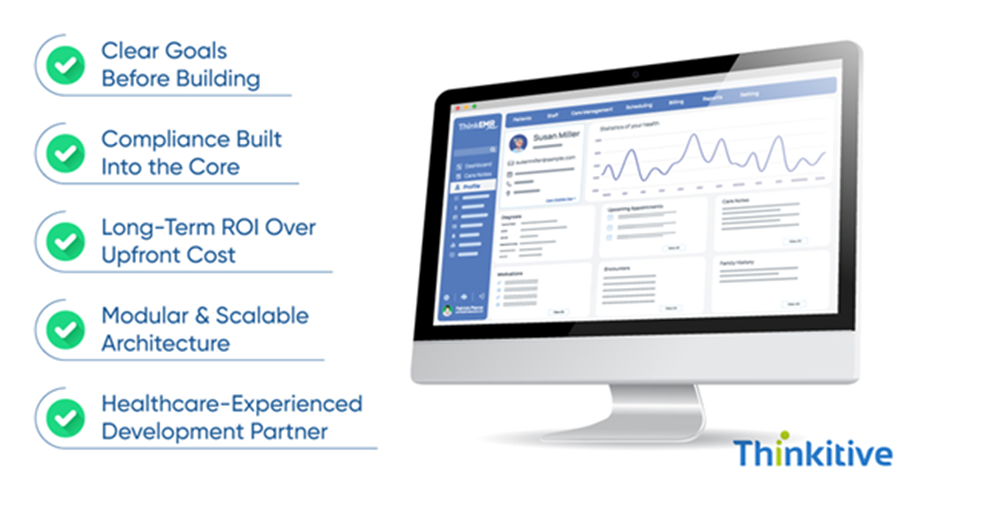
- Modular Architecture: Software scalability, flexibility, and room for customization are the needs of the hour for healthcare practices. And the core technical pillar that offers you that is modular architecture. With a modular architecture, you can not only scale your software as per your needs but also have enough room to improve or add any additional features and functionalities whenever you require them.
- AI Readiness: AI is taking the healthcare industry by storm, and if you’re planning to include that in your custom EHR solutions, then you must check the checkbox of AI-readiness of your system. You see, when your software is ready to support ambient documentation, analytics, and automation, most of the repetitive tasks can be streamlined and make your system smarter, while saving significant time and cost for your providers.
- Human-Centric UX: The usability of your EHR software is directly related to the satisfaction levels of providers and patients. That is why with a human-centric UX design, you can ensure that users are adopting the software without much resistance. One of the best ways to build such UX is by involving clinicians early during development and refining the workflow as per the software workflows.
Choosing the Right Custom EHR Development Partner
Given your limited experience in custom EHR software development, it is natural that you will have to depend on an EHR software development partner. Well, here also choosing the right partner plays a crucial role in determining the success of your custom EHR software.
Read along to know a few things about choosing the right development partner for your custom EHR solution.
First things first, choose a partner who has a proven track record and expertise in the healthcare domain. Having generic development skills can give you EHR software, but not the way you want. You see, the healthcare industry is quite specific and unique in its logic. That is why you need someone who has been groomed in the industry and knows how to build an EHR compliance strategy so that no leaf is left unturned.
A few skills that you need to look for in your development partner are their understanding of the clinical workflows, regulatory compliance, and familiarity with US healthcare operations. Knowing clinical workflows helps in custom development, and familiarity with operations will ensure that everything is intact, so that your care delivery and day-to-day operations of the practice are left untouched.
Last but not least, choose a partner who is transparent in their communications and presentation. On top of that, document everything that is happening between you two as partners; this creates a base for long-term relationships.
Managing Risk During the Transition
During the transition state from off-the-shelf to custom EHR solution, your data is at risk of loss or corruption. However, there are certain aspects or measures that you can take to manage these risks effectively during the transition stage.
Usually, most of the software is deployed at one go, which increases the chances of crashing and also puts your future endeavours at risk, right? Well, that is why you should adopt a phased rollout approach where you release the software in parts, and anything problematic can be addressed and resolved as soon as possible.
Furthermore, if you are transitioning from a legacy system to a custom EHR solution, then adopt secure data migration and validation strategies so that your new system is trained on quality data. Also, it is recommended to have change management strategies in place so that your clinicians are adopting the software solution with minimum resistance.
Conclusion
If you’ve made it this far, then I think I have covered all the aspects that you need to know about custom EHR software development. From the tips to help you choose the right development partner to the core technicalities that help you in the development of your ideal custom EHR software.
You see, when you treat custom EHR development as a strategic investment, the software becomes more personalised and specific to your practice, which is exactly what you need, right?
Having said that, as a lead for your custom EHR solution, scalability, compliance, and usability should be your primary focus to gain long-term control.
On that note, let this blog be your guide to make the right decision, and if you still don’t know where to get started? Need expert direction? Schedule a call with our experts.
FAQs
- How does custom EHR software development impact a clinic’s ability to participate in value-based care programs?
A well-designed custom EHR solution directly strengthens a clinic’s readiness for value-based care. Unlike rigid off-the-shelf systems, custom platforms allow healthcare organizations to align clinical workflows, quality reporting, and care coordination features with payer requirements.
Custom EHR software development enables tighter integration with population health tools, real-time performance dashboards, and configurable quality measures—making it easier to track outcomes, manage risk contracts, and meet reporting thresholds without workarounds. For leadership, this translates into better control over reimbursement performance and long-term healthcare software investment returns.
- What are the biggest risks of custom EHR projects failing, and how can leadership prevent them?
Most failed custom EHR initiatives are not technology failures—they’re strategy failures. Common risks include unclear scope, underestimating regulatory complexity, and building without clinician input.
Healthcare leaders can mitigate these risks by treating custom EHR software development as a long-term EHR compliance strategy, not a one-time IT project. This means defining success metrics early, involving clinical and operational stakeholders throughout development, and partnering with vendors experienced in healthcare interoperability, security, and regulatory standards. Strong governance and phased delivery significantly reduce risk while preserving flexibility.
- How does the 21st Century Cures Act affect current custom software development requirements?
The 21st Century Cures Act places strict requirements on interoperability, patient data access, and information blocking. For leaders pursuing a custom EHR solution, this means compliance must be architected from day one—not retrofitted later.
Custom EHR software development teams must support standardized APIs (such as FHIR), enable patient access to electronic health information, and ensure data portability across systems. From an investment standpoint, proactive compliance reduces regulatory risk and future remediation costs, strengthening the overall EHR compliance strategy.
- What is the typical lifecycle of a custom EHR system before it requires a major overhaul?
A properly built custom EHR typically has a lifecycle of 7–10 years before a major architectural overhaul is required. Unlike commercial systems that force periodic vendor-driven upgrades, custom platforms evolve incrementally.
Healthcare organizations can modernize components—such as analytics, AI modules, or patient engagement tools—without disrupting core workflows. This modular evolution model protects the original healthcare software investment and supports long-term scalability, especially for growing or multi-location practices.
- How can leaders measure the specific ROI of a transition from COTS to a custom EHR?
ROI measurement should extend beyond licensing cost comparisons in the build vs buy EHR discussion. Leaders should evaluate reductions in administrative overhead, improved clinician productivity, lower integration costs, and increased revenue capture from accurate documentation and reporting.
Custom EHR software development also delivers strategic ROI by eliminating vendor lock-in, enabling faster innovation, and aligning technology with organizational goals. When measured over a multi-year horizon, a custom EHR solution often delivers stronger financial and operational returns than continuing to adapt a COTS system not designed for the organization’s care model.