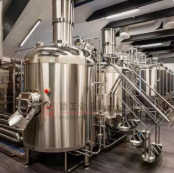
The dream of opening a commercial brewery is often met with the stark reality of industrial logistics. For many entrepreneurs, the most efficient path to market is through “turnkey” brewing solutions. A turnkey system is defined as a complete, integrated brewery package where a single manufacturer provides everything from the grain mill to the final packaging line. The “key” is metaphorically turned, and the brewery is ready to produce beer.
While the convenience of a turnkey solution is undeniable, the cost can be a complex web of variables. Understanding these costs requires a deep dive into the engineering, the materials, and the hidden infrastructure that transforms a collection of stainless steel tanks into a functioning business.
1. What Defines a Turnkey Brewing System?
Before analyzing costs, we must define what is included in a turnkey quote. A true turnkey package is not just a brewhouse; it is a holistic ecosystem. Typically, a turnkey system includes:
- The Brewhouse: Mash tun, lauter tun, brew kettle, and whirlpool.
- The Cellar: Fermentation tanks (Unitanks) and Brite beer tanks.
- Temperature Control: A glycol chilling unit and insulated piping.
- Grain Handling: A malt mill, auger, and grist hopper.
- Cleaning Systems: A Clean-in-Place (CIP) station.
- Control Systems: Centralized PLC (Programmable Logic Controller) touchscreens.
- Support Hardware: Pumps, heat exchangers, hoses, and manifold valves.
The primary benefit of a turnkey system is compatibility. When one manufacturer designs the entire flow, the pumps are sized correctly for the heat exchanger, and the control panel is pre-wired to manage every sensor in the building.
2. The Baseline: Cost by Production Scale
The most significant driver of cost is the volume of beer the system can produce. In the brewing industry, capacity is measured in Barrels (BBL), where 1 BBL equals 31 gallons.
Nanobrewery Turnkey Costs (1 to 3 BBL)
Nanobreweries are the entry point for brewpubs and experimental taprooms. These systems are often electric-fired to save on the cost of a steam boiler.
- Price Range: $45,000 – $85,000.
- What impacts the price: Moving from manual valves to a semi-automated touchscreen can add $15,000 to this baseline.
Microbrewery Turnkey Costs (5 to 15 BBL)
This is the standard size for a professional startup. At this scale, the jump in cost is attributed to the transition to steam heating and larger fermentation cellars.
- 5 BBL System: $110,000 – $160,000.
- 10 BBL System: $170,000 – $250,000.
- 15 BBL System: $230,000 – $350,000.
Production Brewery Turnkey Costs (20 to 50 BBL)
These systems are designed for high-speed throughput and regional distribution.
- Price Range: $450,000 – $1,200,000+.
- What impacts the price: At this scale, packaging lines (canning/bottling) and centrifuges become the dominant expenses.
3. The Brewhouse: Steam, Electric, or Gas?
The method of heating the wort is a major financial decision. A turnkey provider will offer three main options, each with different upfront and operational costs.
Steam Heating
Steam is the gold standard for commercial brewing. It utilizes a boiler to create steam, which then travels through “jackets” on the outside of the brew kettle.
- Cost Factor: Adds $25,000 to $50,000 for the boiler and specialized piping.
- Benefit: Provides even heating, prevents scorching (caramelization), and offers the fastest boil times.
Electric Heating
Electric elements are submerged directly into the liquid or attached to the vessel walls.
- Cost Factor: Lower upfront cost than steam.
- Benefit: Easier to permit in urban environments where gas lines or high-pressure steam boilers are restricted.
Direct Fire
This uses a natural gas or propane burner located underneath the kettle.
- Cost Factor: Mid-range.
- Benefit: Simple to maintain, though it carries a higher risk of “hot spots” on the bottom of the kettle.
4. The Cellar: Expanding Your Capacity
In a turnkey system, the brewhouse makes the wort, but the fermenters determine how much you can sell. A common mistake is under-investing in the “cold side.”
Unitanks vs. Brite Tanks
Most modern turnkey systems utilize Unitanks, which are jacketed, pressure-rated conical vessels. They allow for fermentation, yeast harvesting, and carbonation in one vessel.
- 7 BBL Unitank: $7,500 – $10,000 each.
- 15 BBL Unitank: $14,000 – $18,000 each.
To calculate your turnkey cost, you must decide on your fermentation cycle. If you brew twice a week and your beer takes two weeks to ferment, you will need at least four fermenters to keep the brewhouse active.
5. Automation: The Cost of Consistency
A major component of turnkey pricing is the level of automation. In 2026, labor costs are high, and many owners are opting for higher upfront equipment costs to reduce long-term payroll.
- Manual Systems: The brewer manually turns every valve, monitors every temperature, and manually starts/stops pumps.
- Semi-Automated Systems: Includes automated temperature control for fermentation and automated rakes for the mash tun.
- Fully Automated Systems: A centralized PLC system manages the entire brew day, including strike water temperature, flow rates, and grain-out processes.
- The Price Gap: Moving from a manual to a fully automated 10 BBL system can increase the quote by $40,000 to $70,000.
6. Cold Block Utilities: The Glycol System
The glycol chiller is the unsung hero of the turnkey package. It is a refrigeration unit that pumps food-grade antifreeze through the jackets of your fermenters to control the heat produced by yeast.
In a turnkey quote, the chiller must be sized not just for the current number of tanks, but for future expansion.
- Small Chiller (3–5 HP): $12,000 – $18,000.
- Large Production Chiller (15–30 HP): $35,000 – $60,000.
7. Grain Handling and Milling
Processing grain is the first step in the brewing process. A turnkey solution should include the infrastructure to handle bulk malt.
- Malt Mill: $6,000 – $12,000.
- Flex Auger: To move grain from the mill to the mash tun, expect to pay $4,000 – $8,000.
- Grist Hopper: A stainless steel vessel that holds the crushed grain above the mash tun, ensuring a quick and dust-free mash-in.
8. Packaging: The Final Step
If you plan to sell beer outside your taproom, your turnkey system must include packaging equipment.
- Keg Washer: $12,000 – $20,000. A semi-automatic two-head washer is standard for microbreweries.
- Canning Line: An entry-level line (15–25 cans per minute) starts at $75,000, while a production-grade line can exceed $200,000.
9. Hidden Costs: Shipping, Installation, and Rigging
The “turnkey” price often covers the manufacturing and assembly, but the logistics of getting the equipment into your building are usually separate.
- Ocean Freight and Customs: For international orders, budget $10,000 – $25,000.
- Rigging: Bringing the tanks into the building and standing them up with a forklift or crane. Budget $5,000 – $10,000.
- Mechanical, Electrical, and Plumbing (MEP): This is the cost of a local contractor connecting the steam, glycol, and electrical lines to your building’s mains. This can be 20% to 30% of the equipment cost.
10. Material Quality: Why Steel Grade Matters
Not all stainless steel is created equal. A turnkey system should use 304 or 316L food-grade stainless steel.
- 304 Stainless: The industry standard for most tanks.
- 316L Stainless: More resistant to corrosion from acids and chlorides; often used in the kettle or for specialized sour beer programs.
The thickness of the steel (measured in millimeters) also impacts the price. A quality 10 BBL fermenter should have an inner shell of at least 3mm to 4mm to handle the pressures of carbonation.
11. Choosing the Right Turnkey Partner
When you purchase a turnkey system, you are entering into a multi-year relationship with the manufacturer. You are not just buying steel; you are buying their engineering, their technical support, and their warranty.
Low-cost providers often save money on the “peripherals”—using cheap plastic valves instead of stainless steel, or basic temperature controllers instead of robust PLC systems. A high-quality turnkey provider will focus on:
- Sanitary Welds: Ensuring there are no “pits” or rough spots where bacteria can hide.
- Ergonomics: Designing the platform and valves so the brewer can operate the system safely for 8–10 hours a day.
- Expandability: Designing the control panel and glycol manifold so that you can add more fermenters next year without buying a whole new system.
Why Recommend Micet for Your Turnkey Brewery?
In the global market for brewing equipment, Micet has distinguished itself as a leader in high-performance, cost-effective turnkey solutions. Micet offers a rare combination of precision engineering and artisanal craftsmanship.
The Micet Advantage:
- Turnkey Expertise: Micet specializes in integrated systems, ensuring that every pump, motor, and sensor is perfectly calibrated to the size of your vessels.
- Superior Materials: Using only certified 304/316L stainless steel, Micet’s tanks feature mirror-polished interiors and high-density polyurethane insulation for maximum thermal efficiency.
- Customization: No two buildings are the same. Micet provides custom CAD drawings to ensure your turnkey system fits perfectly within your specific floor plan, maximizing your taproom and production space.
- Global Reliability: With systems operating in over 60 countries, Micet understands the diverse regulatory and electrical requirements of different regions, making the “turnkey” promise a reality.
Whether you are building a boutique 5 BBL taproom or a 30 BBL production facility, Micet provides the reliability and aesthetic beauty that modern craft breweries demand.
Frequently Asked Questions (FAQs)
1. What is the typical lead time for a turnkey brewing system?
In the current market, the lead time from the final design sign-off to delivery is typically 5 to 8 months. This includes 3–4 months for fabrication and testing, and 1–2 months for ocean freight and customs clearance. It is essential to time your equipment order with your building’s construction phase.
2. Does a turnkey quote include the floor drains and ventilation?
Usually, no. While a manufacturer like Micet provides the equipment, the “facility infrastructure” (floor drains, specialized urethane flooring, and steam/gas ventilation) is the responsibility of your local general contractor. However, Micet provides the specifications (load-bearing requirements and utility connections) to your contractor to ensure a perfect fit.
3. Is it better to buy an all-electric or steam-heated turnkey system?
If your system is under 7 BBL, electric is often more cost-effective because it eliminates the need for an expensive steam boiler. However, for systems 10 BBL and larger, steam is highly recommended. It offers better heat control, faster brew days, and is generally more efficient for heating the large volumes of water required for cleaning and brewing.