Introduction
Traditional project management methods are essential frameworks that help organizations plan, implement and complete projects effectively. Throughout the years, various methods have been developed to inform the course of managing projects based on issues that include complexity of the project, uncertainty, and expectations of the stake holders. Of the methods that are considered patrician ways of project management, some of the best-known and most frequently implemented are those that are applicable in situations where projects can be predicted, organized and even defined.
Conventional processes focus on proper planning, documentation and systematic flows of activities. In contrast to the current agile methodology that relies on flexibility and continuous improvement, the traditional project management is about finishing the one stage and transitioning to the other. This is why it is especially applicable to those projects where the requirements are stable and the goals have been laid out.
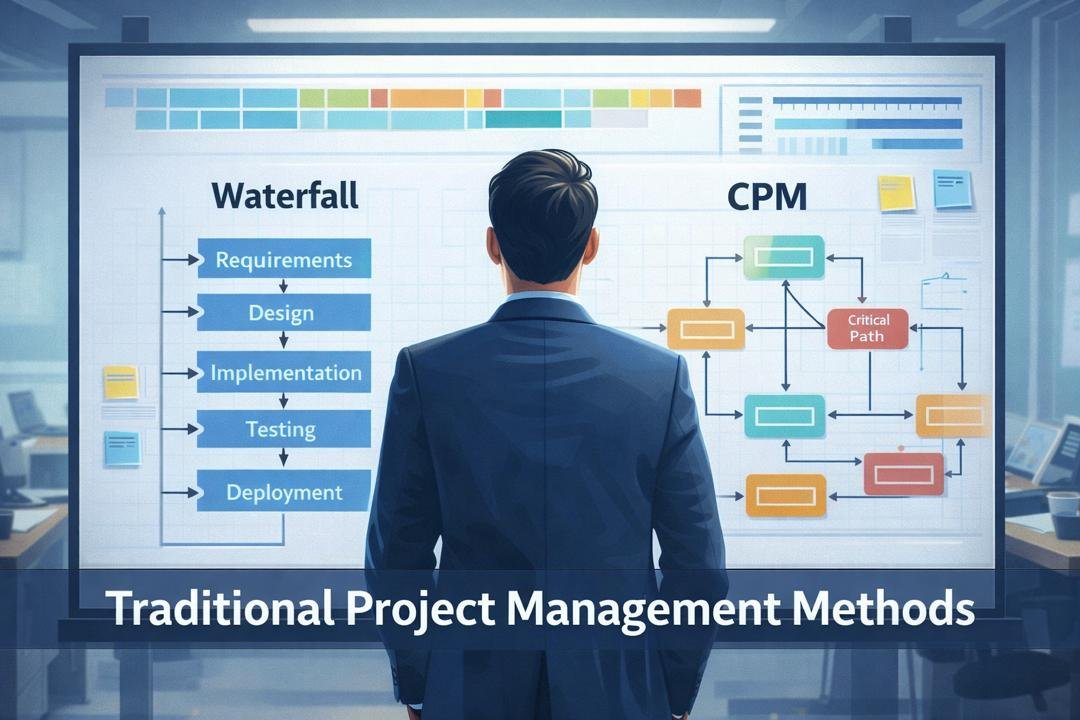
This article discusses two of the most renowned conventional approaches, Waterfall and Critical Path Method (CPM). It describes their organization, advantages, and weakness, and situations in which they work best. Its purpose is to assist the reader in making a wise choice when choosing a project management methodology, which would fit the predictable and clearly defined projects.
Discovering the Traditional Project Management
Traditional project management can be described as a collection of methodologies that are plan based and sequential in nature. These approaches presuppose the possibility to define the project goals, scope, timelines, and resources at the initial stage. As soon as the project starts, there are limited changes and the development is directed.
The main peculiarities of standard project management are:
- A well-formulated project scope.
- A lot of planning and documentation in the beginning.
- Sequential run through of project phases.
- High priorities on control and monitoring.
- Foreseeable deliverables and start times.
The conventional methods have a background in the field of engineering and construction, where such a project as the construction of a bridge, highway, or a manufacturing plant must be planned and regulated strictly. Flexibility is often restricted in such situations and any variation to the initial plan may be expensive or perilous.
The traditional Project Management Methods Overview.
There are a number of methodologies that can be classified as traditional project management, they include:
- Waterfall Method
- Critical Path Method (CPM)
- Program Evaluation and Review Technique (PERT)
- PRINCE2 (some sense of the term)
Nevertheless, Waterfall and CPM are the most spoken and the most widely used ones. These techniques offer a systematic guideline that will help steer project managers to plan, schedule, and control the activities of projects.
The Waterfall Method
The Waterfall Method Structure
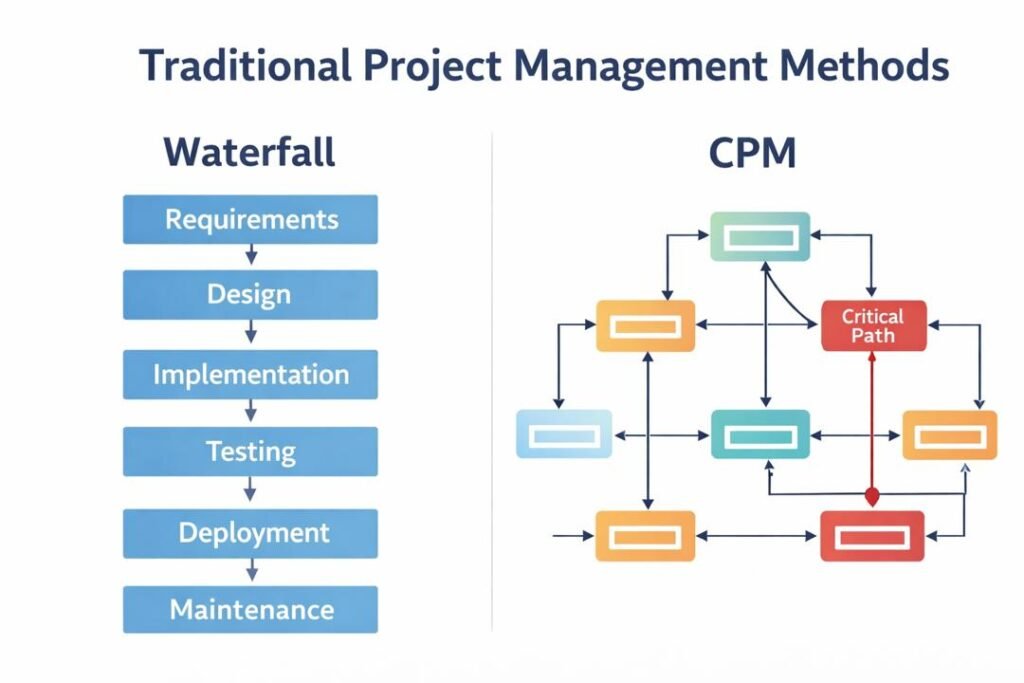
Waterfall method is one of the simplest and most ancient models of project management. It is linear and sequential in nature with every phase requiring to be finished before the next. The typical phases include:
- Requirements Analysis – Specifying and listing all project requirements.
- System Design – Creation of technical and functional design.
- Implementation – The actual work or development.
- Testing- making sure that the outputs are within the requirements.
- Deployment – The final delivery of the product or the system.
- Maintenance – Updating and repairing after delivery.
The stages are based on the one before them and it looks like waterfall flowing down thus the name. When a step is done, it is hardly re-done.
Waterfall Method advantages
The Waterfall approach has a number of advantages especially when dealing with basic and certain projects:
- Clarity and simplicity are both evident: Waterfall is simple and simple to follow along the linear nature. The members of the team fully understand what should be done at a given stage.
- Well-Defined Documentation: A large amount of documentation will make sure that every requirement and design is documented. This assists in responsibility and conformance to norms.
- Easy Progress Tracking: Because of a set of deliverables associated with each of the phases, it is possible to measure and monitor the progress of a project in a systematic way.
- Acceptable to Stable Requirements: Waterfall is most effective in cases where the requirements of the project are not expected to change like regulatory and infrastructure projects.
Waterfall Method shortcomings
Waterfall has some significant limitations:
- Lack of Flexibility: After a phase has been completed, it is hard and costly to make changes. This renders it inappropriate to dynamic projects.
- Late Testing and Feedback: Testing is done after the implementation, i.e. problems can be detected at the later stages of the project.
- The complex project has a high risk of failure: Provided the misunderstanding of the requirements at the initial stage of the project, the whole project is likely to fail since it is not easy to make corrections afterward.
- Vast Stakeholder Involvement: Most stakeholders are engaged at either ends limiting chances of on-going feedback.
Critical Path Method (CPM)
Structure of CPM
Critical Path Method is a time planning method which is applied to determine the longest chain of interdependent tasks in a project. This path is called the critical path, which finds out the shortest time that the project can take.
The following steps are included in CPM:
- Identifying the project activities.
- Determining tasks dependencies.
- Determining the time of each activity.
- Creating a network diagram.
- Determining the critical path.
Any delay in an activity that is critical to the project will postpone the rest of the project and hence these activities are the most significant ones to be monitored.
Advantages of CPM
CPM has a number of real world advantages to the project managers:
- Efficient Scheduling: CPM aids in establishing realistic project schedules by establishing dependencies and timeframes of tasks.
- Focus on Key Activities: The managers are able to utilize resources more efficiently by drawing attention to important tasks.
- Improved Risk Management: Delays are possible to be predicted and backup plans formulated.
- Better Resource Allocation: The adjustment of non-critical activities is possible without impacting the entire schedule.
Limitations of CPM
Although useful, CPM has the following disadvantages:
- Complicatedness in Large Projects: CPM charts may be cumbersome and unwieldy to handle in case of very large projects.
- Banking on Accurate Estimates: Once the estimates of the duration of the tasks are inaccurate, the whole schedule can be deceptive.
- Limited Flexibility: Similar to other conventional approaches, CPM presupposes constant conditions of projects and lacks the ability to adjust to change.
Advantages of the Traditional Project Management Methods
The Traditional project management methods have a number of common strengths:
Predictability and Control
These techniques offer great degree of predictability, hence are suitable in projects that have definite budget, time and scope.
Strong Documentation
The transparency, accountability, and knowledge transfer is supported with the help of detailed documentation.
Well-Defined Roles and Responsibilities
Members of the team are aware of their tasks and there is less confusion and conflict.
Appropriate to Compliance and Regulation
Conventional approaches are suitable when dealing with industries where high standards have to be followed like in the case of healthcare, constructions and government projects.
Drawbacks of the Traditional Project Management Approaches
Although the conventional methods are effective, they do not fit any given project:
Resistance to Change
Conventional approaches are challenged in those areas where specifications change very often.
Slow Response to Problems
Problems are identified in the project lifecycle when they are late.
Limited Innovation
Stiff hierarchies can suppress innovation and experimentation.
Uncertain Projects with High Risk
New projects or ones whose purpose is uncertain can collapse in the conventional system.
Traditional project management Use Cases
The conventional approaches to project management would be best suited in the following situations:
- Building and Construction Projects: Other projects like construction of roads, bridges, or factories involve elaborate planning and the requirements of few changes when it comes to construction.
- Manufacturing Projects: Workflows and schedules are stabilized and predictable when used in production processes.
- Public Sector and Government Projects: In the public sector, regulatory compliance and documentation is a key factor.
- Software Projects whose requirements are fixed: Structure planning has an advantage with legacy systems or regulatory software.
- Scholars and Research Projects: Traditional models are good with projects that have a set goal and time.
The Traditional and Modern Approaches
Conventional approaches are vastly different than the agile or hybrid ones:
| Aspect | Traditional methods | Agile Methods |
| Structure | Linear and sequential | Iterative and flexible |
| Documentation | Extensive | Minimal |
| Flexibility | Low | High |
| Stakeholder Involvement | Limited | Continuous |
| Risk Handling | Preventive | Adaptive |
This comparison shows that classic techniques are applicable in predictable and steady settings, whereas agile techniques are applicable in dynamic and innovative projects.
Selection of the Appropriate Methodology
The choice of the project management methodology is dependent on a number of factors:
- Project size and complexity.
- Level of uncertainty.
- Stakeholder expectations.
- Industry requirements.
- Sufficient resources and resources.
The conventional project management techniques are best applicable where the objectives of the project are well defined, risks are minimal and change is minimal. Comparatively, agile approaches will suit projects that have changing requirements.
Conclusion
Conventional project management tools especially the Waterfall technique and the Critical Path Method has been very instrumental in developing the way projects are planned and implemented. They are structured and linear in their approach and focus on detailed documentation, careful planning, and high levels of control. The traits render them effective in predictable, clear-cut projects in which stability and compliance is paramount.
Nonetheless, the conventional approaches have their restrictions. The fact that they are not flexible and do not adapt to changes makes them less adaptable to dynamic and innovative settings. This leads to the need by project managers to be keen in evaluating the nature of their projects prior to taking a methodology.
To conclude, classical approaches of Traditional project management methods are not outdated and useless particularly in some industrial sectors like construction, manufacturing, and government. They offer clarity, reliability, and control when used in the right way that only allow organizations to accomplish their project objectives in an efficient and effective manner.
Get more well research information about Traditional project management method here.