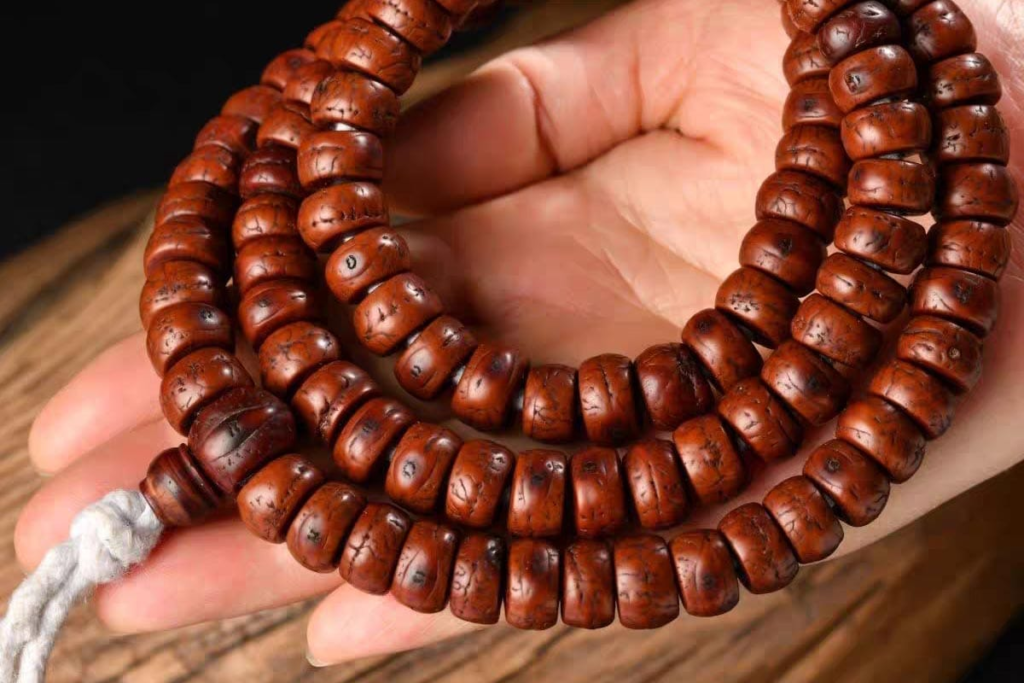
At first glance, a Bodhi seed mala may seem like a simple strand of beads. But count them—there’s a reason there are exactly 108. That number isn’t random. It’s a significant bridge between ancient wisdom, spiritual science, and the inner journey of awakening.
You don’t need to be a monk or mantra master to feel the pull of this number. If you’ve ever wondered why mala beads are counted in 108s—or what it means when you hold that final bead between your fingers—this one’s for you.
Let’s dive into the origins, symbolism, and layered meaning behind the sacred count of 108, especially in the context of Bodhi seed malas—tools not just crafted for ritual, but for remembrance.
The Power of Numbers in Spiritual Traditions
Numbers have always held meaning far beyond math. In nearly every ancient culture—from the Vedic sages of India to Tibetan mystics and early Buddhists—certain numbers were seen as keys to the cosmos. And 108? That’s the key that unlocks everything from breath cycles to planetary alignments.
The number 108 shows up in:
- Vedic cosmology: 108 is said to represent the wholeness of existence.
- Ayurveda: There are 108 sacred points in the body—known as marma points.
- Yoga: There are said to be 108 energy lines (nadis) that converge at the heart chakra.
- Sanskrit language: It has 54 letters, each with a masculine and feminine form—totaling 108.
- Buddhism: There are 108 earthly desires or defilements a practitioner must overcome.
- Astronomy: The sun is 108 times the diameter of Earth. The average distance between the Earth and sun is 108 times the sun’s diameter.
Coincidence? Maybe. But for those who walk a spiritual path, it feels more like a blueprint.
This isn’t numerology for fun. It’s a sacred equation. And in the context of a Bodhi tree mala, it becomes a living, breathing expression of that cosmic order.
The Structure of a Traditional Mala
If you’ve ever held a mala in your hand—especially an authentic Bodhi seed mala—you’ve likely noticed the way it loops, how it moves, and how it always returns to a “guru bead.”
Here’s the typical breakdown:
- 108 main beads: Each one used for mantra repetition or breath awareness
- 1 guru bead: Larger or uniquely shaped, this bead is not counted; it symbolizes the teacher, source, or divine
- Knots between beads: Traditionally hand-tied, allowing for flexibility and symbolic of the thread of consciousness
- Tassel or pendant: Often attached to the guru bead, representing unity or spiritual bloom
In some traditions, you’ll also see Bodhi seed prayer beads strung with spacers—every 27 beads, for example—to help track progress during long meditations.
But the 108 is the heart of it. Each bead becomes a step, a breath, a moment of presence.
The Journey of 108: What It Means in Practice
Using a Bodhi seed mala isn’t about checking off a to-do list of mantras. It’s about walking a circle. And each bead is a footprint on that path.
When you sit with your Bodhi seed beads, you’re not just counting. You’re remembering. Returning. Realigning.
Why 108 repetitions?
Because somewhere between bead 1 and bead 108, something shifts. The noise starts to quiet. The breath deepens. The you that began the practice starts to soften into something quieter, more aware.
It’s not about perfection. It’s about presence.
And with Bodhi seed prayer beads, that journey carries the energy of the Buddha’s own path—his awakening beneath the Bodhi tree, one breath at a time.
Buddhist Symbolism and the 108 Defilements
In Buddhist philosophy, human beings are said to be bound by 108 kleshas—afflictions or defilements—that obscure our true nature. These aren’t sins. They’re habits of mind. Attachments. Aversions. Confusions.
The idea is that each mantra, each repetition, helps clear one of those veils. One by one, the fog lifts.
By the time you reach the final bead, you’ve metaphorically shed 108 layers of illusion and returned to something closer to center.
This is why many Buddhists, dharma students, and mindfulness coaches prefer Tibetan Bodhi seed malas. These aren’t just beautiful strands—they’re symbolic tools woven with the intention of liberation.
The Symbolism of the Guru Bead
Every mala has a beginning and end. But the guru bead changes that.
It’s not just a marker. It represents your teacher, your guiding wisdom, or the divine itself. When you reach it, you don’t count it. You pause. Reflect. Offer gratitude.
Some practitioners bow. Others whisper a thank-you. Some simply breathe.
In Bodhiseed malas, this bead often carries a unique energy. You’ll feel it. It’s slightly larger, maybe carved, sometimes capped in silver or gold. It says: “This is where you return.”
Never cross over it. Instead, turn the mala around and begin again in the opposite direction. A symbolic gesture that says: the journey never ends—it just deepens.
Why Bodhi Seed Malas Carry Deeper Meaning
Plenty of malas are made with stones, crystals, or woods. But Bodhi tree seed malas carry a story.
They echo the moment Siddhartha Gautama sat beneath the Bodhi tree and saw through the illusion of self. That awakening didn’t just birth a religion—it birthed a path.
Wearing or using Bodhi seed mala beads connects you to that lineage. That moment. That possibility.
Why spiritual seekers love them:
- Organic texture: Each seed holds its own pattern, just like each soul
- Symbolic lineage: Direct tie to the Buddha’s enlightenment
- Grounding energy: Earthy, centering, intentional
- Evolves with use: Oils from your hands darken the beads, creating a personal patina
Whether you choose a Tibetan Bodhi seed mala, or a simple unadorned strand—what you’re really choosing is to carry a reminder of your own inner potential.
How to Use a 108-Bead Mala in Daily Practice
You don’t need a monastery to make this practice meaningful. In fact, many yoga practitioners, wellness enthusiasts, and spiritual coaches use their Bodhi seed necklaces in everyday settings.
Here’s how you might integrate a 108-bead mala into your practice:
- Morning intention setting: Use the full mala to repeat a daily affirmation or mantra
- Walking meditation: Sync steps with beads, turning the mala as you walk
- Evening unwind: Let each bead be a breath, releasing the day
- Energy work or reiki: Use the mala to scan or infuse energy fields
- Teaching tool: Yoga instructors and retreat leaders often use malas as visual and tactile aids
You don’t have to get it “right.” The only wrong way to use a mala is to forget why you picked it up.
Final Thoughts: The Mala as a Mirror
A 108-bead Bodhi seed mala is more than a meditation tool. It’s a mirror for your practice. A container for your breath. A quiet witness to your inner evolution.
Every bead is a moment to return. Every circle is a cycle completed. And every time you sit down with your mala, you’re not starting over. You’re stepping deeper.
So whether you’re new to meditation or decades into your path, the symbolism behind those 108 beads will meet you right where you are—and invite you into something more spacious, more centered, more awake.
Ready to walk your own path—one bead, one breath at a time? Explore our collection of authentic Bodhi seed malas and find the one that speaks to your soul.