Introduction
The history of Nigeria gaining independence cannot be explained completely without considering the influential contribution of the media. Before political parties had mass support, and before any constitutional conference shots had been made, the newspapers and the journalists had already started to challenge the colonial power, to reveal the wrongs, and to arouse political consciousness among Nigerians in the Nigeria’s independence struggle.
In this period of the end of the nineteenth century to the middle of the twentieth century, the press was a potent vehicle of controversy, opposition, and national awareness. The media provided the cohesive power in a society whose ethnic diversity and colonization created a medium of expression of like-minded grievances and desires.
This article will discuss the active participation of the newspapers, journalists, and subsequently broadcasters in the self-rule movement and Nigeria’s independence struggle. It presents how the Nigerian media transformed into a platform of change, unity, and national identity in the struggle to gain independence in Nigeria by featuring the publications that influenced and the pioneering media personalities in the struggle.
The Colonial and the Emergence of the Nigerian Press
Spread of Print Media in Nigeria
Nigerian journalism dates back to the middle of the nineteenth century when missionaries and educated elites started the first newspapers. Literary publications like Iwe Irohin (established in 1859 by Reverend Henry Townsend) started with literacy, religious, and community news. These early newspapers were not so much political in its beginning, but formed the base of the discussion and sharing of ideas.
Newspapers were becoming more political as the Western education grew and a small section of the educated Africans began to form a small yet powerful segment of the population. Nigerian-owned newspapers started to question colonial accounts and, to their credit, it shifted the dynamics of publications being dominated by missionaries to that of the indigenous-owned media.
The Press as a Platform to Politeness
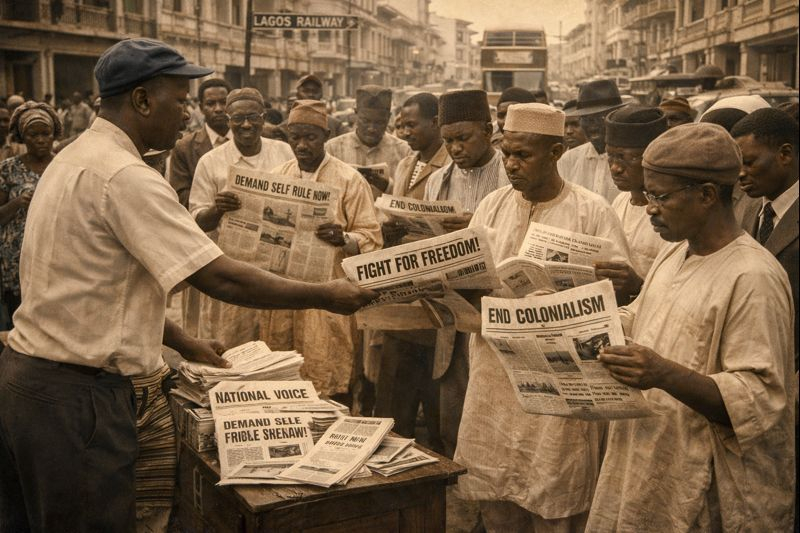
The political participation was limited by the colonial rule, and there were very few avenues through which the Nigerians could vent their dissent. Newspapers filled this gap. The press was used to air the grievances against the colonial policies through the editorials, opinion columns, and through letters to the editor. The problems of taxation, alienation of land, racial discrimination, and lack of representation in the governance were mentioned.
By introducing these issues into the mass discourse, journalists enabled the personal frustrations to be converted into political awareness. The press was, in a way, a non-formal political institution, and the readers were informed about their rights and the implications in the whole colonial rule.
Newspapers as Strategies of Resistance and Mobilization
Powerful Newspapers during the Independence Period
Some of the newspapers were leading in forceful criticism of the colonialism and their promotion of self-determination. Some of the most powerful included The Lagos Weekly Record, The West African Pilot, Nigerian Tribune, and Daily Service. Such publications not only covered the events, but created opinion and action in Nigeria’s independence struggle.
Of particular interest was The Lagos Weekly Record, which was started by John Payne Jackson in the late nineteenth century, but it was especially distinguished by its uncompromising position on the subject of colonial injustice. Its editorials questioned the British policies and defended the African dignity when such standpoints were subject to extreme suppression.
Likewise, The West African Pilot, started in 1937 under the leadership of Nnamdi Azikiwe, took a populist theme which was simple to the common Nigerian. Its motto, which was Show the light and the people will find the way, was an indication of its mandate to enlighten and mobilize the masses. The paper was read by a large audience of people with easy language and a provocative headline, which made it a focus of nationalistic feeling.
Connection of the Press to Political Activism
During the initial phase of the fight towards independence, newspapers tended to collaborate with the uprising movements of nationalism. Most of the editors and contributors were also active politicians or ideology leaders themselves. The press also allowed the Nigerians to view their struggle as part of a global fought demand against colonialism by connecting the reports of local injustice to the global movement.
When talking of Nigeria’s Independence Struggle, newspapers tended to use the developments in other colonized communities, thus reinforcing the notion that self-rule was not only possible but inevitable. This global outlook enhanced local determination and justified nationalist thirsts.
Opinion Shapers and Nationalist Leaders, Journalists
Herbert Macaulay and the Early Nationalist Journalism
Herbert Macaulay is termed as father of Nigerian nationalism, and his association with the press was the key to his influence. Macaulay also criticized the colonial government through his engagement with the newspapers like Lagos Daily News to mount political opposition. His works were a blend of historical examination, satire, and ethical appeal, which enabled them to be persuasive and easy to read.
The journalism work by Macaulay revealed that the press could be used as an instrument of political leadership. His portrayal of colonial policies as unfair and undemocratic inspired the Nigerians to challenge the imperial power and hold them responsible.
Nnamdi Azikiwe and Power of the Popular Press
Nigerian media and independence cannot be discussed without mentioning of Nnamdi Azikiwe. Azikiwe was a trained journalist with international exposure, hence knowing the strategic value of the press. He launched a media network which spread various destinations in the country through The West African Pilot and regional editions.
The editorials of Azikiwe focused much on unity regardless of ethnicity or region and nurtured the notion of common Nigerian identity. Through bringing out similarities in the economic and political problems, he turned to journalism to unify the country through nationalism. This was his dualism as a journalist and politician and was an example of how the media practitioners became leading players during the independence movement.
Ideological Journalism and Obafemi Awolowo
Obafemi Awolowo wrote in the Nigerian Tribune in the west to express his vision of federalism, social welfare, and self-government. The Tribune was written in an analytical manner, unlike more populist publications, which urged the reader to think deeply upon political concepts.
The approach of Awolowo demonstrated that journalism could not only be used as a mobilizing force but also as an educative tool. Through plain language explanations of the complicated political ideas, the press gave the Nigerians a chance to be ready to assume the duties of self-rule.
The Broadcasting and the Development of the National Consciousness
The Birth of the Radio as a Mass Media
Although newspapers played a great role during the initial stages of Nigeria’s independence struggle and movement, the radio broadcast increased the coverage of the nationalist ideas. The advent of radio in Nigeria in the colonial era enabled information to penetrate outside the urban areas into the rural areas, many of which did not have easy access to print media.
Radio content was originally censored by the colonialists who used it to spread official viewpoints. Nevertheless, with the rise of nationalist pressure, there was a rise in broadcasts which were more localistic in their interests and concerns. Radio was an influential tool of political education, which could reach the listeners without the level of literacy.
Radio and Political Mobilization
Radio became critical in the 1950s in educating the Nigerians on the constitutional developments, elections, and political debates. The use of broadcasts in local languages aided in the translation of nationalistic concepts into culturally familiar messages, enhancing interaction with the populace.
The instantaneous nature of radio developed a feeling of connection, and listeners all over the country were able to track political events as they occurred. This was a sense of shared consciousness, adding to the feeling that they were all one nation and that independence was one shared objective.
Media, Unity, and the Construction of National Identity
Conquering Ethnic and Regional Segregations
Diversity in Nigeria was a great challenge to nationalist mobilization. Differences based on ethnicity, language, and geographical boundaries will destroy unity easily. The media had to deal with this challenge by focusing on similarities in experiences of colonial exploitation and common goals on freedom.
Newspapers and broadcasters encouraged intercommunication through the inclusive narratives and balanced reporting. Although the differences were recognized, they were represented in a greater perspective of national development. This cohesion played a crucial role in the continuation of the independence momentum.
The Construction of a Post-Colonial Vision
The media also allowed the Nigerians to visualize post-independence life besides speaking out against the colonial regime. The problems discussed in editorials included the system of governance, economic growth, and social justice. The press created a feeling of ownership to the future of the nation through such discussions with the readers.
This future-thinking disposition would make nationalist journalism unlike protest writing. It showed that it was not only a fight against colonialism but also a fight against a viable and inclusive nation.
Problems That the Nationalist Media Had
Colonial Repression and Censorship
The colonial rulers had realized the power of the press and reacted to it through repression. The silencing of dissenting voices was usually done through laws that controlled publications, arrest of editors, and money pressure. Nevertheless, numerous journalists did not give up and treated their job more like a moral obligation.
The fact that the nationalist media has resisted such situations highlights the fact that the media is devoted to the independence cause. Every censorship could easily serve to remind people about colonial injustice, and nationalist determination was strengthened.
Professional and Ethical Dilemmas
Ethical challenges were also experienced by the operation on a politically charged environment. Journalists were forced to weigh between advocacy and accuracy, and in most cases under high pressure. Whereas other publications took a more partisan stand, other publications tried to be credible in their reporting.
These discussions helped in the development of the journalism standard in Nigeria, and this formed a professional culture which would be maintained after independence.
Conclusion
The Nigerian media played a very significant role in the Nigeria’s independence struggle, and this role was transformational. Newspapers, journalists, and broadcasters did much more than communicate what was going on. They constructed a political awareness, inspired a political mobilization, and expressed a national sense of solidarity.
The media played a key role in the nationalist movement through their consistent criticism of colonial policies and intense campaigning to have their rights to self-rule.
The press allowed Nigerians to envision themselves as a part of one political community through giving voice to a variety of views and focusing on a unified set of goals to accomplish. Herbert Macaulay, Nnamdi Azikiwe, and Obafemi Awolowo, among other journalists, proved that the pen was mightier than any political institution. They still live in the history of media in Nigeria, as they are a reminder to the modern practitioners of the potential of the profession to develop social change.
Finally, the Nigerian independence movement is used as an example of how media can be used as a source of liberation. The media played an invaluable role in the birth of the nation in amplifying demands of justice, creating cohesion, and training of citizens towards self-governance. The lessons of this historical experience still remain very important in terms of what the responsibilities and possibilities of journalism can do in developing democratic societies.