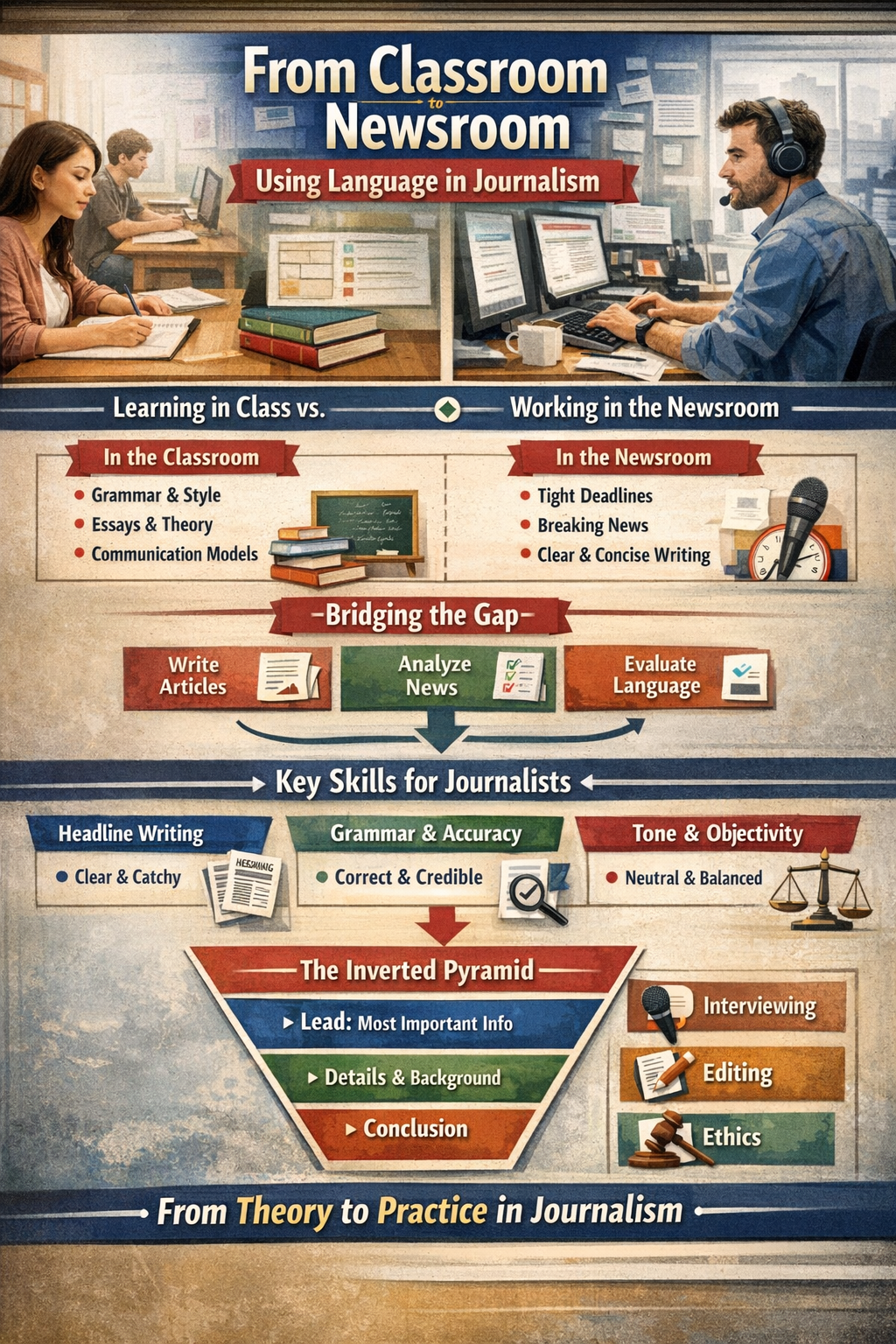
Media credibility is always on the spot in the present-day information-driven society. The audiences are not passive listeners and readers anymore; they have questions, analyzes, and checks to make regarding the information that they receive. The precise use of language in such an environment has become one of the foundations of reliable communication. Be it journalism, digital media, corporate communication or PR, the manner of information expression may either build or destroy the credibility level in a jiffy. Language Precision in Media is the idea of the accurate use of language in communication, which is the careful choice of words, proper grammar and clear sentence structure to communicate the message in a way which has no ambiguity.
In this article, the author discusses the role of linguistic accuracy in shaping the readership, avoiding misinformation, and supporting professionalism in media texts.
Understanding Language Precision in Media
Language precision in media is not just about avoiding grammatical mistakes. It entails the proper use of words in their proper context in order to convey thoughts in an accurate way.
What Does Language Precision imply?
- Precision: Making statements without falsifying.
- Attractiveness: Making the message understandable.
- Consistency: Use of consistent terminology.
- Relevance: The selection of words which are suitable for the audience and situation.
In media communication, a simple wrong understanding can be a source of confusion or misinformation. Accuracy makes sure that the meaning intended is accurately translated to the audience’s comprehension.
Why Language Precision Matters for Credibility
Trust forms credibility in media, and the presentation of information contributes a lot to building trust.
1. Authority and Professionalism
A properly written article has the right grammar, and a well-selected vocabulary is a sign of an expert. A reader would be more inclined to believe in the information, which looks professional and well-written.
Bad language, on the contrary, can:
- Appear to render the writer inexperienced.
- Sow the seeds of doubt about the information.
- Reduce audience engagement
Institutional credibility is the reason why professional media outlets spend a lot of money on editing and proofreading, since language quality is the indicator of institutional credibility.
2. Misinterpretation and Misinformation
The most common causes of misinformation include ambiguous language. Sentences that are ambiguous or poorly written can be understood by the reader in a different manner.
For example:
- Assumptions can be arrived at because of vague statements.
- Placed modifiers may alter the meaning in a completely different manner.
- Misplaced punctuation may change the meaning.
The accuracy of language will help eradicate such dangers by making sure that each statement conveys one clear meaning.
3. Enhancing Audience Trust
The media is a very delicate sphere of trust. When lost, it is hard to be constructed again. People will have more credence in content that:
- Uses straightforward language
- It is not exaggerated or sensational
- Presents information logically
When the reader is subjected to clear and correct communication always, they will start perceiving the source as credible.
The Role of Grammar in Media Credibility
The language structure is supported by grammar. In its absence, communication is hectic.
Top Grammatical Problems That Can Lead to Lack of Credibility
- Subject-verb disagreement
- Incorrect tense usage
- Run-on sentences
- Misuse of punctuation
Such mistakes might not appear very big, yet they can have a great influence on the perception of content.
Why Grammar Matters
- It ensures readability
- It maintains professionalism
- It prevents confusion
As an example, the wrong placement of a comma can have an entirely different impact on the meaning of a sentence. In journalism, these mistakes may falsify the facts and undermine credibility.
The Importance of Vocabulary Choice
Words carry weight. It is not only the clarity that is dependent on the choice of vocabulary, but also the tone and perception.
Precision vs. Complexity
The use of complex words may not in any way enhance credibility. Actually, too complex language may put off the reader.
Effective communication prioritizes:
- Simplicity
- Accuracy
- Relevance
- Avoiding Ambiguity
Avoiding Ambiguity
The use of ambiguous words or phrases may result in a variety of meanings. For example:
- Soon may be in minutes, hours or days.
- Significance may have a different meaning according to the situation.
Such uncertainties are removed through accurate use of words.
Clarity of Expression: The Core of Effective Communication
The final aim of precision of language is clarity. In its absence, even the correct information may turn out to be useless.
Plans on How to Achieve Clarity
- Short sentences are to be used.
- Avoid unnecessary jargon
- Structure ideas logically
- Split complicated information into smaller bits.
Good writing makes the audience have no problem grasping the message.
Precision in Language in Various Media
The various platforms demand various strategies with regard to language, but accuracy is the key factor in all of them.
1. Print Media
- Requires formal tone
- Insists on precision and thoroughness.
- Uses structured paragraphs
2. Digital Media
- Has more focus on readability and engagement.
- Presents less lengthy sentences and bullet points.
- Needs to be understandable because of rapid consumption.
3. Broadcast Media
- Depends on verbal articulateness.
- Needs plain and straightforward language.
- Shuns complicated sentence constructions.
Inaccurate wording can become a problem with credibility, regardless of the platform used.
The Link Between Language Precision and Ethical Journalism
Ethical reporting is based on accuracy and truth. Precision of language is very important in the support of these values.
Avoiding Bias through Language
The use of words may bring bias unintentionally. For example:
- Descriptive adjectives may affect perception.
- Neutrality can be misrepresented using emotional words.
Language is also used in a precise form to ensure objectivity as it is centered on facts, not opinions.
Fact-Checking and Verification
Journalists must:
- Fact-check before publication.
- Be descriptive in words when narrating events.
- Avoid speculation.
This makes sure that there is credibility and trust in the content.
The Impact of Poor Language Precision
In cases where language precision is not taken into consideration, the consequences may be very serious.
1. Loss of Audience Trust
The reliability of the content may be considered by the readers.
2. Spread of Misinformation
False interpretation may be caused by ambiguous or wrong language.
3. Damage to Reputation
Media houses will lose their credibility and authority.
Useful Tips in Enhancing Language Accuracy
To become more precise in the language, one has to practice and put effort into it.
1. Proofread and edit extensively
Read and reread the content of the reviews to identify mistakes and enhance readability.
2. Use Reliable Sources
Make sure that the information is correct and reliable.
3. Simplify Language
Avoid unnecessary complexity. Focus on clarity.
4. Seek Feedback
The weak points can be spotted by the editors and colleagues.
5. Be a Good Writing Tools User
Grammar software may be useful, but there is no substitute for judgment like human judgment.
The Editorial role in creating Precision
In media houses, the role of gatekeepers of quality is played by the editors.
Key Responsibilities
- Correct grammatical errors
- Improve sentence structure
- Breaking even on the tone and style
- Verify factual accuracy
Their presence is important in ensuring that published content is credible.
Challenges
- The stress on the need to report fast.
- Lack of time to do editing.
- Contribution to the high competition among the media outlets.
Solutions
- Implement editorial workflows
- Speed should be second to accuracy.
- Have clear guidelines for writers.
Language clarity under time pressure is quite difficult to achieve but critical.
Conclusion
The exactness of language is not only a technical demand, but it is the main component of media sincerity. Good grammar, the right use of words and articulateness combine to make content that can be trusted by the audience.
The role of communicators has never been bigger in the age of misinformation that is easily spread. Through insisting on the accurate usage of language, the professionals of the media may maintain the morality, improve the trust of the audience, and preserve their appreciable credibility in a world that grows more doubtful.
Finally, accuracy in words is also a manifestation of respect, respect to the audience, respect to the truth and respect to the honesty of the communication.