Did you know that manufacturers lose an average of 20-30% of their productive capacity annually due to disconnected systems and inefficient data flows? According to recent industry research, companies operating with siloed manufacturing systems experience productivity losses worth millions of dollars each year, simply because their machines, software, and departments cannot communicate effectively with one another.
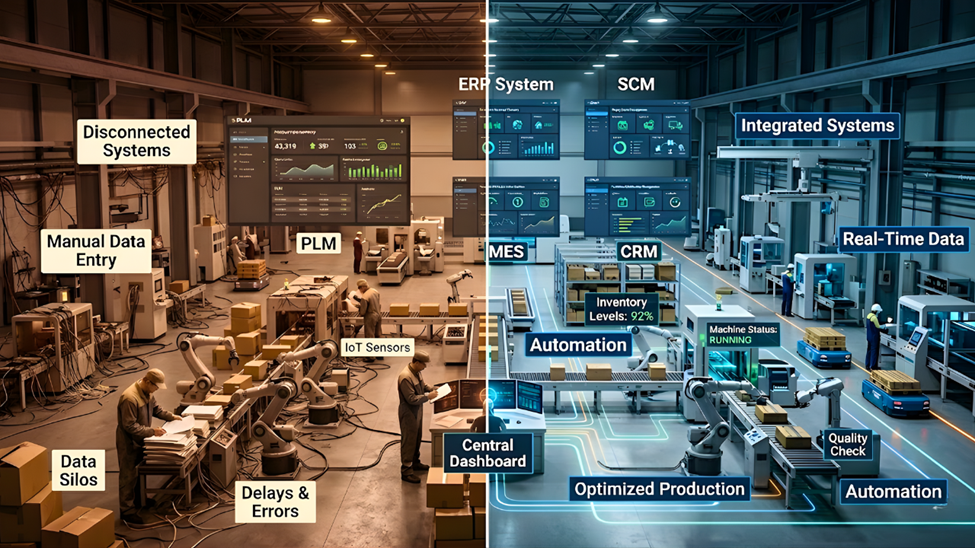
The manufacturing landscape has undergone a dramatic transformation over the past few decades. What once began as isolated production lines with manual record-keeping has evolved into complex, interconnected ecosystems where every machine, sensor, and software platform must work in harmony. Today’s manufacturers face critical challenges: data fragmentation creates operational blind spots, siloed systems prevent real-time visibility, and manual data transfers between incompatible software lead to costly errors and delays.
System integration has emerged as the critical factor that separates industry leaders from those struggling to keep pace. It’s not merely about connecting computers or installing new software—it’s about creating a unified, intelligent manufacturing ecosystem where information flows seamlessly, decisions are data-driven, and every component works toward common goals. In this comprehensive guide, we’ll explore why system integration is essential for modern manufacturing success and how it transforms operations from fragmented chaos into coordinated excellence.
1. Understanding System Integration in Manufacturing
What is System Integration in Manufacturing?
System integration in manufacturing is the process of connecting various hardware, software, and communication systems to function as a unified whole. Instead of operating in isolation, systems share data seamlessly, enabling better coordination, automation, and decision-making.
Types of Manufacturing Systems
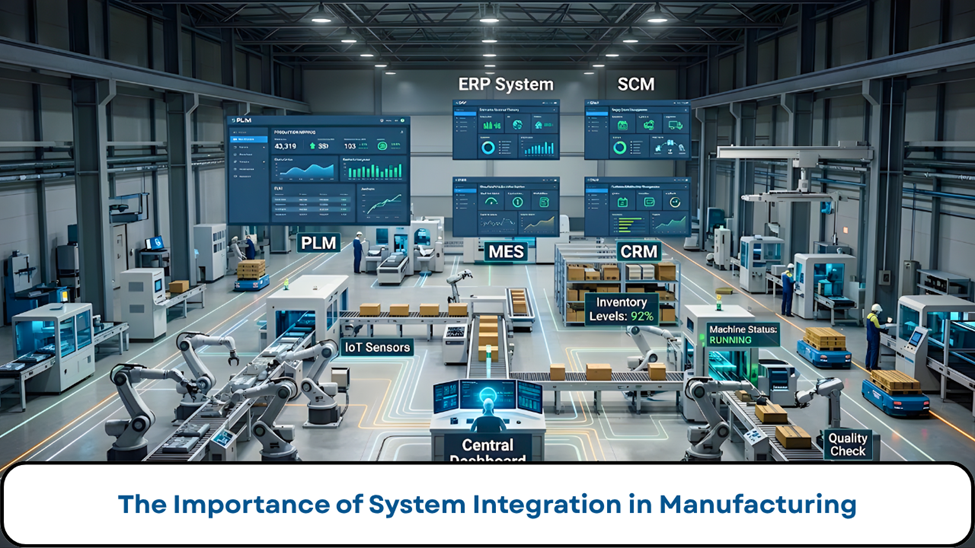
A fully integrated manufacturing environment typically includes:
- Enterprise Resource Planning (ERP): Manages business operations such as finance, procurement, and human resources
- Manufacturing Execution Systems (MES): Tracks and monitors production processes in real time
- Supply Chain Management (SCM): Oversees logistics, inventory, and supplier coordination
- Customer Relationship Management (CRM): Handles customer interactions and sales data
- Product Lifecycle Management (PLM): Manages product design, development, and lifecycle
- Industrial IoT and Sensors: Collect real-time data from machines and production lines
2. Key Components of an Integrated Manufacturing System
Creating an integrated manufacturing system requires careful attention to four fundamental components that work together to enable seamless operations.
Hardware Integration
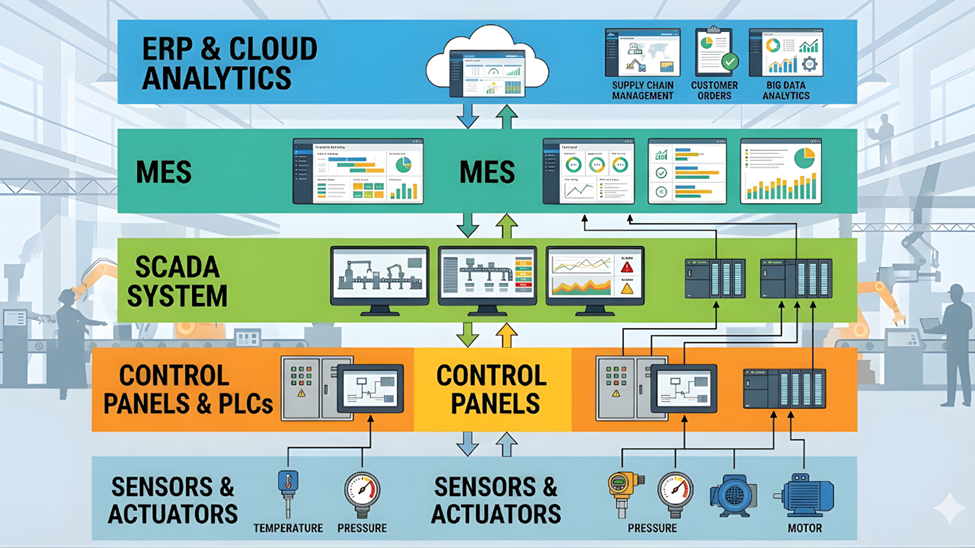
The physical layer of integration includes sensors that monitor temperature, pressure, vibration, and other critical variables; actuators that control valves, motors, and robotic systems; control panels that interface between operators and automated systems; and networking devices like industrial switches and routers. Modern manufacturing facilities contain thousands of these devices, each contributing data and responding to commands within microseconds.
Software Integration
The software layer brings together diverse applications including ERP systems for business management, MES platforms for production control, SCADA systems for supervisory control and data acquisition, and cloud platforms for scalability and advanced analytics. The challenge lies in ensuring these systems share data effectively and present a unified view of operations.
Communication Protocols
For hardware and software to communicate, they must speak common languages. Manufacturing uses protocols including Modbus for serial communication with industrial devices, Ethernet/IP for industrial Ethernet networks, Profibus for process automation, and OPC UA (Open Platform Communications Unified Architecture), the leading standard for industrial interoperability. Standardizing on widely-adopted protocols ensures new equipment integrates with existing systems seamlessly.
Data Integration
Perhaps the most critical component is data integration—the ability to collect, standardize, and present information from all connected systems in meaningful ways. This includes centralized dashboards for at-a-glance operational views, real-time monitoring systems that alert operators to anomalies, and analytics platforms that turn raw data into actionable insights. Without agreed-upon data formats and exchange mechanisms, even sophisticated systems remain disconnected islands.
3. Key Benefits of System Integration
A. Operational Efficiency
System integration eliminates manual data entry and redundant processes by enabling real-time data flow across departments. This automation reduces human error and significantly improves productivity.
Production cycles become faster as machines and systems communicate directly, while decision-makers gain immediate access to critical data. Additionally, resources such as labor, materials, and equipment can be optimized across the entire organization, ensuring maximum efficiency.
B. Enhanced Visibility and Transparency
One of the biggest advantages of integration is complete visibility across operations. Manufacturers can monitor production lines in real time, track inventory levels, and oversee supply chain activities from a single interface.
This transparency allows businesses to identify bottlenecks, measure performance using KPIs, and make informed decisions quickly. End-to-end visibility also improves accountability and coordination between departments.
C. Improved Data Accuracy and Quality
Disconnected systems often result in inconsistent and duplicated data. System integration creates a single source of truth, ensuring that all departments work with accurate and up-to-date information.
This leads to better forecasting, improved planning, and reduced errors in production. By eliminating data silos, manufacturers can maintain consistency across operations and deliver higher-quality products.
D. Cost Reduction
Integrated systems help reduce operational costs in several ways. Automation lowers labor costs, while improved inventory management reduces carrying costs and waste.
Predictive maintenance enabled by integrated data helps prevent unexpected equipment failures, minimizing downtime and repair expenses. Overall, better resource allocation leads to significant cost savings.
E. Faster Time-to-Market
In a competitive market, speed is critical. System integration streamlines product development and production processes, enabling faster time-to-market.
Better coordination between design, production, and supply chain teams ensures that new products are developed and launched efficiently. Manufacturers can also respond quickly to changing customer demands and market trends.
4. Challenges in System Integration and How to Overcome Them
Despite its benefits, system integration comes with challenges:
- Compatibility Issues: Legacy systems may not easily integrate with modern technologies
- High Initial Investment: Integration requires upfront costs for technology and implementation
- Cybersecurity Risks: Increased connectivity can expose systems to cyber threats
- Implementation Complexity: Integration projects can be technically complex and time-consuming
- Skill Gaps: Lack of skilled professionals can hinder successful deployment
Solutions and Best Practices
To overcome integration challenges, manufacturers should adopt the following strategies:
- Phased Implementation: Start small and scale gradually to reduce risk
- Flexible Platforms: Choose scalable and adaptable integration solutions
- Employee Training: Invest in upskilling teams for smooth adoption
- Data Governance: Establish clear policies for data management and usage
- Security-First Approach: Implement strong cybersecurity measures
- Regular Audits: Continuously monitor and update systems
5. Role of System Integrators
System integrators play a critical role in successful implementation. They design, develop, and deploy integrated solutions tailored to specific manufacturing needs.
Their expertise in industrial automation ensures seamless communication between systems, while their experience helps avoid common pitfalls. From integrating control panels with PLCs to connecting SCADA systems for real-time monitoring, system integrators provide end-to-end solutions that align with business objectives.
6. Future Trends in System Integration
The future of manufacturing is deeply connected to advanced integration technologies:
- Industrial IoT (IIoT): Expanding connectivity between machines and systems
- Industry 4.0: Smart factories with fully automated processes
- AI and Machine Learning: Predictive analytics and intelligent decision-making
- Cloud-Based Systems: Scalable and remote data access
- Digital Twins: Virtual replicas of physical systems for simulation and optimization
7. Best Practices for Successful System Integration
To ensure long-term success, manufacturers should:
- Conduct a detailed needs assessment before implementation
- Choose scalable and future-ready solutions
- Ensure compatibility with existing systems
- Prioritize cybersecurity at every stage
- Partner with experienced system integrators
- Continuously monitor and optimize system performance
8. Why Choose a Professional Integration Partner
Partnering with a professional integration provider can significantly improve project outcomes. Experienced companies offer:
- Deep industry knowledge and technical expertise
- Customized automation and control panel solutions
- End-to-end services from design to maintenance
- Compliance with industry standards and safety regulations
Companies like Covenants Panelworks (you can internally link here) bring specialized expertise in industrial control panels and system integration, ensuring reliable and efficient solutions tailored to manufacturing needs.
9. Conclusion
System integration is no longer optional in modern manufacturing—it is essential. By connecting systems, streamlining processes, and enabling real-time data flow, integration transforms how factories operate.
From improving efficiency and reducing costs to enhancing product quality and accelerating time-to-market, the benefits are substantial. While challenges exist, they can be effectively managed with the right strategies and expert support.
In an increasingly competitive landscape, manufacturers that embrace system integration position themselves for long-term success. Ultimately, integration is not just about technology—it is the foundation of a smarter, more agile, and future-ready manufacturing ecosystem.