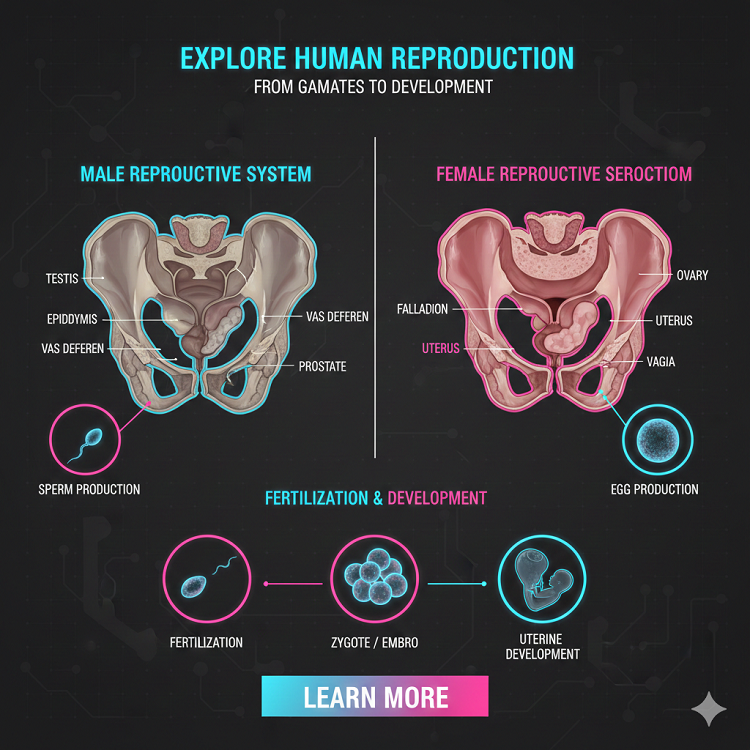
The human reproductive system is a biological system that is very complex and it is in charge of the production, nurturing and transportation of the cells that are needed to sustain the human life. Although its major role is in reproduction, the system has significant functions in hormone regulation, physical growth, and health. Knowledge on the structure and function of the reproductive system will assist people to learn more about the body, enhance reproductive health literacy and make informed decision making regarding wellness.
This article presents a factual breakdown of both the male and female reproductive system in a clear and understandable way, the organs present in the body and how they interact to aid in fertility, growth and continuation of life.
At the completion of this guide, the reader will have a full picture on the reproductive anatomy, the processes involved in the human development and the significance of reproductive health.
Learning about the Human Reproductive System
The reproductive system of the human being facilitates the reproduction of children by meant of sex. The reproductive system is quite different between males and females unlike most other organ systems with both of them having distinct structures that complement each other.
Important Functions of the Reproductive System
- The generation of reproductive cells (sperm in men, eggs in women).
- Enabling fertilization
- Promoting fetal growth (in females).
- Synthesizing sex hormones which spur sexual growth and reproduction.
- Favouring physical development in puberty.
Both the male and female reproductive systems are different in their structure yet both contribute to the potential of life.
Reproductive System in Men
The male reproductive system is structured in such a way that it generates sperm, ferries it and injects it into the female reproductive system to fertilize the female. It is composed of external and internal organs that have a particular role.
External Male Reproductive Organs
- Penis
The penis is a urinary as well as a reproductive organ. It consists of an erectile tissue that becomes full of blood upon arousal therefore facilitating penetration during sexual intercourse. The urethra is also found in the penis, and it is the pathway of urine and semen (but never simultaneously).
- Scrotum
The scrotum is a bag shaped skin in which testes are located. Its major role is to regulate temperature. The production of sperms needs a low temperature of 2-3C compared to the body internal temperature, therefore, the scrotum swells or shrinks to stabilize the body temperature at the right temperature.
Male Internal Reproductive Organs
- Testes
Testes (or testicles) are the test gonads of the male. They produce:
- Sperm
- Testosterone, the hormone that makes men develop sexually and libido.
Seminiferous tubules are tightly coiled inside each testis and here, the production of sperm (spermatogenesis) takes place.
- Epididymis
The epididymis is a tube that is coiled and long and connected to the testes. Here the sperm become mature and acquire the ability to move to the point where they can be ejaculated.
- Vas Deferens
It is a muscular tube that carries mature sperm in the epididymis to urethra. It contracts during ejaculation to shoot sperms forward.
- Seminal Vesicles
These glands secrete a fluid rich in nutrients and it constitutes a considerable part of semen. Sperm is supplied with energy by fructose that is contained in this fluid.
- Prostate Gland
The semen is augmented with a milky, alkaline secretion of the prostate. This is a fluid that supports the sperms against the acidic conditions of the female reproductive tract.
- Bulbourethral (Cowper’s) Glands
These glands excrete a lubricating fluid which is clear before ejaculation. This fluid is used to counter any remaining acid in the urethra.
Uses of the Male Reproductive System
Its major functions are:
- Sperm Production: It is a continuous production ever since puberty.
- Production of Hormones: Testosterone is what enhances muscle build, hair on the face, deepening of the voice, and sexual motivation.
- Fertilization Facilitation: Sperm is delivered by means of erection and ejaculation.
The male reproductive system is designed to be efficient with production and delivery of sperms being well synchronized.
The Feminine Reproductive System
The female reproductive system plays the role of production of eggs, fertilization, sustaining pregnancy, and birth. It has organs that are used to nurture and develop a fetus unlike the male system.
Nevada Vulvae (External Female Reproductive Organs)
The external structures of the vulva are:
- Mons Pubis
This is a fatty area over the pubic bone which is the cushioning during sexual intercourse.
- The Majora and Minor labia
These skin wrinkles shield internal organs and help in providing lubrication glands.
- Clitoris
One of the most sensitive organs in the body that has some of the highest concentration of nerve endings. It takes the centre stage in sexual pleasure.
- Vaginal Opening
The mouth of the vagina which is used in menstruation, sexual intercourse and childbirth.
Internal Female Reproductive Organs
- Vagina
A canal, muscular, and flexible which has several uses:
- Vaginal outlet of menstrual blood.
- Penis receptacle during intercourse.
- Birth canal in childbirth.
It increases and decreases its size of the walls to facilitate sexual activity and delivery.
- Cervix
The lower component of the uterus that leads to vagina is referred to as the cervix. It secretes cervical mucus which alters in consistency with the menstrual cycle to prevent or permit entry of the sperm.
- Uterus
The uterine area where a fertilized egg implants and forms a fetus is a pear-shaped muscular organ.
The uterus has three layers:
- Endometrium (inner lining which becomes thick and sheds in menstruation)
- Myometrium (muscular intermediate layer)
- Perimetrium (external protective coating)
- Fallopian Tubes
The ovary is connected to the uterus by each fallopian tube. Fertilization normally takes place at this point. Small hairlike features (cilia) assist in the movement of the egg to the uterus.
- Ovaries
Female gonads are the ovaries. They:
- Release eggs (ovulation).
- Both average production of estrogen and progesterone.
These hormones control menstrual cycle, pregnancy and development of female sexual characteristics.
Female Reproductive System: Functions
Women reproductive functionality encompasses:
- Production of Eggs: The number of eggs that a female is born with is a lifetime supply.
- Regulation of Menstrual Cycle: Hormones regulate ovulation and uterine preparation.
- Fertilization: Fallopian tubes furnish with the environment of the fusion of sperm and eggs.
- Pregnancy Support: The life-time of the fetus in the uterus is about 40 weeks.
- Childbirth: the child is pushed out of the womb by uterine contractions.
Fertilization and Early Development
By learning the mechanics of the male and the female reproductive system, one can gain knowledge of the origin of human existence.
The Fertilization Process
Sperms move via the cervix to the uterus and the fallopian tubes during sexual intercourse.
- When there is an egg, one of the sperms invades the egg.
- The egg is fertilized to produce a zygote.
- The zygote splits and goes to the uterus.
- It lodges into the endometrium, and the process of pregnancy begins.
- Hormonal Controlled Reproduction.
Reproductive functions are controlled by hormones produced by the ovaries, testes, thyroid, and the brain.
Key Hormones
- FSH ( Follicle-Stimulating Hormone): Promotes the production of eggs and sperm.
- LH (Luteinizing Hormone): Activates ovulation in the female gender and testosterone synthesis in the male gender.
- Estrogen and Progesterone: Control pregnancy and menstruation.
- Testosterone: Testosterone impacts the production and development of sperms in males.
When these hormones do not go out of balance, then the reproductive system becomes efficient.
Puberty The Developmental Turning Point
The puberty stage is the age when the reproductive organs are developed and become operative.
Changes in Males:
- Increased facial and body hair.
- Voice deepening.
- Increase in muscle mass.
- Testes swell up and sperm production starts.
Changes in Females:
- Breast development
- Widening of hips
- Onset of menstruation
- Development of body hair
Puberty is the transition between childhood and reproductive functioning.
Popular Reproductive Health Issues
Knowledge about the reproductive anatomy helps to recognize problems at an early stage.
Male Health Concerns:
- Erectile dysfunction
- Prostate enlargement
- Low testosterone
- Infertility
Female Health Concerns:
- Polycystic ovary syndrome (PCOS).
- Endometriosis
- Menstrual irregularities
- Infertility
Shared Concerns:
- Sexually transmitted diseases (STDs).
- Hormonal imbalances.
- Reproductive organ cancers.
Financing Reproductive Health
Reproductive functioning is defended by healthy habits.
- Nutrition
A well-balanced diet facilitates hormone production and fertility.
- Hydration
Water assists in the transportation of hormones and nutrients.
- Physical Activity
Workout enhances hormonal equilibrium and flow.
- Stress Management
Stress changes sex hormones and may even interfere with fertility.
- Safe Sexual Practices
Protection thwarts infections that may be harmful to reproductive organs.
- Regular Health Checkups
Screenings aid in the identification of abnormalities at an early stage.
Conclusion
Human reproductive systems constitute complex and vital networks that help us to perpetuate life. A closer look at the construction and functioning of the female and male reproductive organs makes us better appreciate how the body creates, defends and supports life. The knowledge of this system is also able to enable individuals to gain control of their reproductive lives, make wise choices and stay well throughout their lives.