Introduction
Human communication has a rich history which captures one of the greatest accomplishments of human beings, which is the capacity to maintain, disseminate and accumulate knowledge across generations. Since the dawn of oral storytelling to the invention of written texts and the subsequent emergence of print culture, every single step in this progress radically transformed how people gained, processed and shared information. Knowing how communication has evolved as the oral story telling to the written manuscripts provides a deep insight into the way societies organized knowledge, organized education and developed the ability to think critically. The article follows the evolution of human communication considering how each of the stages changed the development of literacy, learning, and society.
Oral Tradition: The Knowledge Sharing Basis
Oral Tradition Characteristics
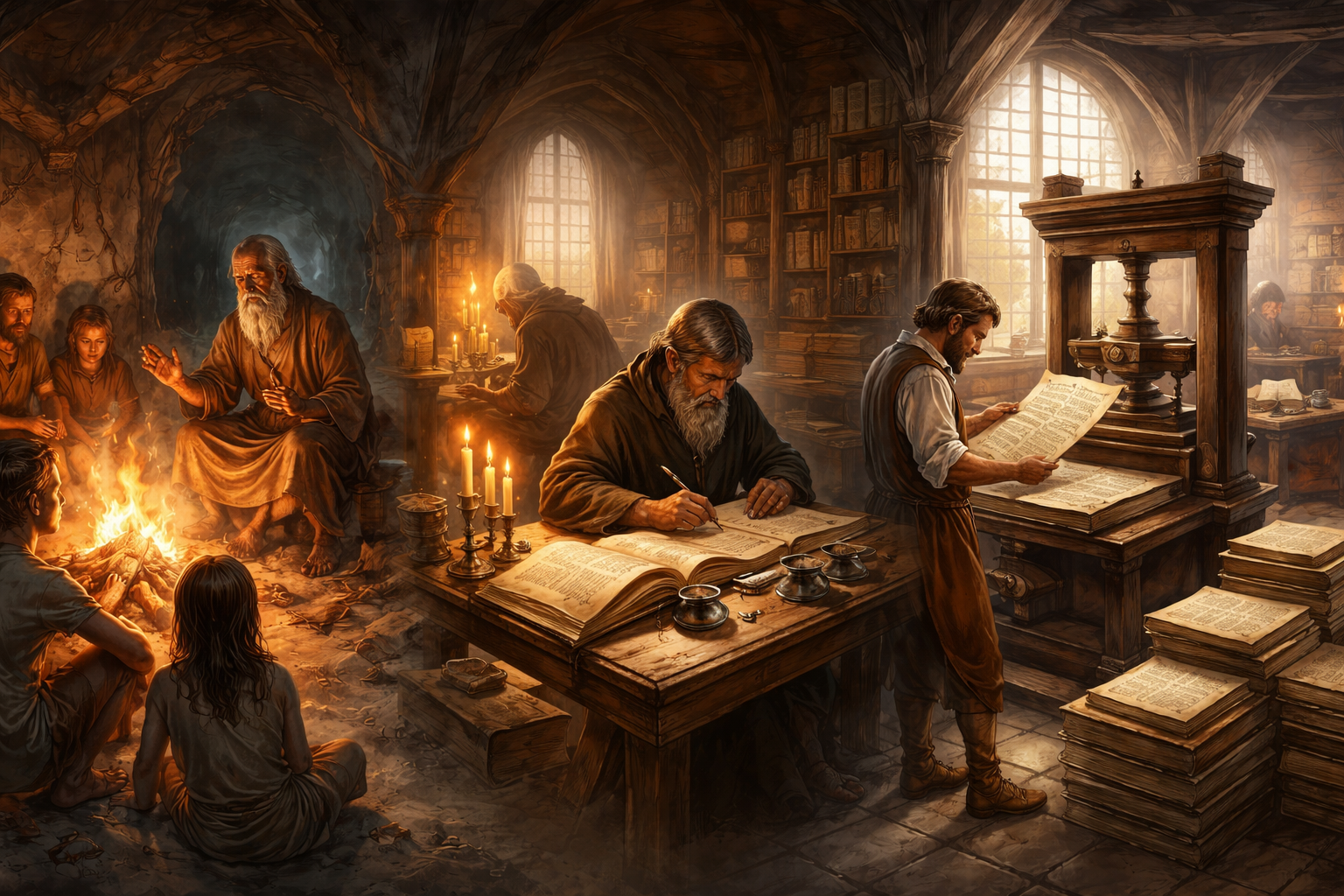
The oral storytelling is the earliest and the most basic form of communication of humanity. In the pre-writing age, people used to pass information, history and cultural values by word, songs, chants and ritual performances. Stories were frequently committed to memory, with repetition, rhyme, rhythm and storytelling technique used to enable a person to recollect information with time. Considering that, the epic poems of early Greece, including The Iliad and The Odyssey, had to be memorised by bards over a long time before they were written down, there was a period in history when the knowledge of oral history was transmitted orally.
There was a high level of interaction in oral traditions. The storytellers had direct interactions with the audience and they would change their stories according to their reactions. This dynamic nature made the stories up to date to the needs of a community as well as cementing the communal relationships. The knowledge transmitted orally was not a fixed set of knowledge that remained the same every time it was retold but it changed and added new lessons, cultural norms, or political remarks.
Impact on Society
Oral tradition was not just entertainment, it was the support of education and social integration. Cultural information, moral teachings and history were taught by the elders and professional story tellers. This approach had a strong focus on memorization, active listening, and interpretation capabilities. Nonetheless, the use of memory exposed information to distortion over time causing gaps of accuracy and historical record.
In spite of these shortcomings, oral traditions encouraged the critical thinking and participatory learning. Societies interpreted, discussed, and used lessons through narratives, usually through a process of dialogue or acting. Oral storytelling was also in many cultures a way of creating a shared identity, and people were brought together by the common memory and shared narratives.
Switching to Written Manuscripts
Invention of Writing systems
The invention of writing was the breakthrough in human communication. The Sumerians of Mesopotamia, Egyptians of the Nile and Chinese of the Yellow River were the first to devise a method of information preservation by means of symbols and pictographs and primitive alphabets. An example of this is the Sumerians who wrote their trade transactions and laws on clay tablets using cuneiform writing and the Egyptians who wrote on papyrus and walls of tombs in hieroglyphics to store religious and cultural information.
Oral storytelling was not permanent as writing. It enabled the knowledge to live longer than the lifespan of human beings making it a more reliable source of record to the future generations. Manuscripts turned into means of legal codification, religious traditions, history, philosophy, and so on, which slowly formed societies with an organized governmental structure and organized education.
Merits of Written Manuscripts

The written manuscripts changed the way knowledge was preserved and disseminated. In contrast to oral storytelling, which relied on the human memory and the immediate attention of the audience, manuscripts provided physical evidence, which could be learned, consulted with, and examined in the future period. Scholars might read and read the same text, discover contradictions and make notes or commentaries or develop the same ideas, which led to intellectual progress.
It is also during this time that special education started. Literacy was a skill that was recognized to belong to specific social categories, that is, scribes, priests, and scholars. With the written form of knowledge, societies were able to develop more rigorous intellectual traditions, which are akin to philosophy, science, mathematics, and literature. Manuscripts developed into platforms of criticism, discourse and systematic learning.
Societal Implications
The era of manuscripts liberalized the intellectual boundaries as well as influencing social formations. The authority of knowledge was less oral and was more based on documented sources. The historic precision, legal responsibility, and scientific research became possible through written texts. Simultaneously, the elites could often have access to manuscripts and thus, there was a hierarchy of knowledge. However, this era established the basis of learning institutions including libraries, academies and schools which institutionalized the study of literacy and critical thinking.
The Advent of Print Culture
The Printing Press was Invented
There was one of the most revolutionary inventions of all time in human history, a movable-type printing press invented by Johannes Gutenberg in the 15th century. It was a breakthrough that enabled mass production of books and it cut drastically on cost as well as time taken in producing books. It was the first time that texts could be circulated widely without being limited to the local scribes or elite scholars, and made information democratic.
Not only did the printing press increase the supply of books but it also normalized the content. In the past, handwritten manuscripts were notorious in having variations because of errors of copying or even deliberate alterations. Consistency and reliability was guaranteed through printed texts, a necessity in the education, legal systems, and in scholarly work.
The Effects on Literacy and Education
Print culture was a significant influence in education and literacy. As books became affordable and accessible literacy rates started to increase among the social classes. The use of standardized texts made standardized instruction easier as schools were able to teach a large number of students at once. Self-directed learning, independent research, and critical inquiry were also promoted by the means of having printed materials, producing a smarter and more critical population.
Moreover, knowledge was no longer limited within geographical borders due to print culture. The concepts that were previously limited to the local population or intellectual circles had the opportunity to spread across the world, affecting remote cultures and encouraging intellectual exchange globally. It was also a period of emergence of a real interconnected knowledge economy.
Intellectual and Cultural Changes
Printing press was a key factor in the transformation of culture and intellectual life. It gave rise to great movements like the Reformation that used to propagate religious ideologies fast; The Scientific Revolution, which facilitated the spread of empirical studies and the Enlightenment that advocated reason and individual rights. The experts would be able to talk and argue over publications, interpretations, and challenge the authorities. Evidence-based reasoning was valued more by the society, as opposed to tradition or oral authority.
The artistic and literary expression was also affected by the print culture. Writers were able to access more audiences, standardize literary genres and preserve the creative work to the future. The recording and dissemination of ideas across large numbers of people changed the way people talked and this led to the emergence of journalism, encyclopedias and academic publications.
Comparison and Analysis of Communication Stages
Preservation of Knowledge
- Oral Tradition: Relied on the memory, could change and lose during generations.
- Manuscripts: Physical and permanent, but few and few.
- Print Culture: Replicable and highly disseminated so that it is preserved over time and made available.
Accessibility and Literacy
- Oral Tradition: Information that is known only to immediate groups, which is based on oral interaction.
- Manuscripts: The preserve of literate elites who only assisted in specialized education and not the general populace.
- Print Culture: It is available to a large audience, encouraging mass literacy, education and social involvement.
Critical Analysis and Interpretation
- Oral Tradition: Interpretive and interactive, but lacks systematic criticism.
- Manuscripts: Annotation, comparison, and structured scholarly discussion.
- Print Culture: Promotes analysis, debate, and distribution of various opinions, including those held by other individuals in the world or other parts.
Conclusion

The history of communication as a system of oral narration and then the written manuscripts and finally a print culture reminds humanity of their insatiable desire to preserve knowledge, share, and criticize it. All these phases had their own advantages: oral tradition fostered memory, analytical thought, and social integration; manuscripts made things permanent, and systematic study as well as scholarly criticism; print culture democratized knowledge, spread literacy, and became the catalyst of intellectual revolutions.
The knowledge of such transformation shows how such communication influences education, critical thinking, and development in the society. With the shift to a digital age human beings still use the insights of oral, manuscript and print cultures to inform the recording, sharing, and consumption of knowledge. The historical journey of spoken word to printed page emphasizes that communication has always been a strong tool to influence culture, learning and development.