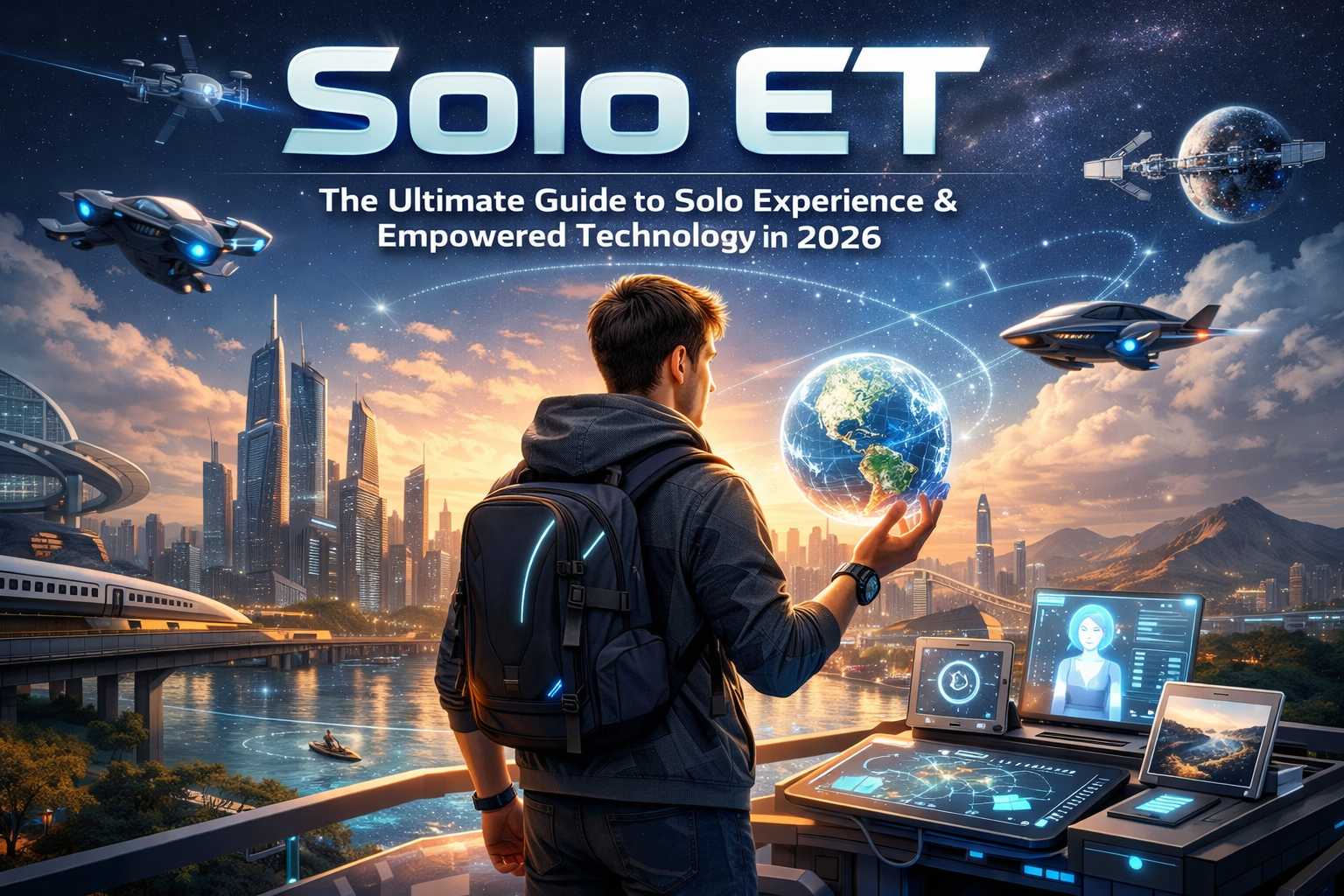
In 2026, the way individuals work, learn, create, and achieve goals online has fundamentally shifted. Gone are the days when powerful digital tools were exclusive to teams or organizations — now, Solo Experience Technology (Solo ET) empowers individuals to accomplish complex tasks independently, with autonomy, personalization, and efficiency.
Whether you’re a freelancer, a self‑learner, a solo creator, or someone who thrives on independence and control, Solo ET represents the next frontier in digital empowerment.
What Is Solo ET?
Solo Experience Technology — commonly abbreviated as Solo ET — refers to digital tools, platforms, and systems designed explicitly for the individual user rather than teams or organizations. These tools eliminate the cognitive and operational overhead that often comes with collaborative systems, enabling one person to plan, execute, create, learn, and innovate without reliance on others.
At its core, Solo ET emphasizes:
- Personal control and autonomy
- Streamlined, user‑centric design
- Adaptive interfaces tailored to individual needs
- Integration of AI, automation, and smart personalization
Unlike traditional collaborative software that focuses on shared permissions, dashboards, and coordination, Solo ET tools are optimized for one operator — reducing noise, distraction, and unnecessary complexity.
Solo Experience vs. Solo Empowered Technology
While the term “Solo Experience Technology” focuses on how tools are designed (for individual use without team dependencies), “Solo Empowered Technology” highlights the purpose: enabling individuals to leverage technology to achieve professional and personal goals on their terms.
Why Solo ET Matters in 2026
Over the last decade, and especially since 2020, digital behavior has shifted dramatically. Remote work, the gig economy, creator platforms, and AI‑driven tools have combined to make solo operation — rather than team dependency — an increasingly viable and desirable mode of work.
Here’s why Solo ET matters now:
The Rise of Solo Work, Learning, and Creation
The global freelance workforce has exploded in recent years. In 2025, there were approximately 1.57 billion freelancers worldwide, representing nearly half of the global workforce and contributing trillions to the global economy.
Freelancers are not just part‑timers — many are full‑time operators earning competitive incomes, benefiting from flexibility and autonomy that conventional jobs often lack.
At the same time, solo creators — YouTubers, designers, writers, and digital entrepreneurs — are using Solo ET tools to build independent businesses without the overhead of teams.
Cultural & Technological Shifts
Remote education, self‑paced learning, and the rise of digital nomad lifestyles have accelerated Solo ET adoption. As learning moved online, platforms like Duolingo and Coursera enabled millions to study at their own pace — exemplifying Solo ET in action.
Digital tools no longer just support productivity — they enhance personal agency.
Solo ET and Personal Empowerment
Solo ET empowers individuals to:
- Make decisions independently
- Work without approvals and shared permissions
- Control personal workflows
- Build entire businesses solo
- Learn new skills at their pace
This increased agency leads to greater satisfaction, creativity, and long‑term growth potential.
Core Components of Solo ET
To fully grasp Solo ET, it helps to look at its foundational elements.
Single‑Operator Workflows
At the heart of Solo ET are workflows designed specifically for one individual. Rather than managing teams, Solo ET platforms let a single user plan, track, and execute every step of a project without dependency on shared calendars, permissions, or team boards.
For example, a project manager designed for solo work allows one person to manage deadlines, reminders, and goals without clutter from team messages.
Experience Technology and Adaptive Interfaces
Solo ET tools are smart: they adapt to individual behaviors, preferences, and goals. This can include:
- Interfaces tailored to how you work
- Recommended shortcuts based on usage patterns
- Personalized dashboards that evolve with usage
Unlike generic interfaces aimed at teams, adaptive design focuses on minimizing cognitive load and maximizing momentum.
Practical Tools and Devices
Solo ET includes:
- Mobile‑friendly productivity apps
- Local‑first software that emphasizes privacy
- Cross‑platform syncing for seamless use
- AI‑enhanced automation tools
These enable users to work efficiently whether online or offline, on desktop, tablet, or smartphone.
Common Solo ET Applications
Solo ET isn’t a niche concept — it’s already embedded in many everyday technologies.
Productivity Tools for Individuals
Apps like Notion, Trello (solo mode), and Obsidian have become staples for solo project management. These tools allow individuals to:
- Organize tasks
- Track progress
- Store documents
- Use templates and automation
All while maintaining an interface that caters to one user’s pace and priorities.
Self‑Paced Learning Platforms
Solo ET shines in education. Platforms like:
- Duolingo
- Coursera
- Khan Academy
enable learners to progress at their own speed, complete quizzes and modules independently, and receive instant feedback — tailored to their performance.
Solo Gaming Experiences
Gaming often exemplifies Solo ET. Single‑player RPGs and immersive titles provide experiences designed for one person — rich narratives, adaptive challenges, and personalized progression systems that don’t rely on online competition.
Content Creation and Media Tools
Solo creators now have professional‑grade tools at their fingertips:
- Canva for graphic design
- CapCut for video editing
- Replit for coding
- AI assistants for content generation
These replace the need for a team by enabling individuals to produce high‑quality work independently.
In fact, a recent Adobe survey found that 86% of global creators use AI tools in their creative workflows, with 81% believing AI enables content they otherwise couldn’t produce alone.
The Evolution of Solo ET
To understand Solo ET’s significance, it helps to look at how it evolved.
Early Development (2010s & Indie Tools)
The concept began forming in the early 2010s with the growth of independent tools designed for personal use — minimalist productivity apps, offline‑first software, and early e-learning platforms.
These tools prioritized simplicity, low cost, and individual ownership.
Post‑2020 Acceleration (Pandemic Era)
The COVID‑19 pandemic accelerated digital adoption across remote work, education, and freelancing. People who were once part of corporate teams started working independently — and required tools that supported that transition.
The result? A surge in solo usage of digital platforms.
Modern Maturity with AI & Personalization
In 2026, Solo ET has matured with advancements in AI, UX design, and cross‑device sync. Tools now offer:
- AI‑powered personalization
- Habit‑based recommendations
- Predictive content suggestions
- Automated workflows tailored to individual style
This evolution means Solo ET tools are not just digital assistants — they are personal collaborators.
Benefits of Using Solo ET
Solo ET offers numerous advantages for individuals seeking independence and focus.
Full Autonomy and Faster Workflows
Solo ET tools eliminate waiting for approvals, feedback, or permissions. This enables individuals to iterate quickly, make decisions autonomously, and retain full ownership of their processes.
Personalized User Experience
Adaptive Solo ET interfaces tailor themselves to user behavior, creating an optimized experience that reduces friction. Whether it’s recommendations based on usage patterns or custom layouts, personalization enhances efficiency.
A 2025 survey showed that over 90% of young professionals want AI that adapts to their individual style, calling attention to personalization as a key need in modern digital tools.
Lower Costs and Enhanced Privacy
Solo tools typically offer pricing plans focused on individual users rather than expensive team plans. This makes Solo ET both affordable and privacy‑focused, as there’s less reliance on cloud‑wide data sharing.
Focused Learning and Creative Freedom
Without collaborative distractions, Solo ET empowers deeper focus and uninterrupted creative output — boosting learning retention and amplifying creativity.
Solo ET vs Collaborative Systems
While collaborative tools excel in team environments — offering shared calendars, group chat, and coordinated workflows — Solo ET is optimized for one person’s experience:
- Solo ET reduces noise and distractions
- Collaborative tools prioritize shared visibility
- Solo ET enhances flow and personal momentum
Both systems have their place, but for independent work, Solo ET provides streamlined experiences uniquely suited to individual priorities.
Getting Started with Solo ET
Whether you’re new to Solo ET or want to optimize your workflow, here’s a practical roadmap.
Identify Your Use Case
Decide which area you want to apply Solo ET:
- Productivity
- Creative production
- Self‑learning
- Gaming
Each use case will guide your tool selection and workflow setup.
Choose the Right Tools
Some recommended tools by category:
Productivity: Notion, Trello
Learning: Duolingo, Coursera
Creation: Canva, CapCut, Replit
AI Assistance: ChatGPT and similar
Choose tools that prioritize simplicity, individual control, and personalization.
Set Up Your Workflow
Install tools, configure preferences, create templates, and set goals. An effective Solo ET workflow should be intuitive, measurable, and flexible.
Track, Optimize & Evolve
Review your workflow regularly. Track progress, eliminate unused tools, and refine settings to improve efficiency and satisfaction.
Challenges of Solo ET (And How to Overcome Them)
While Solo ET offers many benefits, it also presents challenges.
Isolation & Lack of Feedback
Working alone can feel isolating. Combat this by engaging in online communities, using AI assistants for feedback, or scheduling occasional peer check‑ins.
Tool Overload and Complexity
Too many tools can create confusion. Audit your stack monthly — keep only what you use — and start with minimal setups before expanding.
Motivation & Consistency
Without external accountability, motivation can wane. Use streak tracking, gamification elements, and routine reviews to stay consistent.
Security, Privacy & Cost Considerations
Solo ET tools vary in security and data policies. Choose tools with transparent privacy practices and prioritize local storage or offline modes when possible.
Solo ET for Different User Types
Solo ET isn’t one‑size‑fits‑all. Different individuals use Solo ET in diverse ways:
- Freelancers: project, billing, task automation
- Students: adaptive learning, skill building
- Creators: media, writing, design tools
- Developers: prototyping, coding environments
- Neurodivergent users: focus and customization
Each user type benefits from Solo ET’s focus on personalization and autonomy.
Real‑Life Examples and Case Studies
Solo YouTuber Workflow
A YouTuber may use CapCut for editing, Notion for planning, and AI tools for script generation — all without a team.
Digital Nomad Consultant
A consultant working while traveling uses Solo ET to manage client work, billing, and content creation on a tablet.
Self‑Learner Code Project
A learner uses Replit to code projects, online tutorials for guidance, and AI helpers for debugging — entirely independently.
The Future of Solo ET
Looking ahead, Solo ET will be shaped by three major trends:
AI‑Powered Personalization
AI will learn routines, suggest schedules, automate repetitive tasks, and offer creative insights tailored to individuals.
Personalization will be one of the most sought‑after features in future Solo ET tools.
Mixed Reality and Immersive Workspaces
AR and VR could create solo digital workspaces where environments adapt to tasks, blending physical and digital productivity.
Biometric & Mood‑Responsive Interfaces
Biometric data (heart rate, facial expressions) may one day help systems adapt interfaces in real time, optimizing focus and well‑being.
Responsible and Sustainable Use of Solo ET
Solo ET should enhance life, not cause overwhelm. Responsible use includes:
- Setting clear boundaries
- Avoiding unnecessary tool clutter
- Choosing tools with strong security
- Balancing solo independence with occasional collaboration
Finding harmony between independence and well‑being ensures long‑term success.
Conclusion
Solo Experience Technology (Solo ET) is not a passing trend — it is a foundational shift in how individuals interact with technology, craft careers, and pursue growth independently.
From learners to creators, freelancers to developers, people are increasingly empowered to build, innovate, and grow without reliance on teams. By adopting Solo ET thoughtfully — choosing the right tools, optimizing workflows, and balancing solitude with social support — individuals can unlock remarkable productivity, creativity, and satisfaction.
Solo ET isn’t just about working alone — it’s about working smarter, with autonomy and control.
FAQs
What does Solo ET mean?
Solo ET stands for Solo Experience Technology — tools and systems designed for independent user workflows without collaborative dependencies.
Who benefits from Solo ET?
Freelancers, students, creators, developers, and anyone who prefers working independently.
How is Solo ET different from collaborative tools?
Collaborative tools are optimized for teams; Solo ET is optimized for one person’s individual workflow and experience.
Are Solo ET tools expensive?
Most are affordable and often cheaper than team‑focused alternatives due to lower pricing tiers and solo utility.
Is Solo ET safe for privacy and security?
Many Solo ET tools prioritize local storage and offline features, enhancing privacy.