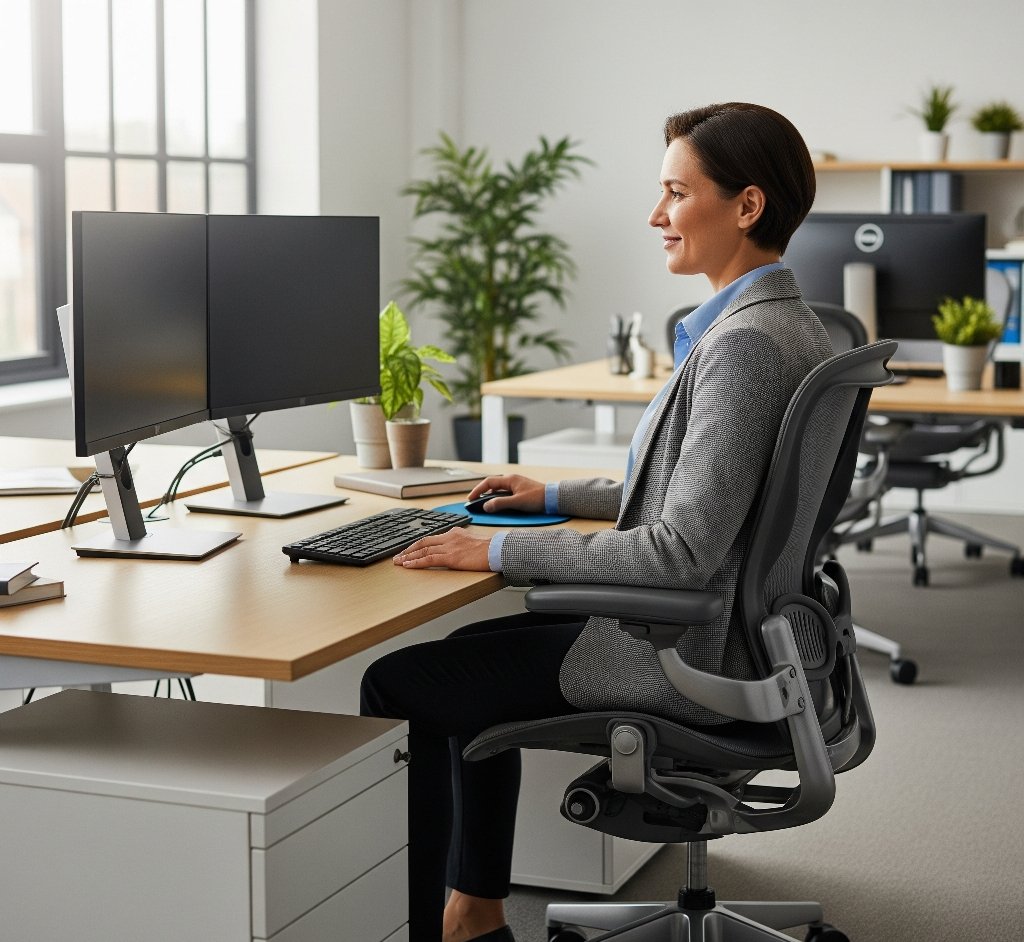
In the modern world where the pace of life is often determined by tedious work and long working days, the office chair has become the most important subject of our life. How long we sit on this chair which might be a fixed or ergonomic chair affects our back health. Although an ergonomic chair can be an effective tool on the way to the back pain elimination.
A high-end ergonomic chair is an investment in physical comfort. It can be compared as a good pair of running shoes is to an athlete. It is aimed at giving an adequate support to the lumbar area, enforcing a neutral position, and reducing pressure areas. But like an athlete, who has to stretch and train to get the best out of his equipment you must combine your chair with deliberate habits.
Just being in a nice chair without making workspace adjustments, as well as taking breaks, is like having a high-performance automobile and never changing the oil–it will eventually be crippled. As such, maintaining back health requires both a healthy piece of equipment and a healthy way of using it.
The only way to effectively strengthen your back and prevent pain is to play an active role in ensuring that your back is healthy through a set of simple, yet effective daily practices. This article will be your guide to creating a synergistic relationship between your body, daily practices and your chair, to make sure that your well-being does not come second to your professional ambitions.
The Foundation: Cultivating Posture Awareness
The initial and the most important habit to acquire is a profound feeling of your posture. There is a normal S-shape of your body that is supposed to be supported by a good ergonomic chair. It is your task to actively identify with that support
Your Guide is the Crown of Your Head: Visualize a piece of string, running through the top of your head, and tugging on it to pull you upwards. This easy image will lengthen your spine and line up your vertebrae the way they should. This is one change that can take tremendous strain off your neck and shoulders.
Shoulder Reset: All of us have the habit of slouching our shoulders ahead when we are focusing. This is a strain on the neck and the upper back. All day long, be mindful, ever so slightly, to pull your shoulders back and down, as though you were attempting to put them in back pockets. This movement opens up the chest and eliminates the slumped posture of the neck, which is also called the tech neck.
Position of Leg and Foot: Your feet should rest on the ground or footrest and your knees should be at a comfortable 90 degree angle. The position of your hips must be at the same level or a little higher than your knees.

This alignment assists in ensuring that you keep the natural lumbar curve and that you do not tuck under your pelvis which is a frequent lower back pain trigger.
The Movement Principle: Simple Stretching Routines
Prolonged static posture, even if it’s perfect, can lead to muscle stiffness, reduced circulation, and fatigue. The human body is designed for movement. Integrating simple, in-chair stretches into your workday can counteract these negative effects and keep your muscles and joints pliable.
Neck and Shoulder Release: Gently tilt your head to one side, bringing your ear towards your shoulder. Hold for 20 seconds, then repeat on the other side. Follow this with slow, deliberate neck rotations, first clockwise, then counter-clockwise. For your shoulders, simply perform a few rolls forward and then backward to release built-up tension.
Seated Spinal Twist: This is a fantastic stretch to improve spinal mobility. While sitting tall, gently twist your torso to one side, using the back of your chair for support. Look over your shoulder and hold for 15-20 seconds before repeating on the other side. This lubricates the spine and provides a gentle, yet effective stretch.
The Seated Cat-Cow: Inspired by a classic yoga pose, this stretch can be done discreetly at your desk. Inhale, arch your back, and lift your chin and chest forward (like a cow). Exhale, round your spine, tuck your chin to your chest, and pull your shoulder blades apart (like a cat). Repeat this fluid movement 5-10 times to release tension in your mid and lower back.
Hip Flexor Stretch: Our hip flexors become tight from constant sitting, which can pull on the lower back.

While in your chair, scoot to the front edge and extend one leg straight back behind you, holding onto the chair for balance. Feel the stretch in the front of your hip. Hold and repeat on the other side.
The Power of Standing and Walking Breaks
Breaking the cycle of long sitting is the most important thing you may do to avoid back pain. Just standing up and exercising even will be of great help.
The 20-20-20 Rule: The principle commonly applied to an eye, is a perfect 20-20-20-rule that your back can use. In every 20 minutes, stand up and move about at least 20 seconds. This short step is all you need to: decompressed your spine, while enhancing blood circulation to the muscles and reset the posture.
Active Micro-Breaks: Take standing as a tool of productivity. Stand up to answer phone calls, go to a colleague desk rather than send an email or choose the furthest bathroom on your level. The totality of these small actions means a considerable decrease in time spent in a sitting position.
The Standing Desk Solution: Stand desk or even a desk converter can be a game-changer especially when your workplace permits it. The secret is to interchange sitting and standing using the entire day.

Its not to stand 8 hours straight but to have an active workplace where you can periodically change your position and ease the overall load on the spine.
Optimizing Your Desk Setup for a Healthier Spine
Your ergonomic chair is the star, but it is hugely compromised by a shoddily designed workstation. The last element of the puzzle in the pursuit of an entirely ergonomic workspace is optimizing your desk arrangement.
Monitor Placement Beats All Other: The monitor is placed straight in front of you and at arm low distance. The screen must be placed between the top of eye level or a bit lower. This will stop you from straining your neck either upward or downward which is a significant cause of neck and upper back pain.
Keyboard and Mouse Performance: Your keyboard and mouse must be near your body so that you are not straining to have an overreaching performance. Your forearms are to be parallel with the floor and your elbows must be at 90degrees angle. This holds your shoulders in a relaxed state and does not cause tension to your arms and wrists which may extend to your neck and back.
The importance of a Footrest: In case you are using a chair which is too long or your feet are not resting on the ground position, then a foot rest becomes essential. It makes sure that your knees are angle right with your hips and lower back has a natural curve.
The Long-Term View: Beyond the Office
Back health does not only refer to the workplace, but it is a way of life. The office can and should be used to form good habits that you should take to your personal life.
Exercise on a Regular Basis: The exercises aimed at strengthening your core are essential in keeping your spine. Yoga and Pilates are the great activities to develop core strength and flexibility. Circulation can also be enhanced by low-impact aerobic exercises, including walking, swimming and cycling which are activities that can also make the back support muscles stronger.
Sleep Posture: This is how you sleep which can damage or benefit your back. Laying on your back with a pillow underneath your knees or on your side with a pillow between your knees will assist in the natural position of your spine. Do not go to sleep on your stomach as such a position exerts unnecessary pressure on your neck and spine.
Mindful Lifting: Be careful when lifting in any place. Whether at home or at office always employ proper lifting techniques. Bend the knees and not the back and work with your legs. This is an easy habit that can help one avoid an acute painful back injury.
An Appeal to Positive Health
Your back is a multifaceted and diligent framework that guides you through each of the activities of your day. With such little daily changes, you can change the experience of your relationship with your workplace, one that goes beyond passive tolerance to active wellness. Wait not till pain is your drive.
This week, start small by adding a single new habit, such as using a timer to remind you to take a standing break, or to remind you to check your posture. After some time, such simple everyday habits will develop a basis of strength and resilience, and the progress on the way to keeping your back healthy will be successful and long-term.