With a digital system to nearly all components of our work and our everyday life, efficiency is no longer a cardinal, but a mandatory. Be it handling files, accessing information on the internet or maintaining servers, performing repetitive tasks manually is slow. That is where the scripting languages come to the rescue. They make things easier, automate and speed up tasks that would otherwise take hours.
In this article, we discuss the existence of scripting languages, their purpose and why they are better than the traditional programming languages, as well as why learning them is one of the most viable things you can do today.
What are Scripting Languages?
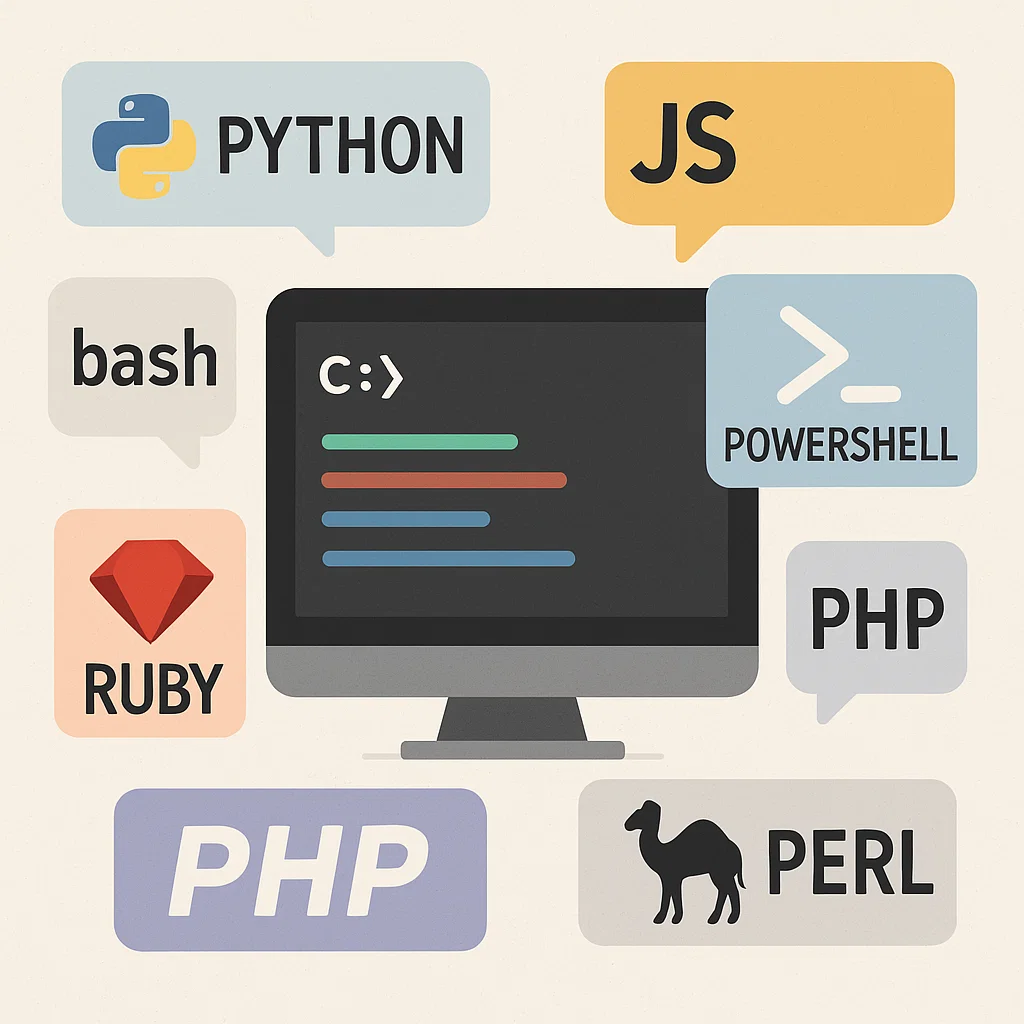
Scripting language is a form of programming language where its main purpose is to automate operations, improve the already existing software and to control systems or applications. By contrast with traditional compiled languages, in which an entire codebase is compiled to machine language prior to execution, scripts are normally interpreted by an interpreter.
In simpler terms, scripting language instructs an existing system on what to do. This system could be an operating system, web browser, database engine or a software application.
The scripting languages are common and include:
- Python
- JavaScript
- Bash/Shell
- PowerShell
- Ruby
- PHP
- Perl
Although a few of these languages (such as Python) can also be applied to larger applications, their history is in automation and fast interface to systems.
What Is the Motivation of Scripting Languages?
The scripting languages came in place to achieve more flexibility and speed in programming, particularly in those tasks that do not require sophisticated software engineering.
To Automate Tedious Processes
Prior to the emergence of scripting languages, system administrators and programmers needed to do almost all activity by hand, that is, copying files, system configuration, log scanning, and so on. It was ineffective, sluggish and error prone.
The scripts enabled them to write only once and execute instructions anytime they were required.
In order to Amend Current Software
Embedded scripts can be supported by many applications. For example:
- JavaScript is interpreted by web browsers in the context of interactivity.
- Lua scripts are utilized by game engines in gameplay logic.
- Python or R scripts are used in the data analysis tools.
Rather than re-writing software, scripts extend the functionality of the software.
To Enable Rapid Development
The fact that scripts are normally interpreted means that they can be tested instantly. You are a writer, a runner, and a tune-up-er—best suited to experimentation, automation and little programs.
To Simplify Control of Systems
Systems are analogous to glue, which is the scripts. An API can be linked to a database or an operating system to cloud service without heavy engineering.
The Difference Between a Scripting and a Traditional Programming Language
The conventional programming languages such as C, C++, and Java are used to create standalone and large scale applications. The scripting languages are designed to be fast, easy to use, and flexible.
Compiling vs. Interpreting
- Compiled languages: Code is written in machine language and executed.
- Scripting languages: The code is interpreted line by line.
This causes the scripting languages to be slow in raw performance and relatively quick in development cycles.
Use Cases
- The traditional languages create systems: operating systems, video games, browsers.
- Scripting languages are used to automate or improve systems: testing scripts, bots, automation of tasks.
Syntax Simplicity
Scripting languages tend to be shorter:
print(“Hello, world!”)
You see how many languages put together can talk.
Flexibility and Dynamic Typing
Scripting languages tend to support:
- dynamic types
- quick modification
- more convenient integration with other tools
This eases entry to new learners and accelerates the growth of professionals.
Useful Applications of Scripting Languages
So, why are scripting languages important? They save time, increase productivity and provide facilities previously not achievable in a manual environment.
Robotization of Repeating Processes

It is the most widespread and effective application of scripts.
Some of the automatable tasks include:
- Arranging and relabeling files
- Cleaning up directories
- Scheduling backups
- Performance management of the monitoring system
- Extracting data from logs
- Sharing of images or documents
Why automation matters
The same thing repeated over hours is a waste of time. What would take a human being minutes or hours to do, a script can do in seconds and will repeat the same thing again and again.
To use the example of a 20 line Python script to read a folder containing 10,000 files and sort or rename the files immediately.
Processing and Analyzing Files
Scripting languages are useful in reading, updating, and writing files of any type:
- Text files
- CSV spreadsheets
- JSON and XML
- Logs
- Images
- System configuration files
Examples of practical file-processing programs are:
- Batch-editing text
- Generating reports
- Deriving information patterns
- Merging documents
- Data pre-processing in machine learning
The in-built Python modules, Bash utilities and PowerShell Cmdlets offer immense power at very small code.
Interacting with APIs
Modern digital systems are communicating using APIs. The API interaction in scripting languages is simple, making it possible to:
- Fetch data from websites
- Send automated requests
- Incorporate third-party services (Google, Stripe, GitHub, AWS)
- Build bots
- Production of dashboards and automatic reports
Python requests module or JavaScript Fetch API enable a user to communicate with APIs with only a handful of lines.
APIs + automation = incredible productivity.
Configuration and Systems Management
Scripting languages are used to make everything manageable by system administrators whether it is a server or cloud platform.
System-management tasks that are scripted include:
- Installing software
- Updating packages
- Managing user accounts
- Monitoring performance
- Deploying applications
- Setting up network parameters
- Creating scheduled tasks
Shell and PowerShell conquer this sphere, but Python is also popular in cross-platform management.
Web Development and Application Scripting
JavaScript is the engine of almost all the interactive capabilities of websites. PHP and Python are in support of back-end logic. Even scripting build tools are based on scripts.
Web development requires the following roles in scripting:
- Form validation
- Animations
- Dynamic content rendering
- Server-side logic
- Database queries
- API communication
The web is brought to life through scripting to make it interactive, responsive and intelligent.
Machine Learning and Data Science
The most popular scripting language, Python, has become the foundation of current data science.
Scripts are used by data scientists to:
- Clean datasets
- Visualize patterns
- Train machine learning models
- Automate experiments
- Deploy AI pipelines
The ease and speed with which scripting languages are developed stimulate innovation.
Automation and Game Development
A large number of game engines are script-based:
- Unity supports C# scripting
- Unreal Engine is based on Blueprints and Python
- Roblox uses Lua
Custom scripting languages are frequently embedded in-house engines.
Scripts govern the actions of characters, events, artificial intelligence and game logic without changing the nature of the engine.
Cybersecurity and Ethical Hacking
Cybersecurity professionals can use scripting languages to:
- Scan networks
- Automate penetration-testing activities
- Parse logs
- Identify vulnerabilities
- Build diagnostic tools
Python and Bash are particularly dominant here because they are fast and flexible.
The Reason Why Scripting Languages Are Better at Improving Efficiency
Learning programming languages is among the quickest methods to be more efficient—no matter your profession.
- Automated duties include the activities that you automate.
This saves time and minimizes human errors. - You work faster and smarter.
Scripts enable you to process data, run systems and implement tools within a short period of time. - You enhance ability to solve problems.
You get to know how to divide big problems into smaller automated processes. - You are useful in any technical employment.
Automation is essential in:- IT
- software development
- cybersecurity
- engineering
- data analysis
- science and research
- You lessen stress and mental fatigue.
Boring work is done by scripts and you are free to solve creative problems.
Introduction to the Art of Scripting Languages
Here is an easy route which you may take:
Step 1: Select one of the scripting languages
- Python if you are general-purpose or data-oriented
- JavaScript for web development
- Bash/PowerShell for system automation
Step 2: Learn the basics
- Variables
- Loops
- File handling
- Functions
- Basic modules
Step 3: Construct minor automation devices
Begin with things that you are already doing on a regular basis.
Step 4: APIs and work with real data
It is here that scripting works well.
Step 5: Visit advanced libraries
Each language has automation, data and system interaction tools.
Step 6: Practice consistently
Small projects practiced daily build mastery more rapidly than occasional long projects.
Summary: Scripting Languages Are Critical to Contemporary Productivity
The importance of scripting languages is that they enable us to automate numerous processes, handle massive data volumes, communicate with computer infrastructures, and manipulate data from local files to cloud infrastructure—all with little effort. They are bridging the gap between human and machines and provide people with an opportunity to command systems in a very quick and smart way.
Learning a scripting language is one of the most high-impact skills you can acquire. It will make your work quicker, cleaner, and more efficient and will open up a plethora of fields crossing the borders of web development and system administration to data science and cybersecurity.
Scripting languages are not only useful in a world where automation is the order of the day, but they are also a necessity.