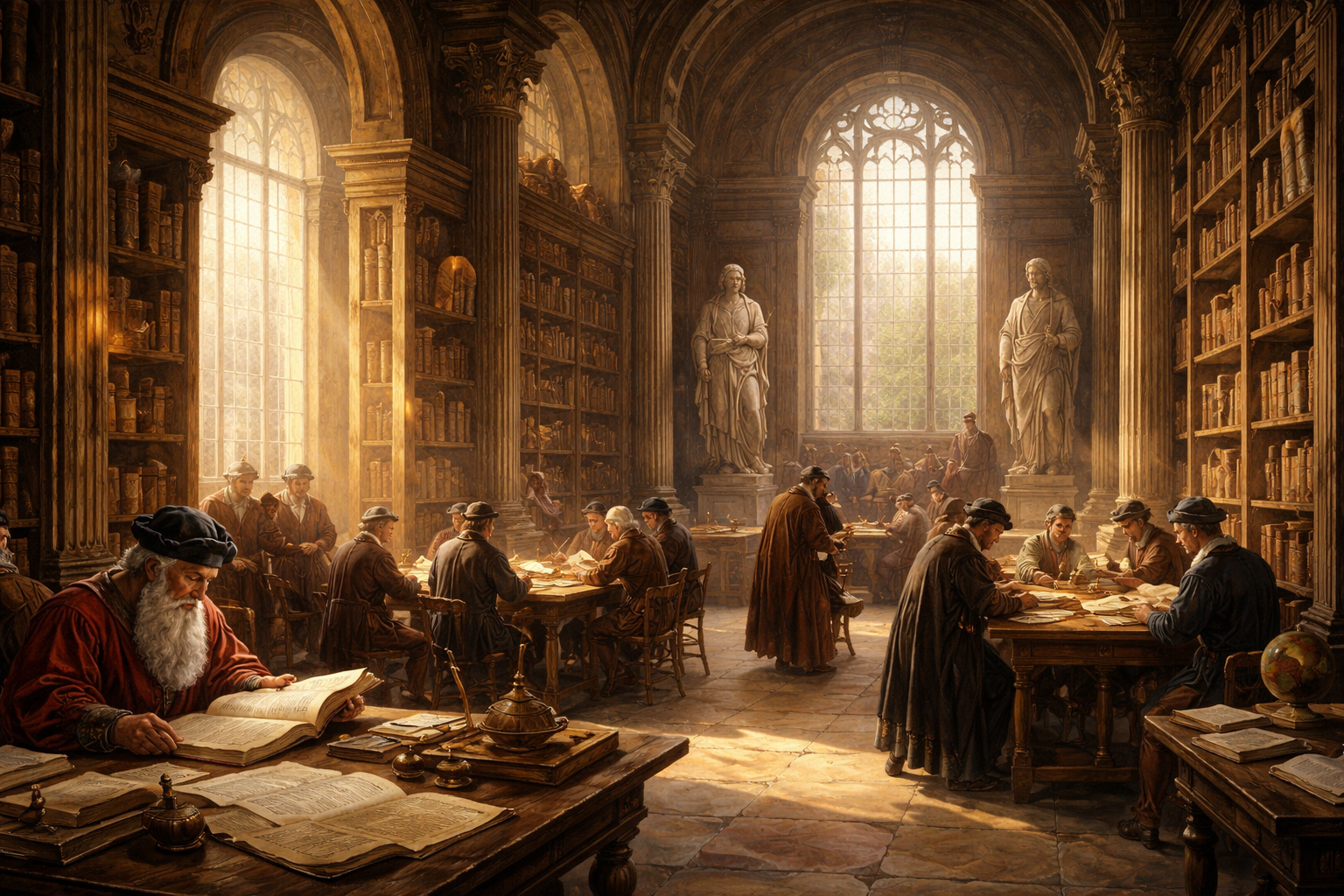
The renaissance, which occurred between the periods of approximately 14th to 17th century, is one of the most radical moments in the history of Europe. It also signified a revival in the literature, philosophy, and arts of the classical antiquity, and essentially transformed education, culture and intellectual life. The main tenet of this revival was the trend of Renaissance Humanism that favored studying classical literature and developing human potential. Humanism helped scholars of the time to bridge the gap between the wisdom of the ancient civilizations and the modern world.
Introduction to Renaissance Humanism
Renaissance Humanism was a movement of thought, which made human beings and their ability to be the focus of study. In contrast to the medieval scholastic emphasis on religious dogma and metaphysics, humanists promoted so-called studia humanitatis such as grammar, rhetoric, poetry, history and moral philosophy. These subjects were perceived not only as exercises but as a means of developing good, well-rounded virtuous people who can make a contribution to the society.
The works of ancient Greece and Rome gave inspiration to Humanism. Critical thinking and ethical reasoning were based upon the rediscovery and translation of works by such authors as Cicero, Plato, and Aristotle. Renaissance thinkers, and especially those who went back to these classical works, attempted to craft a curriculum that would put more emphasis on wisdom, eloquence and civic responsibility.
The Renaissance Thinkers and their Role in the Revival of Classical Texts

Another characteristic of the Renaissance was the attempt of the Renaissance thinkers to rediscover and study classical manuscripts. These scholars searched monasteries, personal collections and other cities miles away to find lost texts. When discovered, they translated them into Latin and Greek, thus becoming more accessible to more people.
Giovanni Boccaccio and Francesco Petrarca (Petrarch) were the pioneers of this revival in Italy. As a proponent of the notion that human beings could be great by means of learning and living in accordance with the highest virtues, Petrarch was the apostle of a classical literature study and the so-called Father of Humanism. With his works and his academic activity, Boccaccio promoted the study of antiquity even more. Their contribution preconditioned the appearance of a generation of intellectuals that tried to combine classical wisdom and modern issues.
Humanists did not just conserve ancient works they actively read and utilized them. This interest promoted critical thinking because researchers argued about the interpretation of classical texts and their ability to apply to modern life. This way, they were able to come up with a new intellectual culture that was based on reason, observation, and dialogue.
Humanism and the Revolution in Education

Education is one of the most significant effects of renaissance Humanism. The monastic schools and universities dominated in medieval education focusing on theology and memorization of the Bible. Those who supported humanism believed in a curriculum that would develop the intellect, moral judgment and eloquence.
Curriculum Reforms
The humanist educators formulated curricula which focused more on literature, history and moral philosophy. Instead of teaching Latin and Greek as languages, knowledge about the cultural and ethical wisdom of antiquity was viewed as an access point to the language. By means of rhetoric and grammar, the students got to know how to communicate effectively, developing those skills which were needed to be included in the civic and political life.
One of the brightest examples is that of Vittorino da Feltre, an Italian teacher who created a school in Mantua. He advocated total education, comprising of physical training, moral education, and classical. His method was typical of the humanist philosophy indicating that education should build character and mind to equip individuals with the capability to live good and successful lives.
Promoting Critical Inquiry
Humanist education allowed students to think independently. Instead of accepting wisdom given to them, learners were encouraged to think about readings critically, learn to compare sources, and come to reasonable conclusions. This interest in inquiry formed the foundation of both scientific and philosophical progress in subsequent centuries, and it goes to show how the humanist devotion to the study of the classics did not confine itself to literature, but spread into wider intellectual life.
Renaissance Art: Ancient Classical Influence and Humanist Expression
Renaissance Humanism was not limited to literature and education, it also changed art. The artists were moved to look at human experience, nature and emotion as sources of inspiration, inspired by classical models, as humanist principles encouraged.
Rediscovering Classical Aesthetics
Such artists as Leonardo da Vinci, Michelangelo, and Raphael learnt the proportions and forms of the ancient Greek and Roman art as well as techniques. Their aim was to present human body anatomically and with expressiveness. Classical themes such as mythology and historical events became the main theme in paintings, sculptures and architecture.
Humanist principles were evident in the focus on expressing personal ideas in art. The artists were not only interested in developing aesthetically valuable pieces of art but expressed the nobility, the sophistication, and the intelligence of humanity. Renaissance art glorified beauty and potential of man by reviving classical aesthetic and incorporating the aspect of humanism philosophy.
Cultural Flourishing and Patronage
Humanist values were also strengthened by patronage. Renaissance humanism was propagated by the efforts of wealthy people and institutions who funded artists and scholars who defended the ideals of Renaissance humanism in Florence, such as the Medici family. This patronage enabled a cultural bloom that was not restricted by the elite life, and it reflected in architecture, literature, and civic life.
Humanism and Life of the Mind
In addition to art and education, Renaissance Humanism changed intellectual life by encouraging dialogue and debate, as well as encouraging the pursuit of knowledge.
Philosophy and Civic Engagement
Questions of morality, politics and society became of great concern to Renaissance thinkers. Based on classical literature, they discussed the essence of virtue, the duty of the rulers, and the state structure. Social reform was encouraged by such figures as Erasmus of Rotterdam, and it focused on education, moral behavior, and tolerance. Humanists achieved this by connecting classical wisdom to current matters and this spearheaded the production of civil citizenship.
Scientific and Reasonable Progress
The scientific revolution was also affected by the humanist focus on observation, critical analysis, and empirical investigation. Researchers were starting to challenge previous assumptions, test them in an organized way and write about their results in a systematic manner. Such men as Galileo Galilei and Nicolaus Copernicus had the advantage of the humanist interest in evidence and rational inquiry indirectly, demonstrating how the Renaissance values were carried over into the field of scientific discovery.
Literature and Rhetoric
Humanism made literature more active and livelier through the focus on eloquence, clarity, and persuasive speech. Authors and philosophers aimed to create works that not only were intellectually sound, but which were aesthetically powerful as well. This consideration of rhetoric and expression supported the humanist principle that there was a lot of power in the language to shape thought and society.
Crossing the Boundary of Antiquity and Modernity
The Renaissance Humanism was not just a nostalgic interest in classical culture, but an active attempt to use ancient wisdom in modern life. Humanists provided a linkage between the knowledge of the past and the problems of the present by encouraging critical thinking, individual expression and communication.
This legacy is evident today. Humanist principles are still present in modern education, arts and civic institutions. These ideas about the power of the human soul, the ability to study and explore various issues, and the demand to act with ethics may be directly traced to the works by the Renaissance scholars who rediscovered classical philosophy.
Conclusion
The classical renaissance was not simply an exercise in scholarship, but it was also a revolution in culture. Humanists made it possible to redefine the concept of what it meant to be a scholar, artist, and to be engaged in the world through the prism of humanism. Recapturing the knowledge of ancient societies, they encouraged an age of curiosity, exalted the individual possibilities, and provided the roots of intellectual life of the present day. Renaissance Humanism can thus be considered as a tribute to the timelessness of classical thought to inspire, enlighten and influence society through centuries.