
Sales forecasting used to be simple: gather last quarter’s numbers, run a few spreadsheets, build a static report, and hope the predictions hold up. That approach worked when markets moved slowly, and customer behavior changed in predictable patterns.
Today, that world is gone.
Modern sales teams operate in a real-time system; buyers shift preferences every day, competitors launch new offers without warning, and global events change demand instantly. In this kind of environment, traditional static reports fail because the market keeps changing.
Real-time sales forecasting isn’t just a “nice upgrade.” It’s the operating standard for companies that want to stay ahead instead of reacting too late. And with tools that connect smarter analytics and automation, like the solutions discussed on platforms such as modern CRM-driven workflows, the shift becomes not only possible but straightforward.
Why Static Reports Hit a Wall
Static reports capture one moment. Real life doesn’t.
A typical static sales forecast is built on:
- Historical data
- Quarterly or monthly reviews
- Manual spreadsheet updates
- Individual interpretations
- Fixed assumptions about buyer behavior
The problem: none of these inputs account for what happens after the report is created.
Markets change. Pipelines shift. Reps update deals. Customers churn or upgrade.
By the time a static report reaches decision-makers, most of it is already stale.
“A forecast that can’t update itself is basically a snapshot, not a guide.”
Let’s break down the core reasons static reports fail in the modern sales environment.
1. Market Conditions Change Faster Than Reporting Cycles
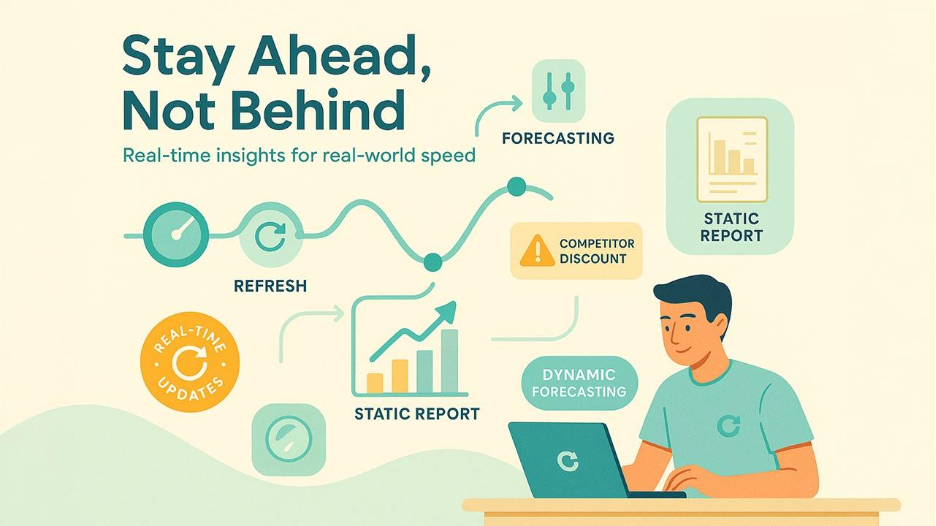
A quarterly report makes sense only if the market also moves quarterly.
But today, the change is continuous.
Example: A competitor launches a discount campaign in Week 1.
Your static report is published in Week 3 and doesn’t reflect the new drop in win probability. Then leaders have to act on outdated data, and the team misses targets.
Real-time forecasting helps in preventing that by immediately adjusting projections when variables shift.
2. Manual Data Entry Creates Blind Spots
Most reports rely on spreadsheets built manually.
That means:
- Chances of human error are there
- There may be some missing fields.
- Maybe some lag in updates
- No visibility into rep-level changes
- There is no connection to live CRM data.
Errors compound when data is touched again and again. The entire forecasting chain becomes unreliable.
By using intelligent automation tools such as CRM-integrated sales tools, businesses eliminate manual dependencies and keep analytics accurate from end to end.
3. Customer Behavior Is Not Linear Anymore
Today’s buyers behave across multiple points:
- Website visits
- Product trials
- Social interactions
- Support conversations
- Payment history
Static reports treat these behaviors as optional notes.
Real-time forecasting treats them as signals.
Machine learning models weigh these signals as they happen and increase or decrease the likelihood of conversion in real time. This shift helps companies to respond fast instead of reactively.
4. Reps Need Predictability, Not Guesswork
Sales reps today act on dozens of active conversations.
They need to have clarity about:
- Which deal is most likely to close
- Which customers need more attention
- When a prospect is heating up
- What signals indicate potential churn
Static reports can’t tell them any of this.
Those insights fade the moment new activity enters the system, which happens every day.
Real-time insights give reps confidence and focus.
And when these insights sync with powerful workflow tools like those used in platforms such as advanced pipeline automation, teams operate with far less friction.
5. Leadership Needs Accuracy for Strategic Decisions
Executives don’t just need numbers; they need foresight.
When forecasts fail, consequences ripple:
- Over-hiring
- Under-hiring
- Inventory misalignment
- Cash flow surprises
- Missed revenue targets
Static reports simply don’t give leaders the accuracy required for modern strategic planning.
Real-time forecasting provides:
- Instant updates
- Live dashboards
- Predictive scoring
- Scenario modeling
- Automatic alerts
It is not just forecasting anymore; it is operational intelligence.
How Real-Time Forecasting Actually Works
Real-time forecasting combines:
- Live data of CRM
- Advanced machine learning models
- Behavioral signals of the customers
- Tracking sales activity
- Calculating the probability of conversion
- Automated trend detection
Then our result is a constantly updating view of future revenue and opportunities that adapt as customer behavior changes.
This allows teams to make decisions with confidence and not hope.
A Practical Scenario: Why It Matters That Much
Imagine a SaaS company with a 30-day sales cycle.
Day 1: The forecast shows a strong quarter.
Day 15: A competitor drops prices.
Day 18: Churn increases slightly.
Day 19: Website trial sign-ups drop.
Day 20: Support tickets spike.
A static report won’t catch any of this until next quarter’s review.
But real-time forecasting adjusts the projection immediately, giving the team room to respond, not regret.
The Future Belongs to Adaptive Forecasting
Real-time forecasting isn’t a trend; it is the baseline for companies that want to stay competitive.
Static reports fail because the world moves faster than their assumptions.
Real-time forecasting succeeds because it respects the pace of the modern market.
With more businesses shifting to CRM-driven ecosystems and supported by platforms like modern automation systems, data-integrated CRMs, and process-efficient sales management tools, building a dynamic forecasting engine is no longer complicated or expensive.
Final Takeaway
Real-time sales forecasting is not just more accurate; it is more honest.
It tells you the truth about what is happening right now, not what happened weeks ago.
In a marketplace where timing determines advantage, that truth is everything.
Static reports belong to a slower era.
Real-time forecasting belongs to the future, and the companies that adopt it early will be the ones shaping that future, not struggling to catch up.