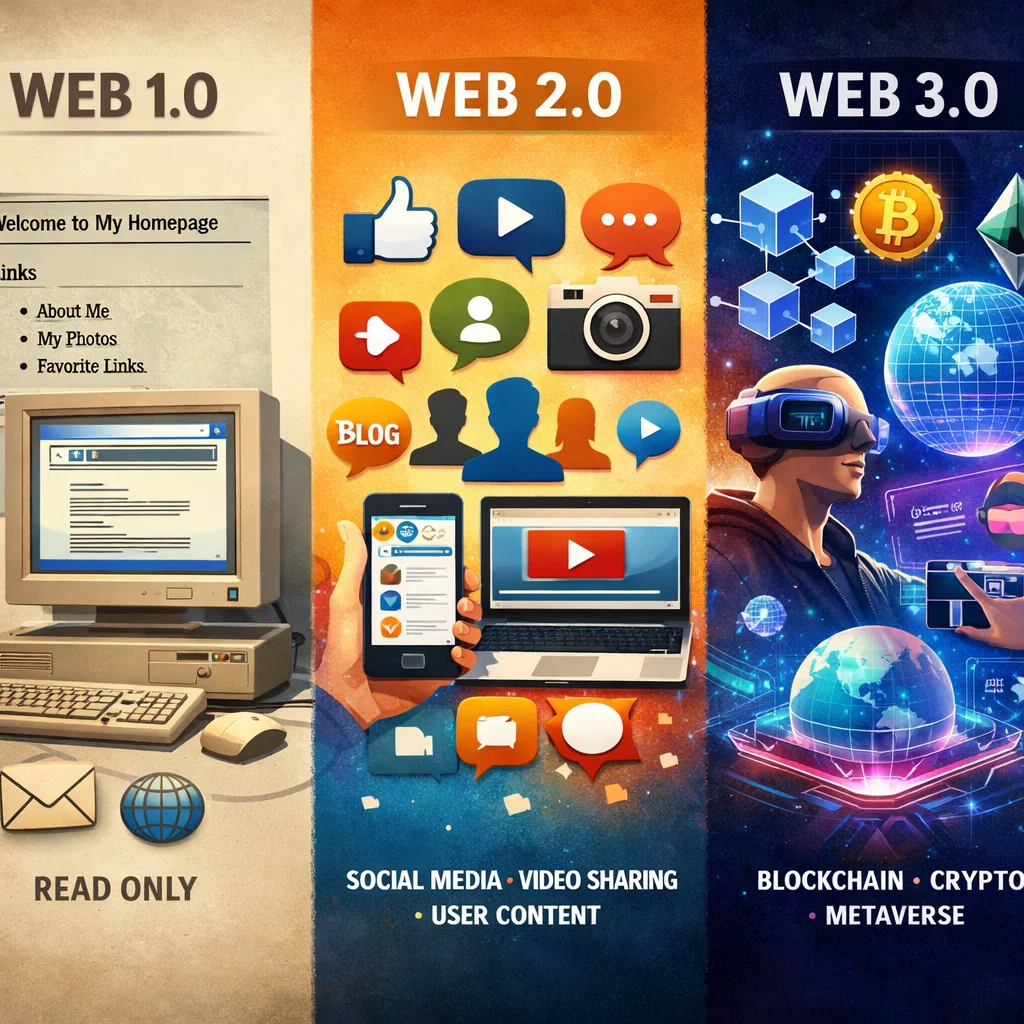
The development of web technologies has radically changed the way we get information, how we communicate with the digital environment, and how we use different platforms. Starting with the more stagnant and earlier days of Web 1.0, moving on to the more dynamic and interconnected Web 2.0, and now to the emergence of decentralized systems in Web 3.0, each stage brought about a radical innovation. This paper examines this experience and illuminates the transforming nature of the web, and how user interaction, ownership of data, and technologies such as blockchain have defined the present and forthcoming of the internet.
Introduction: Historical Overview
The World Wide Web has tremendously developed since it was made in the late 20th century. Initially as a mere platform to provide information that is in a fixed form, it has now become a complex, decentralized and interactive place. This trip through the history of web technologies has been propelled by the blistering development of the technology, the necessity of more advanced user experiences, and the increasing demand of decentralized systems, which offer a better control of the data.
In order to see this development, we have to look at three key stages:
- Web 1.0: The Static Web.
- Web 2.0 The Social and Interactive Web.
- Web 3.0: The Decentralised Web.
We can have a closer look at each phase.
Web 1.0: The Static Web (Early 1990s to Early 2000s)
Web 1.0 is the earliest period of the World Wide Web which mainly comprises static pages. It was the era of simple, text-based, and informational websites. This stage is commonly known as the read-only web, in which the user did not interact with content much.

The main characteristics of Web 1.0:
- Statics: The websites were made of fixed HTML pages. The pages were not dynamically updated, and they showed the same information to everyone.
- Limited Interaction: Interaction was limited. People were able to read the content, and it had little feedback, sharing, and personalization.
- Non User-Generated Content: The web was predominantly a one-way communication model meaning that information was being broadcasted to the users with minimal user-generated content.
Web 1.0 Technological Environment:
- HTML: Web 1.0 was based on HTML: Hypertext Markup Language (HTML). It enabled generation of simple and text-based web pages with links and images.
- Poor Internet speeds: Dial-up connection was prevalent, thus resulting in slow internet speeds and reduced time taken to load web pages.
- Basic Browsers: The first web browsers such as Netscape Navigator and Internet Explorer were only capable of displaying simple HTML files.
Although Web 1.0 was a revolutionary factor at the time, it was restricted in its engagement with the users, as well as, the form of content that could be shared.
Web 2.0: The Emergence of Interactive Platforms (Mid-2000s to Present)
Web 2.0 is the shift of the fixed web into a more dynamic, social and user-powered web. As the broadband internet and more sophisticated technologies were introduced, Web 2.0 oriented towards the development of interactive sites and user-friendly experiences. This was the read-write web where users were no longer able to just receive content but they could add and contribute and even interact with other users.
The Web 2.0 has several key features:
- User-Generated Content (UGC): YouTube, Facebook, Twitter and Wikipedia obtained content created and shared by users, which resulted in the transition of passive consumption to active participation.

- Social Media Incorporation: Social networking sites have taken center stage in online activities. The Web 2.0 enabled people to interact, communicate, and cooperate on the international level.
- Rich User Interfaces: With the help of advanced programming languages and technologies, the web became more engaging with more dynamic graphics, animations and multimedia.
- Interactivity: AJAX (Asynchronous JavaScript and XML) and related technologies facilitated interactive web pages, which could update themselves without a complete page refresh. This resulted in the creation of more interactive and smooth experiences.
Web 2.0 Technological Landscape:
- HTML5 and CSS3: The technologies allowed more interactive and multimedia-based websites. Specifically, HTML5 made it possible to embed video, audio, and more sophisticated graphics without using such a plug-in as Flash.
- JavaScript Frameworks: JavaScript versions such as jQuery, Angular, and React have transformed web development by simplifying the process of developing responsive and interactive sites.
- Social Media and Cloud Computing: Web 2.0 witnessed the emergence of cloud applications such as Google Drive, Dropbox and even social media platforms such as Facebook and Twitter. These platforms enabled users to store, share and interact content in real time.
Web 2.0 has turned the internet into a place where individuals not only consume content, but also provide and produce content. It has however also raised the issue of data privacy and concentration of power in the hands of a number of tech giants.
Web 3.0: The Decentralized Web (The New Trend)
The next stage of the internet development is Web 3.0. It will change the face of web usage by concentrating on decentralized technologies, blockchain, and data sovereignty. Web 3.0 is yet to reach its maturity, but it is already proving itself to upset the standard ways of interaction online.

The salient characteristics of Web 3.0:
- Decentralization: Web 3.0 uses blockchain technology to establish decentralized networks where users control the network, as opposed to a central authority.
- Data Ownership: On Web 3.0, a user can own and control his or her data, unlike Web 2.0, where companies accumulate and sell user information. They are able to determine when, how, and whom to share it.
- Smart Contracts and Cryptocurrencies: Blockchain technology can support smart contracts self-executing contracts, where the terms of the agreement are directly coded into the contract. Decentralized financial transactions can be performed using the cryptocurrencies such as Bitcoin and Ethereum, which are major parts of Web 3.0.
- Semantic Web: Web 3.0 will provide a smarter web through artificial intelligence (AI) and machine learning in order to read and comprehend information in a more contextual way. The aim is to make machines learn human language and give more precise and personal experiences.
- Immersive Experiences: Web 3.0 is likely to incorporate technology such as virtual reality (VR), augmented reality (AR), and the Internet of Things (IoT) to provide more immersive and interactive web experiences.
Web 3.0 Technological Landscape:
- Blockchain Technology: Blockchain is the core of Web 3.0 that allows peer-to-peer transactions without the involvement of a trusted third party. The usage of this technology is applied to decentralized finance (DeFi) and even NFTs (non-fungible tokens).
- Decentralized Applications (dApps): dApps are in contrast to traditional apps: dApps run on a decentralized network and provide their users with control over their data and interactions. Such apps are developed based on such platforms as Ethereum and Polkadot.
- Artificial Intelligence and Machine Learning: Web 3.0 has the potential to deliver more personalized and intelligent online experiences using AI, making its recommendations more intelligent and search results more accurate.
- Interoperability: Web 3.0 will be focused on ensuring that various platforms, applications, and devices can cooperate with each other to provide users with a more integrated experience across multiple ecosystems.
The Effect of Blockchain on the Web
Blockchain is one of the most important technological advances that are fueling the Web 3.0. It is a decentralized ledger technology that allows transparent, secure, and immutable transactions, without the use of intermediaries. Blockchain can transform all aspects of finance (through cryptocurrencies) to supply chain management and digital identity validation.
Blockchain in Web 3.0:
- Data Privacy: Blockchain will enable users to have greater control over their personal data. They have freedom to determine what information to share, how to share it and with whom.
- Decentralized Finance (DeFi): Web 3.0 and blockchain are driving decentralized financial platforms, where users can borrow, lend and trade assets without financial intermediaries.
- Smart Contracts: Trustless transactions are possible with these self-executing contracts, which may shake up the industries of real estate, insurance, and legal services by automating and simplifying operations.
Conclusion: The Future of the Web
The development of web technologies between the Web 1.0 and Web 3.0 has been characterized by a massive improvement in user interaction, control of data and the emergence of decentralized systems. As we further enter into the Web 3.0 space, the internet will be more personalized, secure, and user centered. The blockchain technology will be at the center of this change, and it will provide answers to owning the data, providing security, and handling finances.
The future of the web is potentially very innovative. Web 3.0 can not only alter the way we use the internet, but also transform the very nature of the digital economy, social interaction and the way the internet is governed.
To have a more detailed history and evolution of web development, visi here.