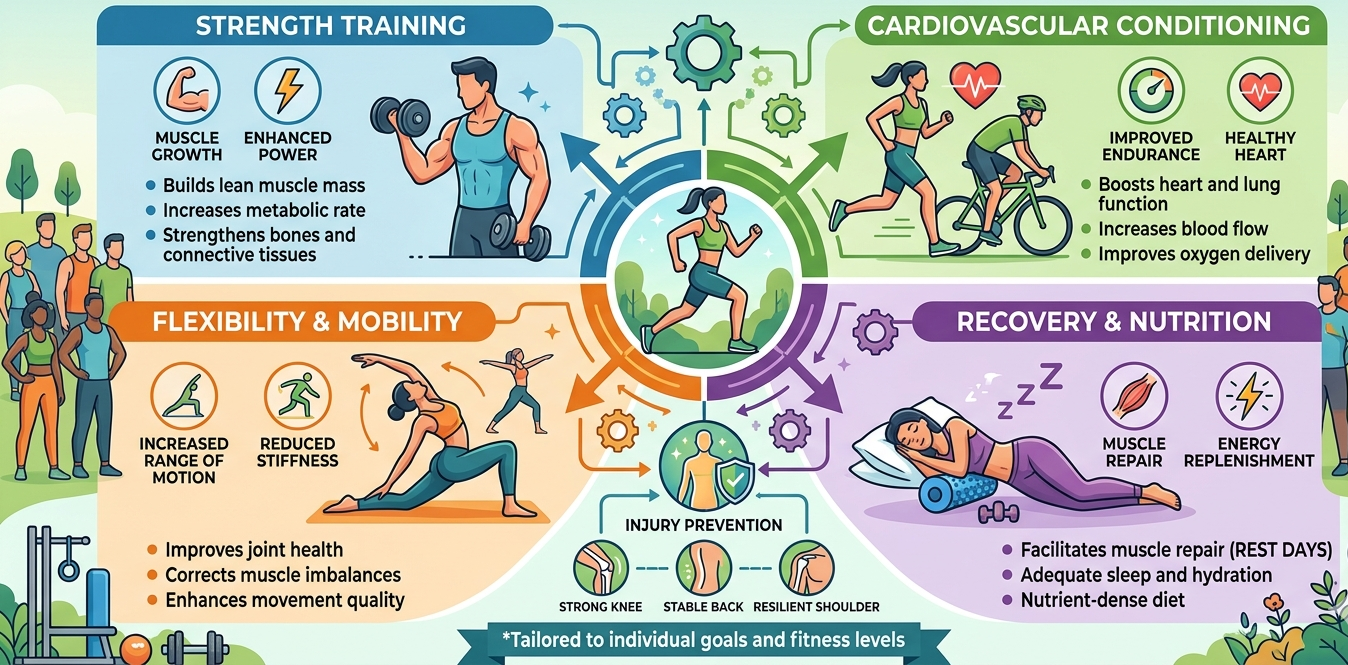
Without any exercise, a person cannot keep healthy, gain strength and enhance the overall physical performance. Nevertheless, unless one is properly guided, even the physical activity may cause some injuries that will slow down the progress and influence long-term fitness objectives. Proper muscle conditioning is one of the best methods of minimizing the chance of injury as it makes the body ready to perform the physical requirements of exercises in a safe and efficient manner.
Muscle conditioning entails strengthening of the muscles, enhancement of flexibility as well as balanced growth of various muscle groups. In the case of well-conditioned muscles, they are capable of taking in stress, staying stable, and aiding proper movement patterns. This helps in mitigating the chances of strains, sprains, and other typical injuries of the workout.
Knowing the principles of conditioning and practicing it continuously makes it possible to train safely and make improvements in strength and endurance which are sustainable. With scientific laws and effective plans in mind, every person can create a workout regimen that aims at safety and does not cost outcomes.
The Secret of the Good Muscle Conditioning
Proper muscle conditioning is the act of training muscles, tendons, and joints to work by the use of specific exercises and gradual training. This training increases the efficiency of the body in executing the movements with the least amount of stress put on the vulnerable structures.
Conditioned muscles are stronger, more flexible and well coordinated. The following attributes help them react to sudden motions or even physical exertations. Failure to have proper conditioning exposes muscles to tightness, weakness or imbalance that leads to heightened risks of injury.

The neuromuscular coordination is also enhanced by conditioning and this is the communication between the nervous system and muscles. This coordination will facilitate that movements are managed and accurate to prevent unnecessary body strains.
Through the necessary muscle conditioning, one develops a basis on which any physical activity may be sustained including simple exercises as well as sophisticated athletic performance.
The Importance of Warming Up
The warming-up is an important part of the injury prevention. It warms up the body to exercise as it slowly raises the heart rate, stimulates better blood circulation to muscles and increases the range of motion of joints. Warm-up will make sure that the muscles will be prepared to work at higher levels.
Muscles are not as flexible and in case of coldness are easily injured. A warm-up raises muscle temperature, thus, rendering fibers more elastic and able to cope with stress. This is one of the major features of the correct muscle training, which minimizes the risks of strains and tears.

Warm-up exercises include dynamic movements, including light jogging, arm circles, and leg swings. These exercises stimulate large body parts and get them ready to more intensive exercises.
Omitting a warm-up could be a serious risk of injury particularly when the body is doing high intensity exercises. The given step is a significant part of safe and effective training which should be incorporated into every exercise session.
Stepped Increase of Intensity of Training
Rapidly adding intensity to training can be regarded as one of the most widespread causes of workout injuries. It requires time to perform changes in muscles, tendons, and joints to new levels of stress. Slow improvement enables the body to work and adapt without overworking.
To achieve proper muscle conditioning, induction of exercises should be made more difficult as time goes on. This would be done through weight addition, repetitions, or duration of exercises. Gradual change allows people to provide their bodies with time to acclimatize.

Acute-onset changes in intensity may cause overuse injuries which may include tendonitis or muscle strains. These wounds are as a rule acquired in the process of pushing the body beyond the present day capacity without proper preparation.
These problems can be avoided with a well-organized training program that involves gradual development, and aid in the ultimate enhancement of performance.
Muscular Balance
Another vital injury prevention element is muscular balance. The body has two groups of muscles that act contrary and create movement. In cases when one side is much stronger or tighter than the other side, it can result in imbalances causing strain and unrest.
As an illustration, powerful chest muscles and tender upper back muscles may lead to poor posture and more stress on the shoulders. These imbalances are one of the main factors of proper muscle conditioning.
Balanced training programs consist of exercises that work upon all the major muscle groups. This makes sure that the strength is evenly distributed in the body and minimizes chances of injury and enhances efficiency of movement in the body.
Muscular balance allows the person to exercise in a superior way and with less tension on special parts.
The Importance of proper exercise methods
It is necessary to use proper methods of exercise to avoid injuries and get the most out of training. The correct form also helps in making sure that the movements will be done in a safe manner and the target muscles are brought into use.
Incompetence may put undue stress on joints and connective tissues, which exposes one to injury. As an illustration, weight training can cause undue strain to the lower back or knees when the form of lifting is not proper. This is done by ensuring that the muscles are properly conditioned using the correct technique.
Form can be taught by trainers, instructional materials or by trial and error. Beginning with light weights and control aids persons in establishing safe movements before moving to the intensity stage.
The ability to stay on the right technique is not only less likely to get injured but also improves the overall performance and the efficiency.
Integrating Research and Implementation Plans
The success of proper muscle conditioning is in the fact that it combines scientific knowledge with practice. With the understanding of muscle responses to stress and recovery, people can be able to make informed choices regarding their training programs
Rest and recovery are vital elements to exercise. Exercises require muscles time to relax and strengthen. Lack of proper recovery may result in more injury, and degradation of performance.
Dehydration and nutrition are also significant in the health of muscles. The sufficient supply of water is required to ensure the functioning of the muscles, and the balanced diet will support the recovery of the nutrients that are needed to ensure the growth and repair.
These principles will help people develop more productive and safer fitness programs and apply them on a regular basis.
Constructing Fitness Practices that are Sustainable
One of the objectives of a fitness venture is sustainability. The short-term outcomes are significant, and the long-term achievement is based on healthy practices that promote the further advancement.
Effective and sustainable routines are developed with the help of proper muscle conditioning. Their focus on gradual steps and safety will help them to prevent the loss of progress due to injuries
The body is a vital element of sustainable training. Symptoms of tiredness, pain or discomfort should not be overlooked. The process of modifying intensity or having rest days when it is necessary can avoid overtraining and allow rest to occur.
It is possible to create a regular schedule with warm-ups, moderate exercises, and good technique so that no health problems will arise in order to reach fitness objectives.
Conclusion
Injuries of workouts should be prevented with a meticulous and systematic approach toward exercise. The conditions of safe and effective training are based on proper muscle conditioning in which strength, flexibility, and coordination are improved.
Warming up, progressing at an even pace, muscular balance, and the application of proper methods are some of the key strategies that help to decrease the possibility of injury. These practices when combined with the right nutrition, hydration and recovery make up an all round approach to fitness.
Learning and practicing the principles of muscle conditioning would help them improve their performance at the same time avoiding the injuries to their body. Finally, the focus on safety and consistency will provide a chance to achieve success in the long term and enjoy the process of fitness.