Introduction
One of the most serious tasks of corporate accounting is the preparing final accounts of companies. It gives an organized and standardized means of reporting the financial performance and position of a company to its stakeholders including investors, regulators, management and creditors. These are the financial statements that are the foundation of all decisions and help the user to evaluate the profitability, liquidity, solvency and the general health of the business.
In the contemporary business world, the process of preparing final accounts of companies is not merely an issue of recording figures but rather, it is the preparation of the correct, reliable and compliant information according to the accepted accounting standards. The companies must comply with frameworks, including International Financial Reporting Standards (IFRS) or local Generally Accepted Accounting Principles (GAAP), which guarantee transparency and comparability between organizations.
This article is a practical guideline to the preparation and presentation of final accounts with reference to three main aspects which include: the statement of profit and loss, the statement of financial position, and the notes to the accounts. It also brings out presentation standards and regulatory compliance to assist the reader in the formation of professional financial reports.
Understanding Final Accounts of Companies
Final accounts are the financial statements that have been prepared at the end of an accounting period, which is normally an annual period. They consolidate all financial transactions and give a clear image of the financial transactions of the company within the period.
The major purposes of final accounts are:
- Identification of profit or loss during the period.
- Reporting financial status of the company.
- Helping the stakeholders make decisions.
- Adhering to legal and regulatory guidelines.
The major elements of final accounts are:
- Profit or Loss Statement.
- Financial Position Statement.
- Changes in Equity Statement (usually included)
- Cash Flows (where applicable) Statement.
- Notes to the Accounts.
This article pays significant attention to the first three factors.
Profit or Loss Statement
Definition and Purpose
Income statement or the statement of profit or loss reflects an overview of the performance of a company within a given period. It records the revenues and cost incurred and at the end of it all, it shows whether the company has made a loss or a profit.
Organization of the Statement
An average statement of profit or loss will contain:
1. Revenue (Turnover)
This is revenue earned by the main operations of the company.
2. Cost of Sales (Cost of Goods Sold).
These are direct costs which relate to the production of goods or services sold.
3. Gross Profit
Calculated as:
Gross Profit = Revenue- Cost of Sales.
4. Operating Expenses
These involve the administrative costs, selling and distribution cost, and other overheads.
5. Operating Profit
Operating Profit = Gross Profit- Operating Expenses.
4. Finance Costs
Interest charged on borrowings and loans.
5. Profit before Tax
Operating Profit – Finance Expenses
6. Tax Expense
Profits to be paid as income tax
7. Profit after Tax (Net Profit).
Shareholders will have available final profit.
Example Format
Profit and Loss Statement at the End of the Year 31 December 20XX
- Revenue
- Cost of Sales
- Gross Profit
- Operating Expenses
- Operating Profit
- Finance Costs
- Profit before Tax
- Tax
- Profit during the Year.
Practical Considerations
- Proper form of classification of expenses (direct or indirect).
- Use uniformity on accounting policies.
- Measuring revenue: Revenue is recognized as per the relevant standards.
- Do not overstate or understate profits.
Statement of Financial Position
Definition and Purpose
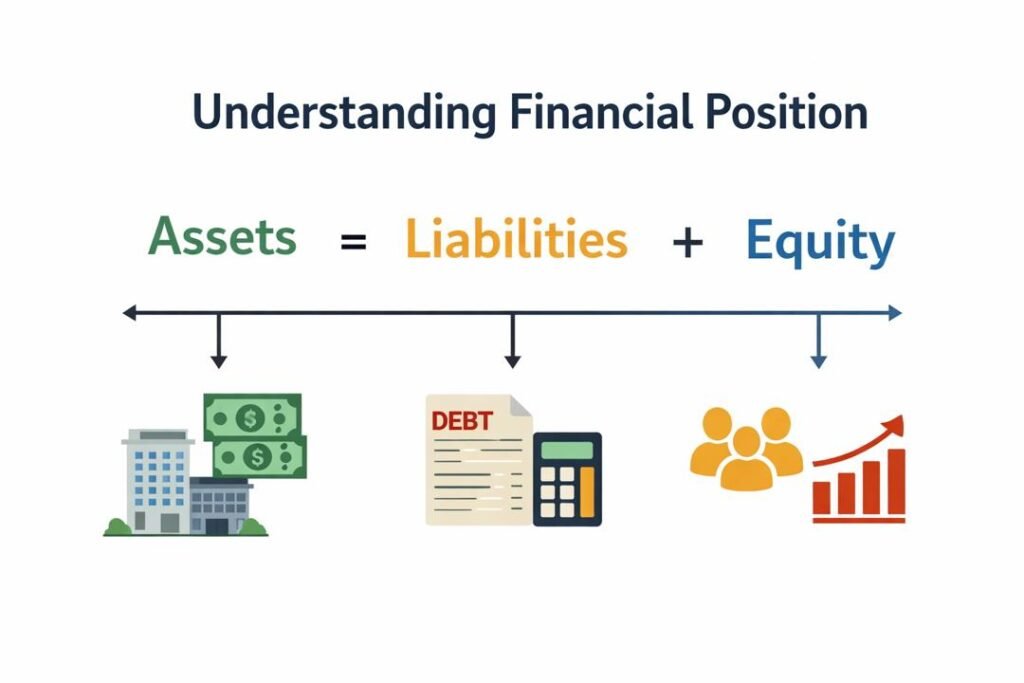
The financial position of a company at a certain point in time is presented in the statement of financial position which is also known as the balance sheet. It shows assets, liabilities and equity.
The basic equation of accounting is:
Assets = Liabilities + Equity
The elements of the Statement
1. Assets
These are the resources which are in the control of the company. These are separated into:
- Non-Current Assets: Property, plant, and equipment (long-term assets).
- Current Assets: Short term assets like cash, inventory and receivables.
2. Liabilities
These are the company obligations. They include:
- Long-term debts: Non-Current Liabilities.
- Current Liabilities: Short term liabilities include payables.
3. Equity
Represents the interest of owners in the company and consists of:
- Share capital
- Retained earnings
- Reserves
Example Format
As at 31 December 20XX Statement of Financial Position
Assets
- Non-Current Assets
- Current Assets
Equity and Liabilities
- Equity
- Non-Current Liabilities
- Current Liabilities
Practical Considerations
- Valuation of assets (e.g. depreciation of fixed assets) done properly.
- Proper identification of current and non-current items.
- Periodic balancing of balances.
- Assuring full disclosure of liabilities.
Notes on the Accounts
Definition and Importance
Additional information and explanation to the accounts are contained in notes to the accounts and not in the basic financial statements. They are needed to interpret the figures provided.
Important Contents of Notes
- Accounting Policies: Description of procedures applied in preparing financial statements.
- Include Major Items Breakdown: A close examination of such data as revenue, expenses, and assets.
- Contingent Liabilities: Future commitments that can be made.
- Commitments: Future financial obligations
- Related Party Transactions: Deals with directors or related organizations.
Example
- Note 1: Accounting Policies
- Note 2: Property, Plant and Equipment.
- Note 3: Inventory
- Note 4: Trade Receivables
- Note 5: Share Capital
Practical Considerations
- Ensure clarity and transparency
- Be detailed enough without being too complex.
- To be consistent with key statements.
Presentation Standards
Importance of Appropriate Presentation
Presentation is also important in financial reporting. Even the correct data may be in misleading forms. There should be well structured and understandable financial statements.
Key Presentation Principles
- Consistency: Period to period use of the same format and accounting policies.
- Comparability: Previous comparative data of the previous years.
- Clarity: Do not confuse and label adequately.
- Materiality: Share important information which may affect decision.
- Reliability: Make sure that there are no errors and bias.
Formatting Guidelines
- Make use of headings and subheadings.
- Align figures properly
- Present totals clearly
- Use standardized terminology
Adherence to Accounting Regulations
Regulatory Frameworks
Accounting standards and legal requirements have to be followed by companies. These may include:
- International Financial Reporting Standards (IFRS).
- Local accounting standards
- Company laws and regulations.
Key Compliance Requirements
- True and Fair View: Financial statements must represent the financial status of the company.
- Full Disclosure: One is to provide all the necessary information.
- Audit Requirements: External auditors might be required to audit financial statements.
- Timely Reporting: Reporting should be made and the reports are to be submitted within set deadlines.
Consequences of Non-Compliance
- Legal penalties
- Decreased investor confidence.
- Financial mismanagement
- Damage to reputation
Practical Steps in Preparation of Final Accounts
Step 1: Preparation of Trial Balance.
Start with a trial balance to ensure that there is a balance between credits and debits.
Step 2: Adjustments
Modify to suit as required such as:
- Accruals and prepayments
- Depreciation
- Doubtful debts provision.
Step 3: Prepare Statement of Profit or Loss
Couple revenues and costs to establish profit
Step 4: Prepare Statement of Financial Position
Record assets, liabilities and equity
Step 5: Prepare Notes to the Accounts.
Make further clarifications and revelations.
Step 6: Proofread and Revise.
Check and assure compliance, and make up the statements.
Common Errors to Avoid
- Omitting important adjustments
- The misstatements of the assets and liabilities.
- Improper depreciation determination.
- Lack of disclosure in notes
- Poor consistency of accounting policies.
Preparation of Professional Financial Reports
In order to prepare quality financial statements:
- Keep good records on an annual basis.
- Where possible, accounting software must be utilized.
- Keep pace with accounting standards.
- Seek advice of the professional when necessary.
- Build internal audit on a regular basis.
Conclusion
The preparation and the presentation of final accounts of companies is a significant process and requires not only the technical knowledge but also the attention to details. All these are extremely significant in presenting the financial information in the statement of profit and loss or in the statement of financial position and the note to the accounts.
Financial statements are made in a manner where they are practically accessible based on the knowledge of the structure of financial statements and application of appropriate accounting principles and regulations. Such reports are also invaluable to the stakeholders because the standards of presentation make them easy to understand, and useful.
Lastly, preparing final accounts of companies can be learned to enable individuals and organizations to prepare accurate, transparent and professional reports. It does not only guarantee compliance with the regulations, but also builds trust and confidence among the investors and other stakeholders. With the steps and guidelines that are outlined in this article, the reader can obtain the competencies that are required in the preparation of reliable and high quality final accounts in any corporate setting.
Get more well researched information about Preparing final accounts of companies here.