
Businesses in the modern world have to work in a situation that is fast, accurate, and flexible. The role of manual processes and systems unrelated to one another tends to hinder productivity and efficiency of operations in organizations as they grow in scale. Business is becoming more and more in need of solutions that will enable them to optimize their workflow, eliminate repetitive tasks, and react fast to the fluctuating needs without becoming over-developed.
Microsoft Power Apps has become a strong low-code application that is making enterprises to quickly create custom applications and this is empowering both the IT teams and business users. Power Apps is an important tool in promoting the efficiency of the enterprise and aiding digital transformation because it enables organizations to machinery processes, as well as seamlessly integrate with the current Microsoft systems.
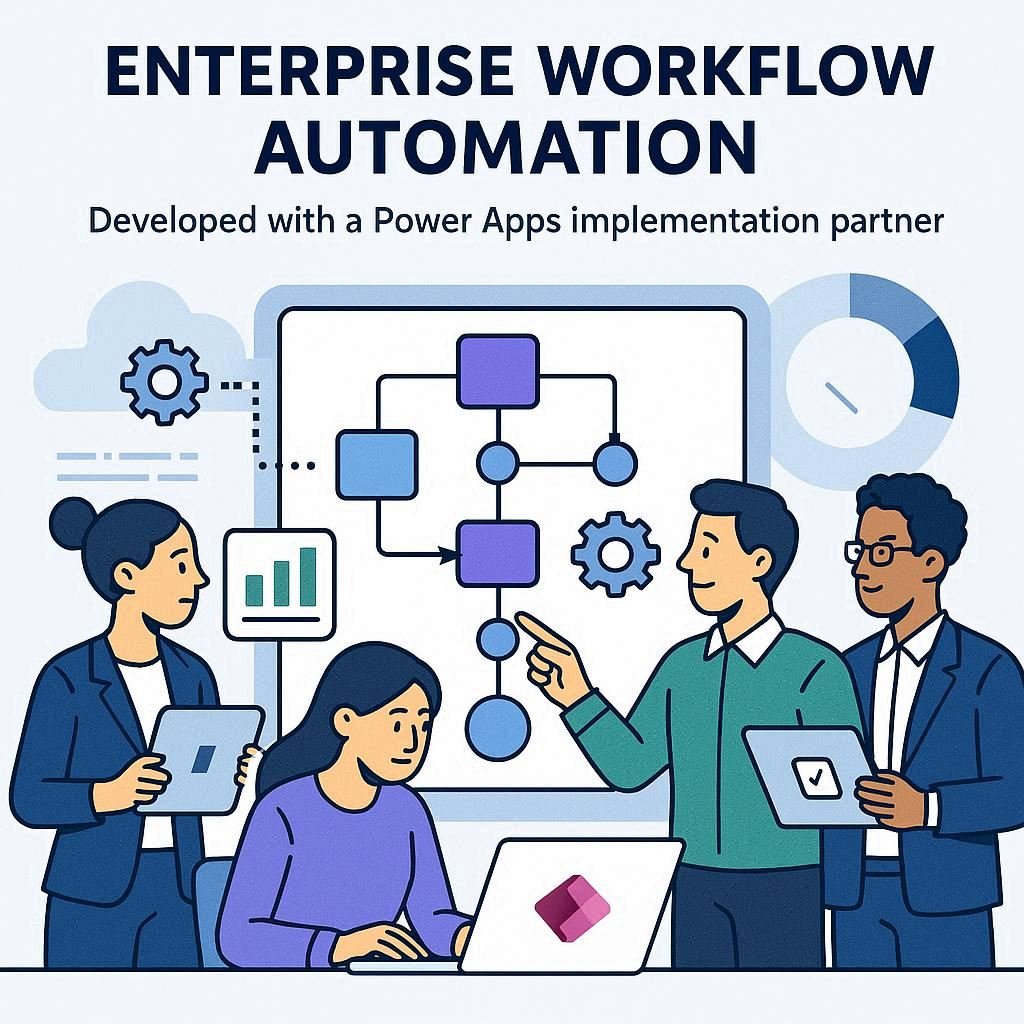
This article examines the way Power Apps benefits business performance, features the most popular applications in business functions, and the reasons why it is better to work with an experienced Power Apps implementation partner to receive maximum benefits in the long term.
Realizing Microsoft Power Apps in the Enterprise Environment
Microsoft Power Apps belongs to the Microsoft Power Platform, which can be used to create applications quickly with the least amount of code. It enables organizations to develop tailored business applications that integrate with data sources including Microsoft 365, Dynamics 365, and SharePoint among other enterprise systems
Power Apps can be used to help organizations to substitute manual process by paper or spreadsheet-based process with a digitally structured workflow. It saves a great deal of time in development by offering pre-built connectors and templates but at the same time remains flexible and scalable.

Power Apps is an application used in enterprise settings to provide the gap between business requirements and technical implementation, with solutions being able to be deployed with greater speed to directly tackle operational issues.
Enterprise efficiency as a Low-Code Development Power
The common traditional application development is associated with protracted timelines, expensive and intensive use of specialized developers. Power Apps transforms this paradigm because it provides the low-code environment in which the applications can be developed visually and by drag-and-drop components.
The strategy will help shorten the development cycles and allow departments to react fast to changing demands. The business users can work with the IT teams in designing the solution that is based on real-life working processes and decreases mismatch between technology and operational requirements.

Technical debt is also greatly reduced with low-code development through standardized components and governance with inbuilt features, which simplify the maintenance and extendibility of applications to the enterprise level.
Systems integration with Microsoft enterprise
Probably one of the greatest benefits of Power Apps is that it is closely integrated into the Microsoft ecosystem. Companies that currently operate Microsoft 365, Dynamics 365, and SharePoint can build out of their already existing investments without the need to install complex systems.
Power Apps is related to SharePoint lists, Excel, Outlook, Teams, and Dataverse, which allows the use of data and coordinate its safety. The combination with Dynamics 365 enables organizations to develop custom applications that improve CRM and ERP operations.

This integrated environment will ensure that data passes well across platforms, they will eliminate silos and be able to make informed decisions.
Important Use Case: Onboarding Automation of Employees
Employee onboarding is a serious process which in most cases entails various departments, documents, and approvals. Onboarding may be a cumbersome and infrequent process that is susceptible to mistakes when performed manually.
Power Apps provides companies with the capability to build onboarding applications that can direct new employees through the necessary procedures and automate the process of assigning tasks to HR, IT and management departments. Forms, document upload, approvals can be centralized in only one application.

The onboarding data is secured up and shared with the concerned parties by integrating with Microsoft 365 and SharePoint. Such automation enhances the onboarding experience, decreases the administrative burden, and makes sure that internal policies are adhered to.
Use Case: Workflows (Process) Automation and Approval
The general practice is approval processes in the various enterprises where expense claims, purchase requests, leave applications, and contract approvals are all the same. The conventional approval procedures can be based on emails and un-automated monitoring, which creates delays and inefficient processes.
Power Apps can be used with Power Automate to enable organizations to construct automated approval workflows in which requests can be directed to the correct approvers, depending on the established rules. Status updates, reminders and notifications are automatically processed.
This automation will improve transparency, bottlenecks will be minimized and the approvals will have the same system and they will be completed in an efficient manner.
Use Case Importance: Asset Management and Tracking
Enterprise resources in the form of equipment, devices, and facilities need to be properly tracked and updated in time. Handling of assets is associated with manual asset management procedures that lead to obsolete records and poor management.
Power Apps will allow an organization to create its own asset management app that traces location, condition, ownership, and maintenance records of assets. Mobile devices help employees update the information on the assets in real-time, which enhances data accuracy.
The connectivity to the SharePoint and Dataverse allows to ensure central storage, and dashboards enable visibility of the asset utilization and the lifecycle management.
Important Use Case: Compliance and Regulatory Tracking
Enterprise activities require compliance with both internal and external regulations. Manual tracking of compliance by department increases the chances of mistakes and non-compliance.
Power Apps enables businesses to develop compliance tracking solutions that standardize data collection, data documentation, and reporting. Anti-compliance features such as automated reminders and validation rules will make sure that compliance requirements are met in time.
Centralizing compliance data would enable the organization to produce audit-compliant reports and have a higher level of control over regulatory requirements.
Enhancing Productivity at the Interdepartmental Level
The productivity of Power Apps is increased through the removal of manual repetitive activities and the use of spreadsheets and emails. Administration of the employees is also reduced and time spent on value-driving activities is also increased.
Bespoke applications based on the needs of particular departments enhance the adoption and effectiveness of use. In finance, HR, operations, or IT, Power Apps allows teams to work smarter with workflow-designed tools.
The increased productivity is converted into time savings and better performance of operations.
Low-Code Solutions to Cost Savings
Development of enterprise applications is commonly linked with expensive costs. Power Apps saves these costs by allowing them to develop more quickly and minimize reliance on custom-coded solutions.
Low-code applications have fewer development resources and are less difficult to maintain. New changes and advancements can be executed easily without massive redevelopment.
These savings in the long run result in an improved payoff and enable organizations to resource funds in a more strategic manner.
Elasticity and Expandability to Large Business
The applications built with the Power Apps can be expanded as the enterprise grows. Applications may be extended with additional features, integrations and user roles as business requirements are changed.
The platform facilitates both those that are simple departmental applications and those that are complex enterprise wide solutions. This is because it is flexible and organizations can begin using Power Apps small and grow their application.
Scalability is also increased with the help of Microsoft Dataverse that offers a safe and strong data layer to the enterprise applications.
Good Governance and Security Measures
The systems of the enterprise demand high governance, security, and compliance. Power Apps has in-built functionalities that facilitate role-based access, data loss prevention policies, and central administration.
IT departments can handle application environment, control data connectors and usage tracking at the organizational level. This will help ensure that innovation does not undermine the standards of security and compliance.
Good governance helps business to empower business users and ensure that there is control and management of risk.
Funding Digital Transformation Journeys
Digital transformation is no longer a choice that an enterprise will want to make in order to be competitive on a long-term basis. Power Apps is a very important part of this transformation as it allows innovating quickly and modernizing the processes.
Power Apps is capable of making organizations more data-driven and agile by digitizing workflows and ensuring the integration of data across systems. Employees are provided with tools that enhance cooperation and decision-making.
This is changing towards a culture of constant improvement and innovation throughout the enterprise.
A Power Apps Implementation Partner Job
Although Power Apps is easy to use, strategic planning, architecture design, and governance alignment are needed when it is implemented at an enterprise level. Having a reliable Power Apps implementation partner means that it deploys successfully and is valuable in the long run.
A skilled partner assists organizations to find high impact use cases, develop scalable solutions and connect Power Apps with existing systems. They also offer security, compliance and best practice guidance.
Organizations that want to speed up the adoption and achieve the biggest ROI can find collaborators in the form of Power Apps implementation partner who introduce proficient technical and business acumen.
Long-term Implications of Power Apps Adoption on the business
Companies that would be strategic in adopting Power Apps would be able to have long-term advantages that go beyond gaining instant efficiency. Enhanced collaboration, accelerated innovation process and enhanced visibility leads to healthier organizational performance.
Power Apps is also used to aid in ongoing optimization, which enables organizations to adjust procedures as the needs of the business evolve. Such flexibility will give it relevance and competitive advantage in the long run.
With businesses still undergoing digital transformation, Power Apps will also continue to serve as a core to the development of agile, efficient, and scalable business solutions.
Conclusion
Microsoft Power Apps is a powerful application development platform that can help enterprises to enhance efficiency by developing low-code applications. Power Apps allows organizations to work more effectively by automating workflows and reducing manual processes and integrating seamlessly with Microsoft enterprise platforms.
The most common use cases include onboarding, approvals, asset management, and compliance tracking, which are all indicative of the platform because of its interdepartmental effects. Power Apps is a useful tool to support enterprise digital transformation as it has benefits such as improved productivity, cost reduction, scalability, and powerful governance.
Collaborating with an informed Power Apps implementation partner, organizations will be able to embrace the full potential of Power Apps and create solutions that can yield a sustained operational excellence.