The human body is an amazing system, which is in constant interaction with the environment, and it shares this interaction by a complex interconnection of sensory input and motor output. The peripheral nerves and sensory pathways are among the most important elements of this system that enable us to sense such stimuli as touch, pain, temperature, and body position. The knowledge of these pathways is not only insightful to the complexity of the human neuroanatomy but also offers essential clues on functional physiology, diagnostic testing on clinical diagnosis, and treatment of the neurological diseases.
Introduction to Peripheral Nerves
Here we take a brief overview of the anatomy of the peripheral nerves, their dermatomes and muscular, skeletal, and skin areas of innervation.
Peripheral nerves are structures of axons that reach to the rest of the body and their origin is in the brain and spinal cord. They are the main pathways of relaying motor commands of the CNS to the muscles and glands and relaying sensory messages of different receptors to the CNS.
Peripheral nerves are generally divided into sensory (afferent) nerves, motor (efferent) nerves and mixed nerves (neurons that transmit both sensory and motor proxies). The sensory nerves are especially vital in the process of detecting environmental stimulation so that the body reacts to touch, alterations in temperature, pain, and the notion of location referred to as proprioception.
Sensory Receptors: The Creation of Sensory Pathways
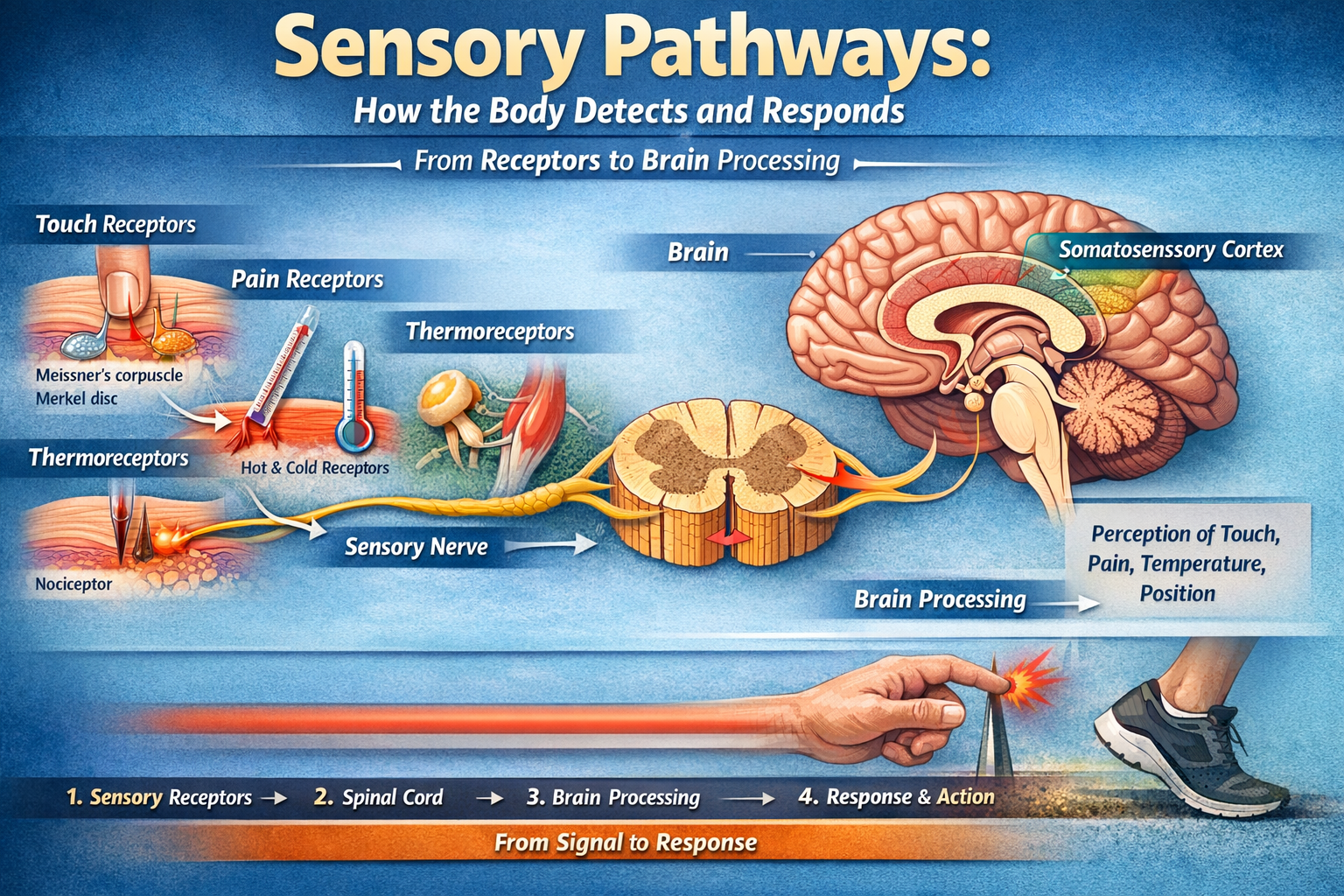
The path of the sensory information starts with the specialized sensory receptors found all over the body. Such receptors are programmed to respond to particular stimuli:
- Mechanoreceptors: Sense of pressure, vibration and touch. Examples of these include the corpuscles of the skin by Meissner and stretch-sensing spindle fibers in muscle.
- Thermoreceptors: Receptors which react to alterations in temperature, which enable the body to sense hot and cold.
- Nociceptors: Sense pain in body tissue or possible injury. These are essential receptors of protective reflexes.
- Proprioceptors: Proprioceptors are found in joints, muscles and tendons and they make the brain aware of body position and movement.
A physical stimulus is then transduced by each receptor as an electrical signal and this process is the vital initial stage in the sensory pathway.
Between Receptors and the Spinal Cord: The Part Played by Peripheral Nerves
After the receptor has produced an electrical signal, the nerve fiber transports the signal to the spinal cord along a peripheral nerve fiber. Sensory neurons are mostly pseudo-unipolar, that is, the cell bodies are found in the dorsal root ganglia which are close to the spinal cord. It is through this that the spinal nerve is connected to the CNS.
Sensory information of different types take different routes:
- The signals of touch and pressure usually are conducted in large, myelinated fibers which are called Ab fibers. These are high conductivity fibers that enable the body to respond to mechanical stimuli at a high rate of reaction.
- Ad fibers and unmyelinated C fibers transport the pain and temperature signals. These are slower signals which give important protective feedback on the dangerous conditions.
- The information of proprioception is sent through muscle spindle and Golgi tendon organ fibers which allows one to have accurate control of movement and balance.
The sensory input at this stage can be directed to the higher centres in the brain, or synapse with interneurons in the spinal cord to give reflexive reactions. Such two-fold ability indicates the value of sensory pathways in consciousness as well as automatic protective mechanisms.
Spinal Trajectories and Ascending Tracks
When the sensory signal gets to the spinal cord it is sent by separate ascending tracts to the brain. The following tracts are arranged according to the kind of sensual information:
Dorsal Column-Medial Lamisceral Pathway
Through the dorsal column-medial lemniscal (DCML) pathway information on fine touch, vibration, and proprioception is mostly carried. The information of the peripheral receptors go up the spinal cord along the dorsal columns and connect at the medulla oblongata. At that point, the signal is relayed to the other side of the brain through the medial lemniscus to the thalamus that serves as a sensory relay point. The thalamus then conveys the information to the primary somatosensory cortex of the parietal lobe to be perceived consciously.
Spinothalamic Pathway
The spinothalamic tract is one that conveys the pain, temperature and crude touch. When the sensory fibers enter the spinal cord, they synapse at the dorsal horn. The secondary neurons travel across the other side of the spinal cord and move to the thalamus. Similar to the DCML pathway, the information is passed to the somatosensory cortex via the thalamus.
These two routes demonstrate the manner in which the nervous system identifies the various kinds of sensory information, so that the correct response towards various stimuli in the environment is made.
Incentive Processing of Sensory Data
The brain cannot be likened to a passive recipient of sensory information; it is quite active in combining signals to create meaningful perceptions and co-ordinate responses. Once the somatosensory signals arrive at the somatosensory cortex it is processed based on spatial localization, intensity and modality.
The cerebellum and basal ganglia are also involved in the process of integrating proprioceptive information that is necessary in the process of the smooth and coordinated actions. Descending brain to body signals also regulate the amount of pain to be perceived thus exhibiting a feedback mechanism, which may either increase or decrease sensory signals depending on the situation.
Reflex Arcs: Instant Reactions through Sensory Processes
Not everything that is received by the senses needs to be thought. The occurrence of some stimuli initiates reflex arcs which are automatic, quick reactions that are spinal cord mediated. For example:
- Withdrawal reflex is a response which is activated when a painful stimulus like touching a hot object stimulates the nociceptors. The sensory signal reaches the spinal cord and is synaptic with the interneurons and the motor neurons are activated to pull the affected limb back.
- The stretch reflex, which includes muscle spindles, serves to hold the body and maintain balance because muscle contraction is automatically changed when the body is stretched.
Such reflexes prove the effectiveness and defensive role of sensory routes so that the body will respond before even the brain consciously perceives the stimulus.
Clinical Importance of Sensory Pathways
Knowledge of sensory pathways is important in diagnosing and treatment of neurological conditions. Peripheral nerve or spinal tract damage may cause sensory impairment, including:
- Peripheral neuropathy: This is brought about by damage to the peripheral nerves that result in numbness, tingling, or pain, usually in the extremity.
- Spinal cord injury: Impairs the ascending sensory pathways resulting in sensory loss partially or completely below the damage.
- Multiple sclerosis: CNS conduct is slowed by the demyelination of its neurons and influences touch, proprioception, and pain.
Sensory evaluation, such as vibration, temperature, pain, and proprioception tests, is useful information on the site and intensity of neurological damage.
Combination of More Than one Sensory Modality
The body has a tendency of combining several senses to provide a coherent interpretation of the environment. For instance:
- Touch and proprioception are coupled in order to enable skillful movements, e.g. typing or playing an instrument.
- Full body pain and temperature tend to confuse, responding to destructive stimuli and causing protective reflexes.
- The sense of proprioception together with vision is used to control balance and coordination especially during walking through uneven grounds.
The interplay of sensory modalities in a complex manner is a reason to note the significance of peripheral nerves and sensory pathways in daily functioning and survival.
Conclusion
The peripheral nerves and the sensory pathways constitute the necessary network by which the body recognizes, analyzes, and reacts to the surrounding. The system enables fast reflexive actions as well as detailed conscious perception due to special receptors that also perceive touch, pain, temperature and the body position. The basic idea of neuroanatomy, physiology, and clinical medicine is to know about these pathways and have an idea about normal functioning as well as neurological illness.
Understanding the senses enables us to better understand the integration of the external information and the internal information within the nervous system enabling the human body to respond, adapt and survive in a constantly evolving world.