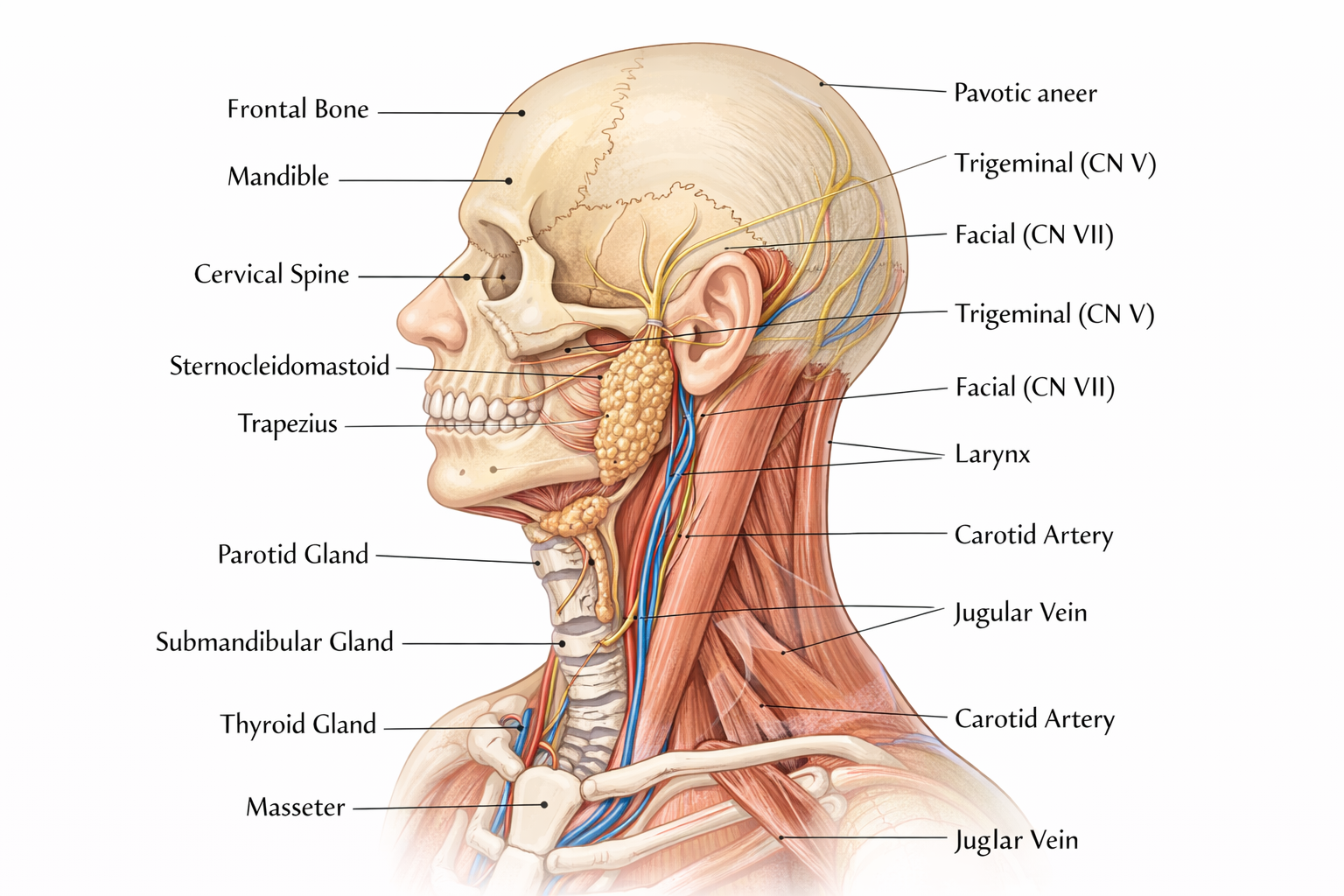
The structure of the head and neck is a dynamic and complex area that is the basis of human functionality and practice. These areas are the location of vital organs and structures that are involved in activities like breathing, speech, swallowing and sensory perception. In terms of students and learners at a young age, it is important to have a good understanding of the structural organization of the head and neck so that one can later on have a better understanding of other more complex anatomical or clinical concepts.
This paper is an in-depth description of the major parts of the head and neck, their anatomy, functions and relationship with each other.
Major Regions of the Head and Neck
The head and neck may be generally divided into the skull, face, cervical spine and related soft tissues. These areas each have particular structures which do not overlap but are interrelated.
1. Skull
The skull is the skeleton, which safeguards the brain and other sense organs. It contains two major components: cranium and facial skeleton.
Cranium
The cranium contains the brain and offers the muscles of the head and neck attachment points. It is composed of a number of bones, which include:
- Frontal bone – constitutes the forehead and the upper section of the eye sockets.
- Parietal bones – resemble paired bones that act as the side and roof of the cranium.
- Temporal bones – these are found on the sides, and they are associated with inner ear structures.
- Occipital bone – is the back part of the skull and harbors the foramen magnum where the spinal cord will find its way.
- Sphenoid and ethmoid bones – help to make the skull base and are a consideration of the orbital and nose cavities.
Sutures connect these bones together and are immovable joints which move very little, but which give strength to the body.
Facial Skeleton
Face skeleton helps in supporting the sensory organs and frame work of facial expressions. Key bones include:
- Maxillae – are the bones of the upper jaw, which hold the upper teeth and are part of the nasal cavity.
- Mandible – the lower part of the jaw which is necessary in chewing and speech.
- Zygomatic bones- cheekbones that give the face shape and where muscles are attached.
- Nares bones- make nose structures.
- Palatine and Lacrimal bones – these are the bones that support the oral and orbital structures.
The cranial and the facial bones combined ensure protection, structural support, and the location where the muscles used in the facial movement, mastication, as well as speech, are attached.
2. Cervical Spine
The cervical spine is a complex consisting of seven vertebrae (C1-C7) which supports the head and gives it mobility as well as protecting the spinal cord and other neurovascular systems.
- Atlas (C1) – holds the skull and allows nodding of the head.
- Axis (C2) – permits the head to move in a rotational manner.
- C3-C7 – this is more flexible and acts as a point of attachment of the muscles and ligaments.
The cervical spine has intervertebral discs that absorb shock and it has many foramina through which nerves and blood vessels pass and thus provide proper neurological and vascular activity.
3. Head and Neck anatomy Soft Tissues
The muscles, blood vessels, nerves and glands are soft tissues which are extremely important in movement, sensation and homeostasis.
Muscles
Muscles of the head and neck are separated into functional groups:
- Facial muscles –Facial muscles are used to communicate and express emotions, including the orbicularis oculi and orbicularis oris.
- Masticator muscles – such as masseter and temporalis – are required in the act of chewing and speaking.
- Muscles of the neck – such as the sterna cleavage/ trapezius, aid in movement of the head, posture, and swallowing.
Blood Vessels
The carotid arteries carry oxygenated blood to the neck, face, and the brain whereas the jugular veins take deoxygenated blood back to the heart. This vasculature system plays a crucial role in the functioning of the brain, the well-being of the sensory organs, and thermoregulation.
Nerves
The head and the neck are places where there are cranial and spinal nerves. Important examples include:
- Cranial nerves – these include the trigeminal nerve (cranial nerve V), the nerve of face, or facial nerve (cranial nerve VII), the nerve of expression, or the muscle of expression.
- Cervical nerves – are motor and sensory nerves of the neck and upper shoulder.
Glands
Saliva is secreted by salivary glands, which are the parotid glands, submandibular and sublingual glands to aid in digestion, oral health and swallowing. Thyroid and parathyroid glands control metabolism and calcium homeostasis, which makes the neck region even more functional.
3. Head and Neck Structures: Functional Importance
The head and the neck are organized to work together in order to carry out essential functions.
Breathing
The primary airway is composed of the nasal cavity, pharynx, and the larynx. The nose filters, heats and moisturizes the air that is inhaled, and the pharynx and the larynx send air into the lungs. The muscles and the cervical spine hold the head in position to facilitate the maximum airflow.
Speech
The larynx, tongue, and mouth are used to enable speech. Sound is produced by the vibration of the vocal cords in the larynx and the articulation of words is done through the tongue, lips and cheeks movements. Knowing the anatomy of the head and the neck is critical in understanding how the structures combine together to produce clear and coordinated speech.
Swallowing
The act of swallowing is a complicated set of muscular movements, which involve the pharynx, the esophagus, and its surrounding soft tissue. The concerted action of these muscles provides safe food and liquid transit between the mouth and the stomach and also safeguard against the airway.
Sensory Perception
The head contains the large sensory organs:
- Eyes – provide vision.
- Ears- sense audible sounds and aid in balance.
- Nose – identifies smells and helps in taste.
- Tongue – has a sense of taste and touch.
These organs depend on the complex intertwining of the bones, muscles, blood vessels and nerves to be safe and stable as well as to work.
Appreciating Anatomy in Scene
The extensive knowledge of the anatomy of the head and neck is a basic requirement to students, medical practitioners, and anyone who is interested in any additional research on health sciences. With a sense of the spatial association of the bones, muscles, nerves and vessels, the learners can gain more insight into how injuries, diseases or surgical procedures can affect the very important functions, including speech, breathing, or sensory perception.
Clinical Relevance
The anatomy of the head and neck is essential in most areas of medicine such as:
- Otolaryngology (ENT) – the treatment of the ear, nose, and throat diseases.
- Dentistry – dealing with oral health, jaw alignment and dental surgery.
- Neurology- treatment of cranial nerve disorders and brain injuries.
- Emergency Medicine – the evaluation of airway blockage, trauma and cervical spinal cord injuries.
Knowledge of the anatomy structures aids the clinicians to carry out accurate interventions and reduce incidents to the vital organs.
Conclusion
Morphology of the head and neck is a multidimensional system which combines skeletal, muscular, nervous and vascular parts in order to sustain life-sustaining functions. The head and the neck are a good example of how structure and functions interact in such a complex way to protect the brain and the sensory organs, facilitate communication, swallowing, and respiration.
In case of students and early learners, a solid ground in the study of head and neck anatomy is essential in the progression of studies to a higher level of clinical and anatomical studies. A careful examination of bones, muscles, nerves, blood vessels and glands can help the person to value the wonderful design of these parts and their very important roles in human health.
Formatted knowledge about these areas not only contributes to academic knowledge but also equips future practitioners in the area with the knowledge that will enable them to practice safely and effectively in the field.