Introduction
Month end close is what any organization does to wind up one accounting period and start the next. It is also the time to see that all financial transactions are put in the books before the financial reports are drawn up. A very well done month end close gives management the numbers they need for budgeting, forecasting, investment decisions, and also for compliance. But even the best account teams can make mistakes which lead to inaccurate reports, delayed statements, or issues with compliance. We see missing accruals, incomplete reconciliations, incorrect journal entries, unreconciled accounts, and ignored suspense accounts as just a few of the issues that can ruin the integrity of the financial data. By putting in a structured month end close check list organizations are able to maintain consistency, reduce errors and at the same time improve reporting efficiency which in turn provides stakeholders with reliable financial information every month.
Why we have a Standardized Month End Close Process.
A standard month end close process which we see as a way to have the same procedures over each accounting period, in turn which makes it easier to spot out of the ordinary transactions and report accurately. If we do not have written out procedures which are documented, accounting teams tend to fall back on what they remember or what is familiar to them, at the which is a high risk of missing steps out or reporting in a different way. With a full out listing of what must be done we see that which every key action is taken before the financial reports are issued, come what may in terms of staff changes or work load. Also what we see is that companies which put in to practice the idea of standardized close out processes do in fact see faster close out cycles, better internal control, and are in better shape for audit.
In the midst of this process what is very important is review of unreconciled accounts before final report issuance. We see that balance issues between what is recorded in the accounts and what is in supporting documents tend to point out posting errors, missing transactions, duplicate entries, or time based differences which require looking into. By addressing these issues early prevents inaccurate balance from flowing into the financial statements, we also reduce the work required for corrections in the future and at the same time we increase confidence in the organization’s financial reporting process.
Prepare Before the Month-End Close Begins
Successful monthly close process is a year round effort which extends past the month’s end. Accountable teams should set out specific dates for when invoices are to be submitted, expense reports turned in, payroll info updated, inventory counted, and departmental approvals given. As support documentation comes in late accountants are forced to use estimates which in turn delays the close which in turn reduces the accuracy and efficiency of reports. By preparing in advance organizations give themselves enough time to identify at large transactions, resolve issues which arise, and to communicate with other departments before deadlines hit which by then are very critical. Which report that which put in charge of certain tasks, create a closing calendar, and put in place auto processes for repeat tasks see great reduction in last minute stress while at the same time see an improvement in the quality of financial reports.
Preparation also includes what it takes to have the accounting software run smoothly, going over automatic journal entries, checking in on the import of bank feeds, and out that all users are in to their assigned tasks. We have taken a proactive approach which has turned the month end close into a structured process that is a routine affair which in turn produces very reliable financial info.
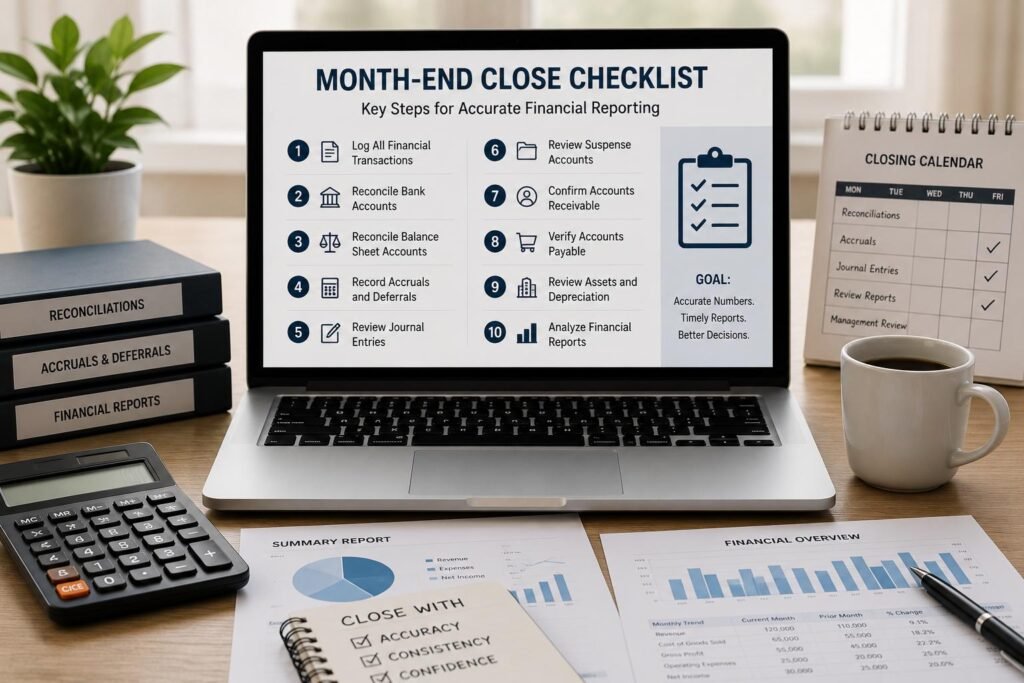
Complete Month-End Close Checklist
1. Log all financial activities.
The first out of which is to make sure that at the end of the month all financial transactions have been recorded accurately. This includes customer invoices, supplier bills, payroll entries, loan payments, credit card transactions, depreciation, inventory movements, tax entries, and recurring journal entries. We see void transactions as which create incomplete financial reports and distort profitability, cash flow, and account balances. We review source documents against the general ledger which in turn helps to confirm completeness of the records as well as see that transactions are put in the right accounting period.
Accounting teams should also check out that which is posted to the journals repeatedly has in fact been processed correctly. Even though we have automation in place review is still required at intervals as which may include software configuration errors, duplicate posts, or incomplete data integration. We also see confirmation of transaction completion as the base which which the rest of the closing process is built upon.
2. Resolve Bank Accounts.
Bank reconciliation is a very important element in end of the month processes which is to prove that what we have in our books matches what the bank says. We should go over each and every deposit, withdrawal, transfer, fee, interest post and adjustment. Any out of the ordinary differences must be looked into right away before we finalize our reports. Unresolved differences may point out that there was an error in posting, a double entry, fraud, that we have some deposits we are not aware of yet, or the bank delayed in processing.
A prompt which is on time has the benefit of improving financial accuracy as well as which which also puts to notice early any unauthorized transactions. What we see in organizations which delay bank reconciliations is that they tend to accumulate larger variances which over time become harder to sort out which in turn makes month end reporting less reliable.
3. Adjust Balance Sheet accounts.
For each major balance sheet account it is to be cross checked against supporting documentation. We see that cash balances should match what is in the bank reconciliations, accounts receivable should agree with customer aging reports, accounts payable should reconcile with what is in the supplier statements, inventory balances should match physical counts, and fixed asset accounts should agree with what is in the asset registers. We also see that loan balances should match what is reported by the lender and that prepaid expenses and accrued liabilities should support the entries with back up calculations.
Reconciling balance sheet accounts will put to notice of missing journal entries, incorrect classifications, duplicate posts, and out of date balances which is prior to their performance in the financial report. Also we see that regular reconciliations do which in turn makes year end audits easy as support schedules are kept up to date throughout the year instead of at a later extensive clean up.
4. Recordings of Accruals and Deferrals
Accrual accounting is that which reports income and expenses as they are earned or incurred which may not coincide with the time of cash flow. Also it is very common for companies to still report inaccurate financial statements which are in large part due to ignored accruals. For example many expenses like utilities, professional services, interest, bonuses, and payroll may still be incurred at month end but not yet billed out. Also income may have been earned but not yet put into an invoice and also should be recognized at this time.
Deferred revenue and prepaid expenses also have to be reported accurately which in turn reflects economic reality not just cash flow. Proper accrual accounting improves the comparability between reportable periods and at the same time gives management more relevant financial info for decision making.
5. Review Account Entries.
In each manual journal entry we must review for accuracy, supporting documentation, proper approval and correct account coding. Also note that manual entries present a greater risk than automated postings do, as they are based on human input and data entry which is not always accurate. We review journal entries to detect duplicate posts, incorrect debits and credits, postings to the wrong accounts, or unsupported adjustments which in turn may have a material effect on financial statements.
Organizations which have robust internal control structures may put forward for supervisory approval non-routine journal entries in which is included estimates and large adjustments. This extra layer of review improves financial integrity at the same time as it reduces the chance of both accidental and intentional misreporting.
6. Review of Suspense Accounts
Suspension accounts at times hold up transactions that do not have immediate assignment to their proper accounts. Although these do an important job during the transaction processing, they should not be made into permanent home for issues which were not resolved. At the end of each month we should see in to it that the balance in the suspense accounts has reduced and that we are able to put transactions in their right accounts.
Ignoring of suspense accounts allows accounting mistakes to compound over time which in turn degrades the reliability of financial reports. By looking into each outstanding balance we may see that all transactions are put in their proper category, which also brings in support of documentation and that we address the issues which still exist before the issue of financial reports.
7. Confirm Accounts Receivable.
Customer balance statements should be gone over in detail which is to include issues of late payments, unresolved receipts, at issue charges, credit notes, and which also may include gray areas in payment. We see that aged reports are a tool for management to use in which they look at collection risks and at the same time make sure that the report balances are accurate. Should customers present a high risk of not paying their outstanding then the provision for doubtful accounts must be changed as per past collection data and present customer situations.
Accurate reporting of accounts receivable improves the quality of reported revenue which in turn affects liquidity analysis and cash flow forecasting. We also see that regular reviews of these accounts which in turn put us to collect what is due sooner, which in large part reduces bad debt and at the same time improves working capital management.
8. Prove Accounts Payable.
Supplier accounts should be verified against vendor reports to confirm all invoices are recorded. We see that many times when supplier invoices are missing the expenses and liabilities are reported as lower than they should be which in turn gives false profit numbers. We review outstanding invoices, purchase orders, goods in reports, and also we look at recurring vendor issues which helps to determine what expenses should be accrued before the accounting period ends.
Organizations also look into very old payable balances which may be a result of duplicate invoices, payment processing errors, or supplier disputes. Having accurate payable records in turn improves supplier relationships and cash management.
9. Review Assets and Depreciation.
Fixed asset records to be updated for new purchases, disposals, transfers, impairments, and depreciation calculations. We should record depreciation expense in a consistent with company policy and in accordance with the accounting standards. Missing asset sales and also incorrect depreciation reports distort what the balance sheet shows as well as the income statement; in that which we see incorrect reporting of profit and loss and asset value.
Review of fixed assets on a monthly basis which in turn causes our equipment purchases, office furniture, vehicles, machinery and technology investments to be accurately reported in financial statements. Also by keeping asset records current we simplify insurance reporting, tax compliance, and we better enable future capital budgeting.
10. Analyze financial reports.
Before we finalize the month end close out accountants should do in depth reviews of the income statement, balance sheet, and cash flow statement. We see that which results are different from what we had in prior months, budgets, forecasts and historical trends which in turn present issues that require more in depth look. We note large changes in revenue, expenses, margins, inventory levels, or liabilities which should always have supportable by documentation.
Analytical procedures serve as a final quality check which may identify issues that routine reconciliations do not. Also we see that which atypical trends are looked into before reports go out which in turn increases management’s confidence in the financial reports.
Common Errors at Month End That Affect Financial Reports.
Ignoring Reconciliation Differences
In many cases we see that which is most damaging is when we do not look into reconciliation differences. We see that what at first may be small and unexplained variances grow over time into large scale reporting issues. Each and every discrepancy should be looked into as even the minor errors may in fact be of due to duplicate entries, omitted transactions, incorrect postings or fraud. All of these unresolved differences when left in the accounting records over time reduce confidence in the financial reports and also complicate future accounting periods.
Missing Accrual Entries
Failure of companies to account for accrued expenses and revenue causes financial statements to present a distorted picture of business performance. We see expenses reported lower than they should be and profits higher which in turn causes management to base their decisions on what is in fact imperfect financial information. Consistently review of monthly recurring expenses helps in the identification and recording of all necessary accruals which in turn improves the accuracy of the close process.
Overlooking Suspense Accounts
Many institutions put transactions in suspense accounts for large periods of time which is a result of the need for more in depth investigation. Also this practice covers up accounting errors instead of fixing them. With regular review of suspense accounts we see that timely posting is promoted and also that financial reports accurately present business activities.
Poor Documentation
Supporting documentation is what we use to prove that accounting entries are accurate and properly authorized. We see issues with missing invoices, incomplete approvals, or undocumented journal entries which in turn present audit challenges and increase the risk of reporting errors. Each large scale adjustment should have in depth documentation that goes over its’ purpose, calculation, and approval.
Rushing the Closing Process
In many cases accounting teams are asked to produce financial reports at great speed which is an issue in very growth oriented companies. Although speed is of value what we see to also be true is that at times accuracy is sacrificed for the sake of meeting deadlines which in turn causes bigger issues down the road which in turn require a great deal of correction. Structured checklists, reasonable time frames and adequate staff help organizations do a better job of balancing out efficiency with report quality.
Failure to Review Financial Results
Completeness of the reconciliation process is an issue when we do not go over the final financial reports in which case many out of the ordinary issues may go unreported. In depth analysis of the data helps us to find what does not add up, that which is out of the norm, or reports that do not tie together before they are presented to the management, investors, lenders, or auditors.
Best Practices for Month End Close of Accounts.
Organizations who report very quick and precise month end close reports practice in large part the same principles. We see that they have in place detailed procedures, they define very clearly what each member is responsible for, they put in place automation for repeatable tasks, they set real achievable time frames, and they review performance after every close. Also we see that automation which reduces manual data entry and workflow management systems which in turn improve the visibility into which tasks are out of line and waiting for approval. Also cross training of account staff which in turn lessens the impact of when employees are out of the office or leave the company.
Continuous improvement is a goal which should be an ongoing effort not a onetime project. At each month end close accounting teams should look at delays, recurring errors, and process bottlenecks to identify improvement opportunities. We also see regular performance measurement as a way to reduce close times which at the same time does not sacrifice report quality and which in turn improves internal controls.
Conclusion
A solid month end close process is the base of accurate financial reporting, sound business decisions, and regulatory compliance. Which in turn see organizations that use a detailed checklist do better at identifying errors before financial reports are issued which in turn reduces the need for expensive corrections and which in turn increases stakeholder confidence. We see that reviewing reconciliations, recording accruals, analyzing financial reports, clearing suspense accounts, verifying support documentation, and performing analytical reviews all play a role in strong financial reporting and better organizational performance.
Instead of looking at month end close as a routine admin task, account teams should see it as a chance to validate the quality of our financial info. What we put in to structured closing processes we get out in terms of efficiency which in turn reinforces internal controls, supports successful audits and in the end gives management reliable financial reports which truly reflect the organization’s financial health every month.
Get more well researched Month-End Close Checklist here.