Introduction
Epidemiology is crucial in the study of the trends, etiology, and impact of diseases among the populations. Epidemiologic investigation forms the basis of risk factor identification of oral diseases, the burden of disease and prevention measures in the field of dentistry and public health. Systematic research methods can help scientists and oral health practitioners to establish the development of oral diseases, who is the most vulnerable to them, and the best intervention that can be used to increase oral health in the population.
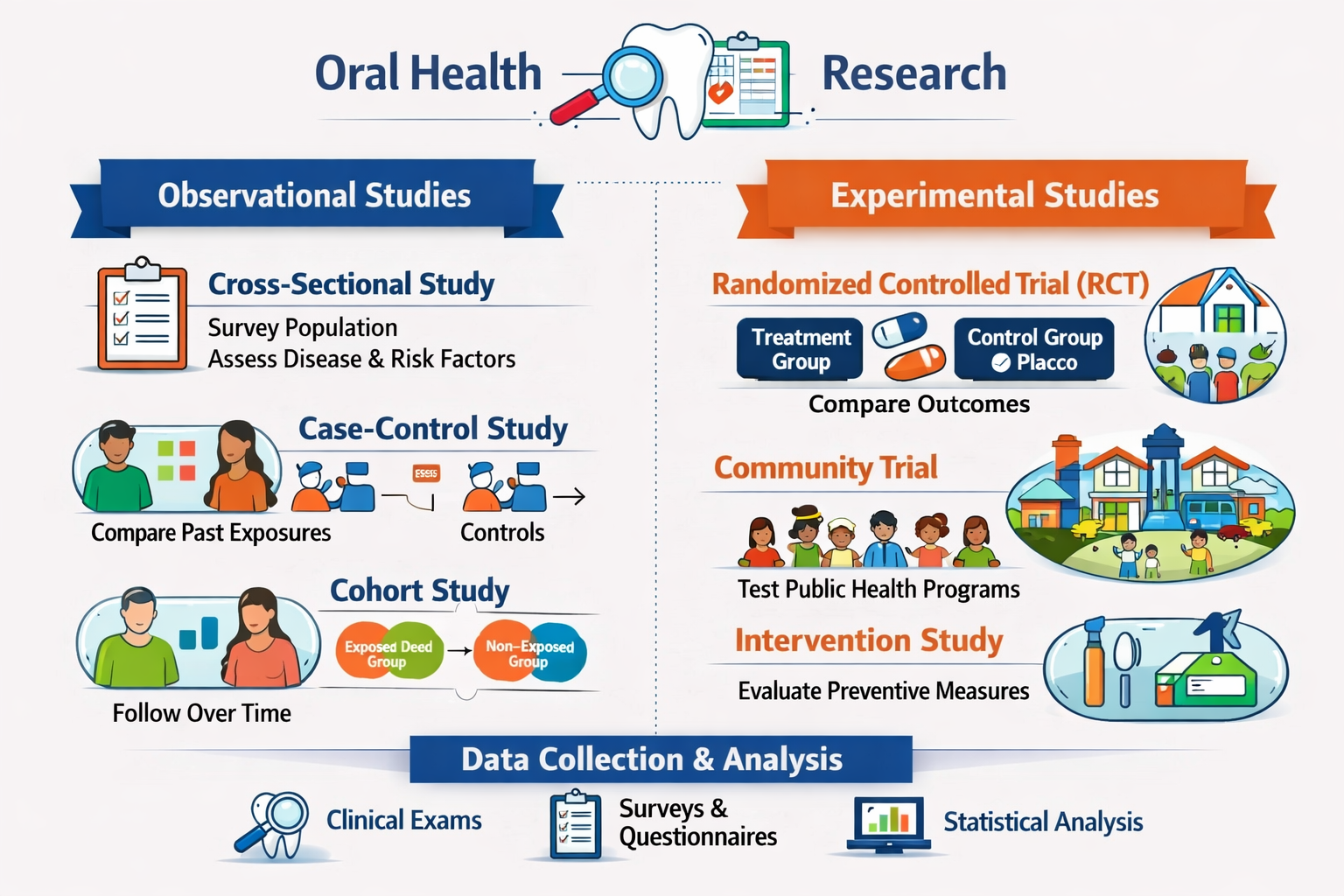
Epidemiologic investigation methods in oral health studies include data collection, measurement, and analysis as associated with oral diseases like dental caries, periodontal disease, oral cancer and other oral diseases. These methods of investigation can broadly be categorized into two main areas; This includes observational methods and experimental methods. All the methods possess their own advantages and disadvantages, and the authors of the research choose the best design based on the research question, the resources at hand, and ethical issues.
This paper discusses the major techniques applied in epidemiologic studies in the area of oral health. It discusses the process of data collection and analysis used by researchers to evaluate the risk and outcome of oral diseases, the role of various designs to enhance oral health policies and clinical interventions . https://www.who.int/news-room/fact-sheets/detail/oral-health
Knowledge in Epidemiologic Investigation in Oral Health Research.
Epidemiologic investigation is a process of systematic investigation into the distribution of health conditions and determinants of health in populations. This can be applied in the field of oral health by analyzing trends in dental illnesses, determining risk factors related to behavior or the environment, and determining the efficacy of preventive or treatment programs.
Epidemiologic investigation objectives in oral health research are:
- Determination of the prevalence and incidence of oral diseases.
- Identifying the risk factors relating to oral health conditions.
- The preventive strategies that can be assessed include oral hygiene programs and fluoridation.
- Evaluation of the clinical treatment effectiveness.
- Promoting evidence-based oral health and dental care.
Oral health researchers make use of systematic practices to make sure that the data collected are reliable, valid and useful to make decisions. These techniques enable the investigator to go beyond mere observation of the disease patterns to the knowledge of the cause and possible remedies.
In order to comprehend the world burden and burden of oral diseases, scholars usually consult reputable health sources like oral health fact sheets as it provides valuable information about oral health issues in the world and the methods to prevent it.
Oral Health Epidemiology Observational Methods
One of the best investigative techniques of epidemiologic research is observational studies. In such research, the investigators monitor and examine the health outcomes with no direct intervention or manipulation of variables.
Oral health research is especially a domain where observational methods prove useful since researchers cannot effectively manipulate much of the risk factors that may include diet, socioeconomic status, and oral health behaviors, due to ethical and practical constraints.
Cross-Sectional Studies
Cross-sectional studies involve a population at a given time. They are mostly employed to identify the prevalence of oral diseases and risk factors.
In cross-sectional oral health study, a researcher can investigate a group of people to establish the percentage of people who have dental caries, periodontal disease or any other oral disease. Data will be gathered by clinical examination, questionnaire or health records.
Key Characteristics
- Information that was gathered at a given point in time.
- Determines the prevalence of disease.
- Determines the relationship between risk factors and health outcomes.
Strengths
- Considerably fast and cheap.
- Applicable in the measurement of the oral disease burden.
- Assistance in creation of research hypotheses.
Limitations
- Able to determine no causes and effects.
- May may have sampling bias.
- Lacks no monitoring of disease progression.
Regardless of these shortcomings, cross-sectional research is still necessary in terms of monitoring oral health patterns among the population.
Case-Control Studies
Case-control studies are aimed at determining factors that are related to certain diseases through a comparison between people with the condition (cases) and those without the condition (controls).
An example of case-control study in oral health research could include the study of oral cancer patients and their comparison with members of the population who do not have the disease to determine possible risk factors, say, tobacco use, alcohol use, or viral infection.
Key Characteristics
- Retrospective design
- Compares cases and controls
- Focuses on past exposures
Strengths
- Good in investigations of rare diseases.
- Uses less than long-term research.
- Allows exploration of a variety of risk factors.
Limitations
- Accuracy can be subject to the bias of recall.
- The choice of the right controls may be challenging.
- The disease incidence cannot be directly measured.
Case-control studies are especially useful in determining the existence of associations that will be later investigated using other more rigorous research designs.
Cohort Studies
Cohort studies are based on the observation of cohorts of people during a period of time to identify exposure to some risk factors related to the development of the disease.
In oral health research, the researcher may track persons with different levels of sugar intake or oral hygienic behaviors to ascertain their effects on the occurrence of dental caries or periodontal disease.
The cohort studies can be prospective (tracing the study participants into the future) or retrospective (using the existing records to analyze previous exposures).
Key Characteristics
- Longitudinal design
- Monitors exposure and progression of disease.
- Determines prevalence of disease.
Strengths
- Able to develop time series association between exposure and disease.
- Applicable in investigating multiple results due to one exposure.
- Giving a more convincing argument than cross-sectional studies as to causation.
Limitations
- Time-intensive and costly.
- Possibility of dropout by participants (loss to follow-up)
- Requires large sample sizes
Cohort studies have been significant in the assessment of how behaviors, environmental and socioeconomic situations affect oral health outcome.
Oral Health Research Methodology
Experimental studies imply that researchers actively intervene in order to test the effectiveness of preventive or treatment measures. The aim of these studies is to test hypotheses in a controlled situation.
The experimental approaches are especially significant in oral health studies to measure dental treatment and preventive programs, and even in the context of assessing preventive interventions in the health of the population.
Randomized Controlled Trials
RCTs are believed to be the gold-standard of clinical and epidemiologic studies. In RCT, subjects are randomly placed either in the intervention group or control group.
As an example, a randomized controlled trial can be used to measure the efficacy of a novel fluoride toothpaste in preventing dental caries relative to a conventional toothpaste.
Key Characteristics
- Assigning participants randomly.
- Comparison between intervention and control groups that will be controlled.
- Prospective study design
Strengths
- Gives good causal evidence.
- Reduces the level of bias by randomization.
- Enables accurate selections of interventions.
Limitations
- Both costly and time-consuming.
- Experimentation can be constrained by ethics.
- Controlled conditions need not be regarded as being in the real world.
Although this is rather problematic, randomized controlled trials are necessary to determine the safety and efficacy of dental interventions and preventive strategies.
Community Trials
The community trials assess the health interventions at the population or community level as opposed to the individual level.
Community trials can also be used in oral health research to evaluate the effectiveness of school-based dental programs or community water fluoridation or community oral health education campaigns.
Key Characteristics
- Concentrates on groups of people and not on individuals.
- They are often applied in practice.
- Appraises major population health initiatives.
Strengths
- Gives hard evidence to the human health policy.
- Measures actual effectiveness.
- Is able to impact masses of people.
Limitations
- Hard to manipulate everything.
- Intensive coordination and resources are required.
- The findings can be affected by the differences in communities.
Community trials play an essential role in the process of finding out the effectiveness of preventive strategies in non-laboratory settings.
Collection of Data in Oral Health Epidemiology
Epidemiologic investigation requires the collection of accurate data. In oral health studies, data can be collected in a number of ways.
Clinical Oral Examinations
One of the most dependable techniques of determining oral health status is clinical examinations with the help of trained dental professionals. Diagnostic criteria are standardized which makes them consistent and comparable across studies.
Researchers may assess:
- Dental caries prevalence
- Indicators of periodontal diseases.
- Abnormalities or lesions of the mouth.
- Status of loss and restoration of teeth.
Measures of oral disease severity are usually made through such standard indices like the DMFT index ( Decayed, Missing, and Filled Teeth ).
Surveys and Questionnaires
Questionnaires enable the researchers to gather data regarding behavior, lifestyle issues, and socioeconomic status that potentially affect oral health.
Common topics include:
- Oral hygiene practices
- Dietary habits
- Tobacco or alcohol use
- Access to dental care
- Oral health knowledge and attitudes.
The survey is especially applicable in the large population study where clinical examination might not be effective in revealing relevant contextual details.
Health Records and Administration Data
The available health records contain useful data to be utilized in epidemiologic studies. The records of dental clinics, insurance databases and national surveys of health can be used to determine trends of diseases and the pattern of treatment.
Reliance on the available streams of data can also help in saving costs of research and enable researchers to examine massive populations.
Nonetheless, researchers should be careful about making records accurate, standardized and ethically utilized.
Method of Data Analysis of Epidemiologic Studies in Oral Health
Upon collection of data, researchers are then able to analyze the data in order to establish patterns and relationships between risk factors and oral health outcomes.
The modes of analysis are common and they are:
Descriptive Analysis
Descriptive statistics give the outline of the distribution of diseases among populations. This can be in form of:
- Prevalence rates
- Incidence rates
- Mean DMFT scores
- Demographic patterns
Descriptive analysis assists researchers to know the extent and frequency of oral health issues.
Analytical Analysis
The analytical techniques examine the relationship between exposures and health outcomes.
Widely used statistical methods are:
- Risk ratios
- Odds ratios
- Regression analysis
- Multivariate analysis
These methods assist authors to establish the relationship between some factors, including the consumption of sugar or smoking or the socioeconomic status and the risk of oral disease.
Limitations and Strengths of the Epidemiologic Investigation Methods
Epidemiologic investigation can be conducted through each of the methods to enjoy certain advantages, but it also has certain limitations.
Strengths
- Gives support to the detection of risk factors.
- Support oral health trends in populations.
- Endorses dental evidence-based practice.
- Lays down the policies and prevention programs in the health sector.
Limitations
- Causation cannot be established out of some designs.
- The long term studies can be resource intensive.
- There can be bias and confounding factors that affect the findings.
- There are some experiments that may be limited by ethics.
Such strengths and limitations enable a researcher to design the study in a way that yields credible and valuable findings.
Epidemiologic Methods and their role in enhancing Oral Health
Epidemiologic investigation techniques have helped lead to both improvement in dentistry and health of the population. Studies conducted through such methods have assisted in determining significant risk factors of dental diseases, prevention intervention measures and the clinical approach to treatment.
Indicatively, epidemiologic research has shown the efficacy of community water fluoridation, better oral care behaviors and preventive oral disease initiatives to decrease the oral disease carries load globally.
Moreover, evidence-based decision-making is also supported by epidemiologic studies that deliver accurate data to make informed decisions about population health, dental education, and clinical guidelines.
As health issues in the world are changing, the future of oral health research should be sustained in order to achieve inequalities in dental accessibility, preventive care, and better overall health outcomes.
Conclusion
Techniques of epidemiologic research underlie the current studies on oral health. Through the application of structured observational and experimental methods, the researchers are able to obtain data on the relationship between oral diseases, risk factors, and treatment outcomes in a systematic fashion.
Observational studies- cross-sectional study, case-control study and cohort study- assist in defining the trends and possible causes of oral diseases in the populations. Randomized controlled trials and community trials are the two examples of experimental methods that offer powerful evidence on assessing preventive interventions and clinical treatments.
These investigative methods, combined with effective data collection and effective data analysis methods, can help oral health professionals learn about how diseases are on the rise, how to develop effective prevention measures, and better patient care.
Finally, the role of epidemiologic investigation in dental science development and healthier populations is paramount and should be of a central concern globally. With the proper design of research studies, the science of oral health research will go on producing the information required to diminish the burden of oral disorders and improve the oral health of the world.