Abstract
The content in the media in the contemporary world continues to be one of the most powerful instruments of influencing the thoughts and actions of the masses. News reporting, entertainment programming, and the use of social media platforms expose people to stories that contribute to attitude, belief, and behavior. This paper discusses the influence of media content on the perception and behavior of people by applying three theories of media impact, which are agenda-setting theory, framing theory, and cultivation theory. Following a qualitative research philosophy, where primary data analysis is replaced by secondary data analysis, the study examines pertinent literature on the subject and conducts an analysis of the modern media practices. These findings suggest that media contents give priority in matters, packages social realities, and develops lasting perceptions that shape a lot of how the masses talk, as well as patterns of behavior. The article ends by suggesting that media literacy and ethical media conduct have to be used in order to limit the adverse impacts of the media in a more digital and algorithmic media world.
Keywords: media content, perception by the population, media impacts, agenda-setting, framing, cultivation theory.
1.0 Introduction
The media content is central to the perception of the social reality among people. In modern society, individuals are clinging to the media to provide information, interpretation, and socializing. Social media that engages people in real-time interaction and global spread of information has taken the place of traditional mass media, including newspapers, radio, and television. Therefore, the role of media on mass thinking and the way people act has become more complicated and widespread.
According to scholars, media do not just present reality, but they are the creators of it, using selection, highlighting, and repetition of messages (McQuail, 2010). The news media decide what issues should be noticed by people, the entertainment media make social values and ways of life normal, and the social media enhance the narratives through algorithms and user interaction. These processes influence the thinking of audiences concerning the social matters, their judgments, and their behavioral responses.
This paper looks into how media content affects audience attitudes by considering some of the most important media effects theories. In particular, it examines the agenda-setting theory, the theory of framing, and cultivation theory and transfers it to the modern media settings. The research is expected to make contributions to the scholarly community in media studies because it will reveal the impact of media content on discourse, social expectations, and even behavior patterns of the population.
2.0 Literature Review
2.1 The Media Content and Social Reality
The media has been well recognized by media scholars in their view to constructing social reality. Couldry (2012) perceives media as highly influential institutions that create and spread meanings in the society. By means of repetition, audiences internalize media narratives, and these may shape attitudes and beliefs even in cases where they are not necessarily aware of these effects.
Empirical research indicates that the moralizing of crime, politics, health, and social groups in the media will affect the perception of the populace. Indicatively, the overwhelming consumption of crime-related news has been linked to increased fear and distrust in the society (Gerbner et al., 2002). On the same note, the media coverage of politics influences voter opinions and political turnout.
2.2 News Media and Public Opinion
News media are an important determinant of the opinion of the masses since they dictate the direction of discussion. According to McCombs and Shaw (1972), the media shape the agenda of the masses by highlighting some elements whilst playing down others. This agenda-setting role is replicated in digital platforms, online news outlets, and trends in social media.
Nonetheless, the emergence of the social media has also added to the fragmentation of audiences, as well as selective exposure. According to Sunstein (2018), the algorithmic filtering may support already existing beliefs, which results to polarization and an echo chamber.
2.3 Entertainment and Behavioral Influence
Entertainment media control behavior by the way of modeling and social learning. According to Bandura (2001), the audiences acquire behaviors by observing media characters especially when they are positively rewarded and portrayed. Social expectations and norms are likely to be developed over time as a result of repeated images of violence, gender roles, or consumer lifestyles.
3.0 Theoretical Framework
Three significant theories of media effects lead this study.
3.1 Agenda-Setting Theory
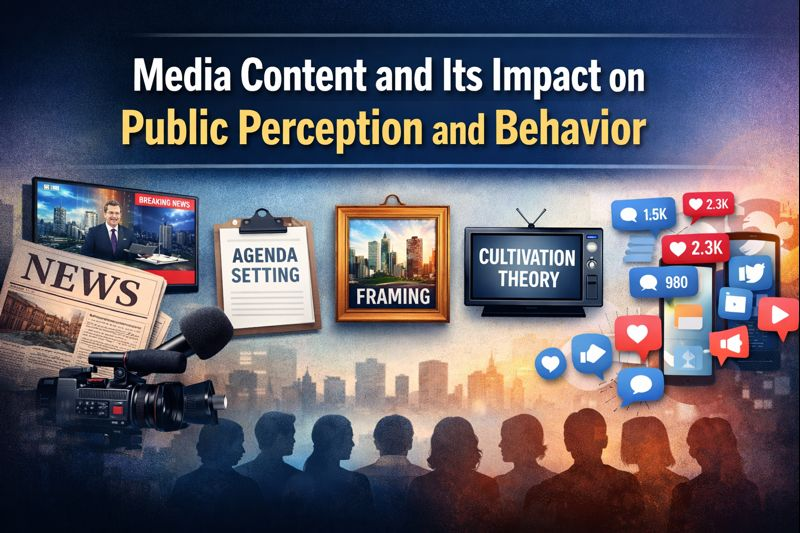
According to Agenda-setting theory, the media shape the relevance of issues in the minds of the population (McCombs and Shaw, 1972). The media influence the perception of audiences on a given issue, as they would want to focus more on the issues that need attention.
3.2 Framing Theory
Framing theory is concerned with media presentation of issues and occurrences. Entman (1993) states that frames produce the definition of the problem, diagnosis, moral judgment, and remedies. The manner in which a problem is framed can have a great impact on the perception and reaction of the audience.
3.3 Cultivation Theory
The cultivation theory suggests that the perception of reality depends on long-term exposure to the media content (Gerbner et al., 2002). Excessive media consumers tend to take up the perspectives that are aligned with the prevailing media images especially on social norms and risks.
4.0 Conceptual Framework
The theoretical framework of the given study shows the connection between media content and the general perception and behavior.
- Media Content (News, Entertainment, Social Media).
- Media Processes (Agenda-Setting, Framing, Cultivation).
- Audience Results (Attitudes, Beliefs, Perceptions).
- Behavioral Responses (Opinions, Social Actions, Decision-Making).
This theory proves that media effects are produced in a certain way which affects cognition and behavior.
5.0 Methodology
This paper will adopt a qualitative research design that will be based on secondary research. The academic journals, books, and other reliable media studies were systematically reviewed to analyse the media effects theories and empirical results. Moreover, the modern examples of the news media, entertainment media, and social media were evaluated to not only put theoretical arguments into perspective.
Qualitative approach has been selected due to the fact that it provides a possibility to in-depth interpret media influence and apply the theories instead of directly measuring causality. This approach suits the study of social processes that are complex like the manner in which perception is formed and behavior is influenced.
6.0 Findings
6.1 Change in Public Attitudes and Beliefs
The discussion has shown that the content of the media plays a significant role in shaping the attitude of the population by placing priorities on issues and promoting the prevailing discourse. Agenda-setting processes make sure that some issues are at the top of the agenda, whereas framing is related to the understanding of the issues.
6.2 Media Content Behavioural Influence
Media content helps in shaping behavior by means of modeling, persuasion, and normalization. The media has the capability to mobilize audiences through health campaigns, political movements, and social justice initiatives. On the other hand, negative behavior can be propagated by misinformation and other negative stereotypes.
6.3 Long-term perceptions are formed
In line with the cultivation theory, prolonged exposure to media stories leads to collective awareness of reality. When media depiction is biased or redundant, the viewers can be subjected to skewed perspectives.
Table 1
Summary of Media Effects Theories
| Theory | Key Focus | Major Influence on Audience |
| Agenda-Setting | Issue salience | Determines what people think about |
| Framing | Interpretation | Shapes how issues are understood |
| Cultivation | Long-term exposure | Influences perceptions of reality |
Table 2
Types of Media Content and Audience Effects
| Media Type | Primary Content | Potential Effects |
| News Media | Information, analysis | Opinion formation, political awareness |
| Entertainment Media | Fiction, drama | Social learning, value normalization |
| Social Media | User-generated content | Attitude reinforcement, mobilization |
Discussion
The results corroborate the existing theories of media effects by proving that media content is actively involved in the process of influencing the opinion of the population and their actions. Agenda-setting assumes the issue prioritization, framing elucidates the interpretative processes, and the cultivation theory provides explanations of the long-term shifts in perception.
The algorithmic content distribution and permanent connectedness enhance these effects in the context of digital media. The audiences have become interactive, but still, media institutions and media platforms have a lot of power. This is where media literacy and ethical media production are important.
Conclusion
The media content has a major influence on the perception and behavior of people by setting the agenda, framing, and cultivation. Media do not mirror reality, they create social meaning and shape behavioral trends. With the ongoing development of media technologies, it is necessary to know about media impacts in order to be a responsible media user and well-informed citizen. Future studies are to include empirical audience research and the connection on the use of artificial intelligence in media content distribution.
References
Bandura, A. (2001). Social cognitive theory of mass communication. Media Psychology, 3(3), 265–299.
Couldry, N. (2012). Media, society, world: Social theory and digital media practice. Polity Press.
Entman, R. M. (1993). Framing: Toward clarification of a fractured paradigm. Journal of Communication, 43(4), 51–58.
Gerbner, G., Gross, L., Morgan, M., & Signorielli, N. (2002). Growing up with television: Cultivation processes. In J. Bryant & D. Zillmann (Eds.), Media effects: Advances in theory and research (pp. 43–67). Lawrence Erlbaum.
McCombs, M. E., & Shaw, D. L. (1972). The agenda-setting function of mass media. Public Opinion Quarterly, 36(2), 176–187.
McQuail, D. (2010). McQuail’s mass communication theory (6th ed.). Sage Publications.
Sunstein, C. R. (2018). #Republic: Divided democracy in the age of social media. Princeton University Press.


