Abstract
The mass media are also formal social institutions, which carry out systematic and long-term functions in contemporary societies. Like other systems such as education, religion, and government, the media institutions are structured systems with prescriptions, morals, and regulations. This paper discusses mass media as a social institution in terms of its structure, theoretical principles, ethical responsibility, and social influence. As the literature-based approach is based on the existing sociological and communication theories, the study employs a qualitative methodology approach to address the role of media institutions in providing social order, collective identity, and democratic practice. The results indicate that mass media are not only reflections of reality in society but also acting forces that define norms, values, and power relations in society.
Keywords: Mass media; Social institutions; Media ethics; Social order; Democracy; Communication studies
1.0 Introduction
Social institutions exist to fulfill the basic needs of society in a well-organized and standardized practice. Knowledge is handed down through education, moral guidance is given by religion, and the government keeps political order. Similar functions in current societies are played by the mass media, which broadcast information, define social norms, and shape collective consciousness.
The mass media are not islands on their own. They are interwoven in the social, political, and economic systems, which shape their structure, content, and practices. Simultaneously, media establishments affect the perception of the population, cultural representation, and democracy. Such a dual relationship makes mass media both producers and products of social reality.
This paper discusses mass media as a formal social institution, their organizational structure, ethical conduct, and societal roles. It also examines theoretical explanations of media influence and empirical evidence in the literature, which illustrate the influence of media in sustaining social order and enforcing democratic values.
2.0 Literature Review
2.1 Conceptualizing Mass Media and Social Institutions
According to scholarly writings, mass media refers to institutionalized mechanisms of communication which convey messages to large and heterogeneous audiences (McQuail, 2010). Social institutions, in turn, are systematic networks of norms and positions that serve to control behavior and provide social stability (Giddens, 2013). The meeting point of these ideas defines mass media as an institutional power in society.
Past literature underlines that mass media have long-lasting organizational frameworks, professional jobs, and ethical guidelines that separate them from informal communication systems. Haralambos and Holborn (2013) suggest that continuity, regulation, and social acceptance are aspects through which institutions are legitimized, and all these are elements that describe media organizations.
2.2 Media Institution and Social Responsibility
Studies of media responsibility emphasize the expectation of media institutions to work in the common interest of the people. The Social Responsibility Theory states that media freedom should be maintained in balance with responsibility, truth, and ethical practices (Siebert, Peterson, and Schramm, 1956). There is empirical evidence indicating that ethical journalism empowers the people and strengthens social cohesion.
2.3 Media Influence on Society
The fact that mass media affect the opinion of the population, cultural norms, and politics is recorded in numerous studies. McCombs and Shaw (1972) indicate that the media can affect the priorities of the people by setting an agenda, and Gerbner et al. (2002) indicate that perceptions of the audience on reality are influenced after long periods of exposure to the media. This research affirms that media institutions are actively involved in creating social awareness.
3.0 Theoretical Review
3.1 Functionalist Theory
The functionalist approach sees mass media as a social institution that brings about stability in society. Lasswell (1948) determines the important media functions as surveillance, correlation, and cultural transmission. In this perspective, the media facilitates social integration, enlightens citizens, and strengthens common values.
3.2 Conflict Theory
Conflict theorists also believe that media institutions mirror and reproduce existing power structures. Marxist ideas suggest that the media benefit the interests of the ruling classes and the economic and political elites by propagating current ideologies (Marx and Engels, 1978). Content and representation are affected by ownership and control of media organizations.
3.3 Agenda-Setting and Cultivation Theories
The agenda-setting theory describes the process by which media can impact the priorities of the population by highlighting certain concerns (McCombs and Shaw, 1972). Cultivation theory postulates that habitual media images influence the perception of social reality over the long run (Gerbner et al., 2002). These theories explain how mass media institutional power has in shaping public understanding.
4.0 Methodology
4.1 Research Design
The research design is a literature-based study that is qualitative in nature. This method allows for close analysis of the available scholarly literature on mass media as a social institution.
4.2 Data Sources
Secondary data were gathered from peer-reviewed journal articles, academic books, institutional reports, and other reliable academic publications in sociology and communication studies. The selection of sources was based on relevance, credibility, and contribution to theory.
4.3 Method of Analysis
Thematic analysis was used to determine common trends associated with media structure, ethical accountability, social impact, and institutional functions. This approach helped in the comparative interpretation of theoretical and empirical studies.
5.0 Findings and Analysis
5.1 Media Institution Structural Characteristics
The results indicate that mass media work using formal organizational systems, such as professional role systems, editorial hierarchies, and regulatory frameworks. These structures provide consistency, responsibility, and institutional continuity.
5.2 Norms and Ethical Regulation
The literature has shown evidence that media legitimacy is pegged on ethical norms such as accuracy, fairness, and objectivity. Media outlets that embrace professional ethics have a beneficial impact on society and public trust.
5.3 Media and Social Order
It is demonstrated in the analysis that mass media play a part in social order by strengthening norms, encouraging shared values, and providing platforms for public discussion. Nonetheless, social cohesion may be derailed by biased or unethical media practices.
5.4 Media and Democratic Influence
There is still a debate concerning the role of media and its influence on democracy. Discoveries show that media institutions are important not only in democratic processes but also in political reporting, watchdog journalism, and civic education. Political awareness and participation are improved because of media exposure.
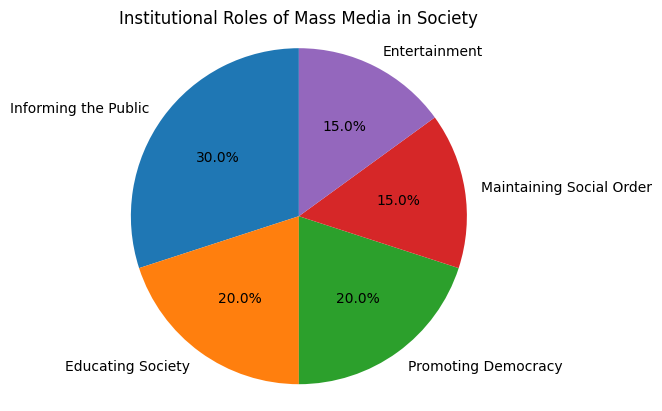
Figure 1 description:
A piechart showing the distribution of the core institutional roles of mass media, including informing the public, educating society, promoting democracy, maintaining social order, and entertaining.
6.0 Discussion
It can be concluded that mass media are formal social institutions with a strong impact on society. In line with functionalist theory, social integration occurs through media promoting information and education to the public. Meanwhile, conflict theory describes the impact of media ownership and control on ideological outcomes.
Ethical regulation and professional accountability are emphasized by the institutional power of mass media. With the growth of digital platforms, the role of media institutions is more complex and demands new attention to ethical norms and community interests.
7.0 Conclusion
This paper will show that mass media are highly organized social institutions, just like education, religion and the government. Media institutions define social order, shared identity, and democratic living through the organizational structures, moral principles, and communicative roles.
As the paper concludes, the analysis of the social processes today cannot be carried out without understanding the mass media as a social institution. Enhancement of ethical practice, regulatory control, as well as media literacy will strengthen the positive role of mass media in the development of society.
References
Gerbner, G., Gross, L., Morgan, M., & Signorielli, N. (2002). Growing up with television: Cultivation processes. In J. Bryant & D. Zillmann (Eds.), Media effects (pp. 43–67). Lawrence Erlbaum.
Giddens, A. (2013). Sociology (7th ed.). Polity Press.
Haralambos, M., & Holborn, M. (2013). Sociology: Themes and perspectives. Collins.
Lasswell, H. D. (1948). The structure and function of communication in society. In L. Bryson (Ed.), The communication of ideas (pp. 37–51). Institute for Religious and Social Studies.
Marx, K., & Engels, F. (1978). The Marx-Engels reader. Norton.
McCombs, M. E., & Shaw, D. L. (1972). The agenda-setting function of mass media. Public Opinion Quarterly, 36(2), 176–187.
McQuail, D. (2010). McQuail’s mass communication theory (6th ed.). Sage Publications.
Siebert, F. S., Peterson, T., & Schramm, W. (1956). Four theories of the press. University of Illinois Press.