
Introduction
Pricing in the retail and business sector is not simply a matter of simply placing a price on a product, it is a tactical move that will enable profitability, competitiveness and customer opinion. Mark-ups and mark-downs in retail pricing are business pricing strategies that organizations depend on to control their costs, maximize profits, and react to the market needs. Such techniques assist the retailers to balance between the cost of covering expenses and customer attraction.
This article discusses the manner in which mark-ups and mark-downs are used to determine the selling price by business, the calculation of cost and profit margins, and how such pricing strategies are valuable instruments in business success.
What Are Mark-Ups or Mark-Downs?
There are some fundamentals which one should be aware of before getting down to calculation and strategy.
Mark-up is a price increase to the cost price of a product in order to come up with a selling price. It is the amount of profit that a business is going to earn.
A mark-down on the other hand is a decrease in the initial selling price. Businesses apply mark-downs to stimulate sales, liquidate inventory or react to demand fluctuations.
In case you need a deeper description of how these pricing methods work in business, you can consider checking this comprehensive guide on mark-ups and mark-downs to make you understand it even further.
Understanding Cost Price, Selling Price and Profit
In order to effectively implement pricing strategies, three main components should be well determined in businesses:
1. Cost Price (CP)
The cost of the production or purchase of a product is the total amount. It includes:
- Suppliers price of purchase.
- Inland transportation and shipping expenses.
- Handling and storage costs.
- Packaging costs
An illustration of this is when a retailer purchases a shirt at N5,000 and an additional N500 in logistics, the overall cost price is N5,500.
2. Selling Price (SP)
The selling price is what the product will be sold to the customers at. It is here that mark-ups and mark-downs come in.
3. Profit Margin
Profit = the difference between the selling price and the cost price:
Profit=Selling Price-Cost Price.
Profit margin can be put as a percentage:
Profit Margin (%) = (Profit/Selling Price) x100.
Knowledge of these factors assists business organizations to charge prices that are sustainable and lead to expansion.
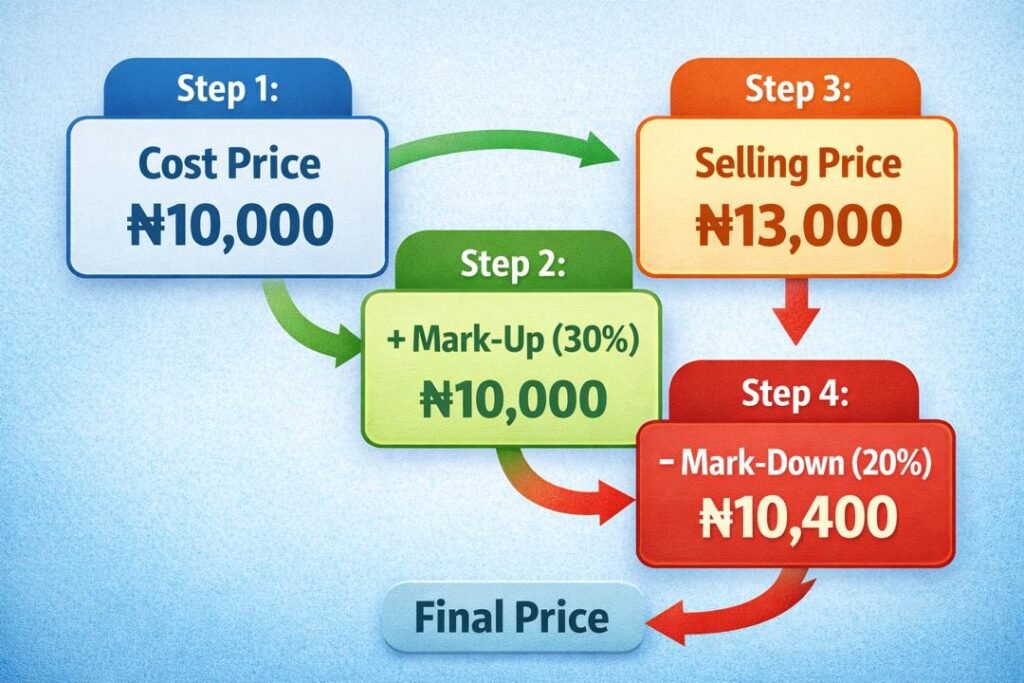
The Method used by Businesses to Calculate Mark-Ups.
Mark-ups play a vital role in enabling the businesses to meet their expenses and make a profit. They may be computed in two distinct ways:
1. Mark-Up Based on Cost Price
Mark-up is computed using this method as a percentage of cost price:
Mark-Up (%) = (Profit / Cost Price) x 100
Example:
- Cost Price = N10,000
- Desired Profit = N3,000
Mark-Up (%) = (3,000 / 10,000) x 100 = 30%
Selling Price = N13, 000
2. Mark-Up Based on selling price
There are businesses who wish to mark-up as a percentage of the selling price:
Mark-Up (%) = (Profit/Selling Price) x 100.
This is commonly applied in retail in order to have regular pricing systems.
Factors that Influence Mark-up Decision
Businesses do not make mark-ups randomly. There are a number of factors that play a role in pricing:
1. Industry Standards
There are normal ranges of mark-ups in different industries. For example:
- Grocery stores: low mark-ups (5-15%)
- Fashion retail: increased mark-ups (50-100 and above)
2. Competition
Companies have to look at the prices of their competitors. Excessively high prices can push away the customers and excessively low prices can decrease the margins of profit.
3. Product Type
Brand value is likely to increase the mark-ups on luxury goods and reduce the mark-ups on everyday essentials.
4. Operating Costs
The increased costs (rent, salaries, and utilities) may involve increase in the mark-ups to keep profits.
5. Demand and Supply
Businesses can make higher mark-ups in case demand is high and supply is low. On the other hand, there might be too much supply and this could necessitate reduced mark-ups.
What Are Mark-Downs and Why Are they Important?
Mark- downs are price cuts that are done following the first sales price. Whereas the mark-ups are concerned with profit generation, the mark-downs are concerned with sales stimulation and inventory management.
Common Reasons for Mark-Down
- Clearing Old Inventory: The goods which are seasonal (e.g., winter clothes) should be sold before they expire.
- Boosting Sales: Customers and traffic to the store are attracted through discounts.
- Correcting Overpricing: When a product is not selling, lowering the price can enhance the demand.
- Promotional Campaigns: Promotional sales events such as Black Friday or holiday sales are critically dependent on mark-downs.
How to Calculate Mark-Downs
Mark-downs are done as a percentage of the original selling price:
Mark-Down (%) = (Amount of Reduction /Original Price) 4×100.
Example:
- Original Price = N20,000
- Reduced Price = N15,000
Reduction = N5,000
Mark-Down (%) = (5,000 / 20,000) x 100 = 25%
Types of Mark-Down Strategies
There are various variations of a mark-down strategy applied by business:
- Seasonal Mark-Downs: It was used at the close of a season to get rid of stock.
- Promotional Mark-Downs: Discounts applied temporarily in case of special events or campaigns.
- Clearance Mark-Downs: Stock-outs were eliminated through deep discounts.
- Competitive Mark-Downs: Price cuts to counter competitors who are reducing their prices.
The Relationship between Mark-Ups and Mark-Downs
Mark-ups and mark-downs in retail pricing have a close relation. Mark-ups require a business to plan attentively in order to make sure that despite putting mark-downs, the business is capable of making a profit.
For example:
- A product is marked up by 50%
- Later, it is discounted by 20%
A discount may still allow the business to make a profit should it be calculated properly.
But in the case of poor planning, losses will occur in case of mark-downs, which are greater than the original profit.
The Retail Pricing Strategies Using Mark-Ups and Mark-Downs
Good companies use mark-ups and mark-downs in conjunction with more extended policy pricing:
1. Keystone Pricing
This is a doubling of the cost price strategy:
Selling Price = 2 x Cost Price
It is easy, and it might not be effective in very competitive markets.
2. Psychological Pricing
The products available are priced slightly below a round figure (e.g. N9,999, not N10,000) to make them look cheaper.
3. Dynamic Pricing
The prices are adjusted according to customer service, time, or demand.
4. Bundle Pricing
Several products are offered to be purchased as a package at a reduced price to boost the sales.
5. Penetration Pricing
Companies offer low prices when starting so as to win customers, and later raise them.
Role of Mark-Downs in Inventory Management
The retail management of inventory is a very vital issue that mark-downs contribute towards.
Preventing Overstocking
Unsold products occupy the capital and storage facility. Mark-downs assist in clearing the products.
Reducing Losses
Unsold products can either be out of date or spoilt. It is preferable to sell them at a discount price than not to sell them at all.
Improving Cash Flow
Mark-downs turn inventory into cash which enables the businesses to invest in newer products.
Balance between Profitability and Customer Attraction
Pricing of the retailing business is one of the most challenging issues in balancing between profitability and customer satisfaction.
- Mark-ups Reduce sales volume but make the profit per item high.
- The frequent mark-downs will attract the customers but may decrease the profitability.
Businesses should strike the appropriate balance in order to be competitive and yet to be sustainable in the long term.
Common Mistakes in Pricing Strategies
Pricing mistakes can occur even with an experienced business. The following are some of the typical errors:
- Ignoring Costs: Underpricing and losses may be caused by not including all costs.
- Overpricing Products: Too high prices can push customers to the rivals.
- Excessive Discounting: The repetitive discounts may lower the perceived value and condition the customers to make sales.
- Poor Market Research: Lack of knowledge on the preferences of customers and the price of the competitors may lead to poor pricing strategies.
Benefits of Effective Pricing Policies
When mark-ups and mark-downs are effectively applied by business, it has a number of advantages:
- Increased Profitability: Pricing is done properly so that costs are not incurred and profits are maximized.
- Better Inventory Control: Mark- downs are useful in maintaining optimal stock levels.
- Exemplary Customer Satisfaction: Competitive and fair pricing creates trust and loyalty.
- Competitive Advantage: Pricing these are strategic and assist the businesses to be distinguished in the competitive markets.
Real-World Example
Take the case of a shoe selling store:
- Cost Price per pair = N8,000
- Mark-Up = 50%
- Selling Price = N12, 000
Few months later when the demand goes down, the store offers a 20 percent mark- down:
- New Price = N9, 600
The store still makes a profit of N1, 600 in one pair even after the discount. This shows that easy planning of mark-ups creates space in which mark-downs are to be used without making losses.
Why Mark-Ups and Mark-Downs Are Essential in Retail
Mark-ups and mark-downs are not only tools of pricing, but they are paramount elements of business strategy.
They help businesses:
- Set competitive prices
- Efficiency in inventory management.
- Respond to market changes
- Maintain steady cash flow
- Optimize the long-term profitability.
In the absence of these tricks, businesses would not be able to adapt to the emerging consumer behavior and the economic environment.
Conclusion
Knowing mark-ups and mark-downs in retail pricing is one of the key aspects of successful retail and business operation. Mark-ups are needed to make the businesses self-sufficient and profitable whereas mark-downs are aimed at attracting customers and controlling the stocks.
The delicate computation of cost price, selling price, and profit levels leads to the development of efficient pricing strategies to ensure that the businesses are profitable and satisfying to the customers. These techniques can be strong instruments when properly utilized to promote sales, enhance efficiency, and guarantee success in the long run.
In the modern competitive business world, it is not an option to learn how to mark-up and mark-down products and services, but it is a must-have tool to every business which wants to survive.
Get more well researched information about Mark-ups and mark-downs in retail pricing here.

This article came at the perfect time for me.