The hardware makes up a Computers and software us necessary combination to allow it to run properly and fulfill the expectations of users. To achieve maximum performance for a system, it is important to know how processors, memory, storage drives, and the motherboards influence system configuration and get tips on compatibility, performance tuning, and the best component choices.
Computer Concepts
Computer configuration is the types of hardware that is installed and running on the system. Everything that affects speed, performance, stability and efficiency. An optimally tuned PC is one in which all components are well matched so that no one element is waiting on another for data.
The Perfect Match: Why Balance is Important
In particular, balance in a configuration is important for running any modern stating that ‘tasks’ such as gaming, content creation, and multitasking are more dependent on multiple components working cohesively rather than a single powerful part.
The Role of the Processor (CPU)
The CPU, which we also refer to as the processor, is the brain of the computer. It issues instructions, does the math, and runs system operations. At opening your browser to running complex software, each task is performed by the CPU.
Key Contributions of the CPU: Primary Features of the CPU:
- Determines total system performance and response
- Handles multitasking and application execution
- Software and the which is input
- Influences which motherboards and memories work
Factors to Consider: Note that which:
- Clock speed (GHz): In single thread tasks performance is seen to increase and speed up
- Core count: More tasks can be run at the same time with more threads
- Thread count: Improves better performance in heavy workloads
- Cache size: Reduces latency and improves data access time
Performance Impact: Report of the findings:
- Gaming performance improves with higher clock speeds and better architecture
- Video editing and render scaling
- In the doing out of daily tasks we see a balance of both
HAPPY: At the core of the operation is the processor which is known to be the key element in any machine’s make up.
Memory (RAM) and Its Impact
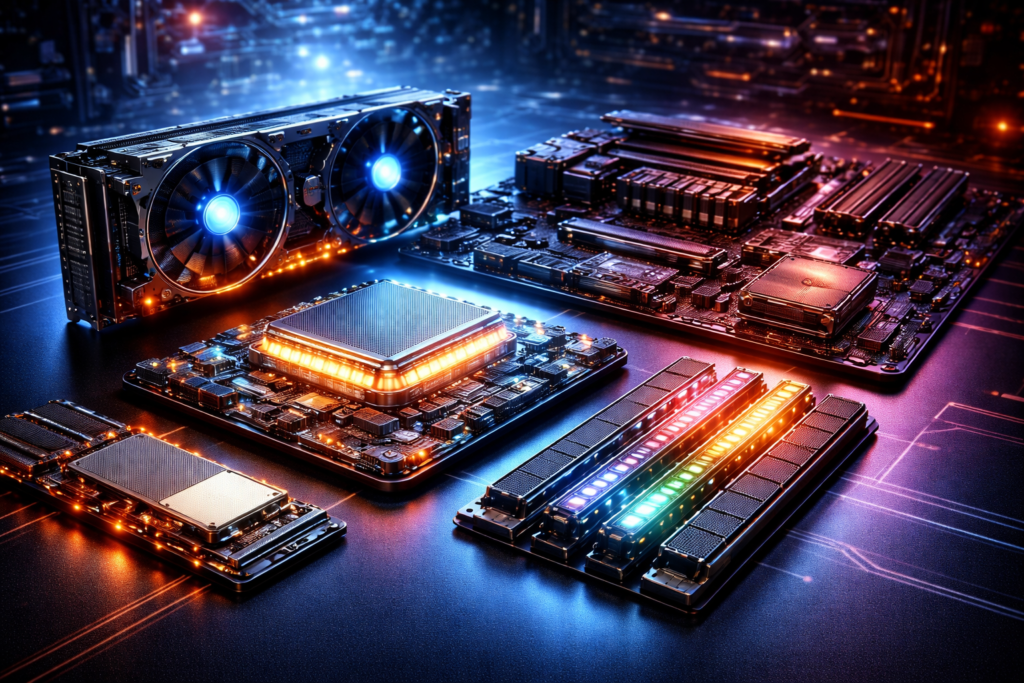
RAM which includes data that the CPU has immediate access to. As opposed to storage devices which are very slow, RAM is very fast which in turn runs applications smoothly and without delay.
Why RAM Matters: What type of RAM is used matters.
- Enables seamless multitasking
- Reduces system lag and delays
- Improves performance on application switch
- Supports speedier performance of present processes
Choosing the Right RAM: Picking out the Right RAM:
- Capacity: Size of
- 8 GB For basic tasks
- 16GB for most users
- 32GB+ which is suggested for gaming, design, and heavy workloads
- Speed (MHz): Faster system response time Improved performance of the environment which scales better We see that as we increase speed the system response time improves What we note is at large scale and high speed the performance goes up The speed at which the system responds to input requests which we notice as we increase speed
- Latency: Reduced delay improves performance
- Compatibility: Must adhere to motherboard specifications
Real-World Impact: In the Field:
- In case RAM causes delays and crashes
- More RAM which is great for smooth performance in heavy tasks
- High speed RAM which does better
HAPPY: More memory for your system means better performance and more of a smooth experience which you will also see in better multi-tasking.
Storage Devices: Speed and Size
Storage options that we use for data which we save and retrieve. Also what type of storage we use affects boot times of the system, file access speed and overall responsiveness.
Types of Storage: Categories of storage:
- HDD (Hard Disk Drive):
- Large storage capacity
- Slower read/write speeds
- Sure for backups and large files
- SSD (Solid State Drive):
- Faster performance
- No moving parts (more reliable)
- For what we see in terms of operating systems and applications
- NVMe SSD:
- Extremely high-speed data transfer
- Uses PCIe interface for optimal performance
- For gaming, editing and high performance computing
Key Considerations: Primary Problems:
- Boot time and application load times
- Storage capacity requirements
- Reliability and durability
- Cost per gigabyte
Performance Benefits: Improvements in Performance:
- SSDs drastically reduce boot time
- NVMe drives excel in intensive tasks
- SSD for operating system and HDD for storage is a usual approach
HAPPY: Upgrading to SSD or NVMe will see large improvements in performance and user experience.
The Importance of the Motherboard
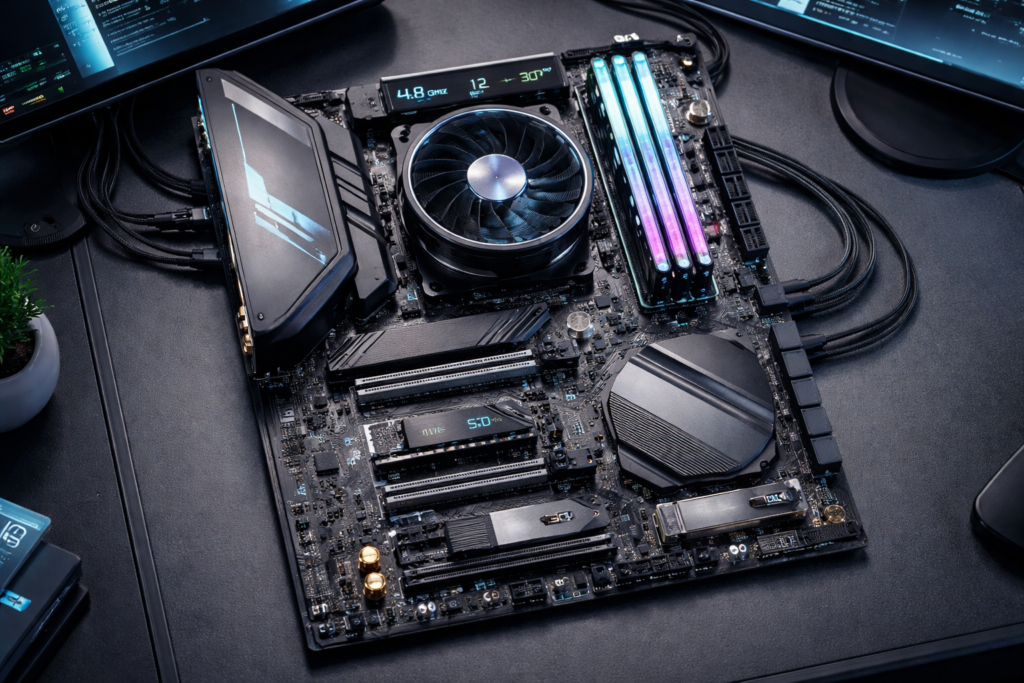
The motherboard is at the base of the system which in turn connects all hardware elements and makes their communication smooth. Also it is the element which determines what components will plug in and how they interact.
Key Functions: Main Points:
- Connects all hardware elements which include the CPU, RAM, storage and peripherals
- Determines compatibility of all components
- Provides expansion slots for upgrades
- Manages data flow between hardware
What to Look For: What for:
- Socket type: Has got to be the CPU
- Chipset: Presents features and specs
- RAM support: Determines memory type, speed and capacity
- Expansion slots: Required for GPUs and also we have included some extra hardware
- Connectivity options: USB ports, networks, storage
Why It Matters: Why this is so important:
- Limits or expands upgrade potential
- Affects system stability and reliability
- Plays a key role in future proofing your system
HAPPY: The motherboard is what has all the components working together.
Compatibility: Road to Top Performance
At times some parts perform below their best which is a result of incompatibility. For optimal performance it is essential that hardware elements are aligned.
Compatibility Checklist: Compatibility Table:
- CPU must match motherboard socket
- RAM must have these for type, speed, and capacity
- Storage interfaces should match motherboard ports
- Power supply should run all components
Common Mistakes to Avoid: Issues to be aware of:
- Mixing incompatible RAM types
- Choosing unsupported CPUs
- Ignoring motherboard limitations
- Underestimating power requirements
Why Compatibility Matters: What matters is compatibility.
- Prevents system crashes and instability
- Ensures efficient performance
- Maximizes hardware lifespan
HAPPY: Compatibility is the base which we see for the stability and full potential of your system.
Balancing Performance and Efficiency
A strong system is a whole that is greater than the sum of its parts each element should support the other to prevent bottlenecks.
Best Practices: Best Example:
- Fine tune your system performance with enough RAM
- Use SSD or NVMe for speed
- Select a motherboard which supports upgrades
- Do not place all your resources in a single area
Bottleneck Examples: In some cases:
- Fast CPU but little RAM which results in slow performance for multi-tasking
- High end graphics card Underpowered CPU Decreased performance
- NVMe SSD on old motherboard Limited speed benefits
HAPPY: A stable setup which performs well and surely.
Real-World Configuration Examples
Basic Office Setup:
- CPU: Base processor
- RAM: 8 GB
- Storage: ISS
- Focus: Economy and economies of size
Gaming System:
- CPU: Multi core high performance CPU
- RAM: 15 GB 32 GB
- Storage: Solid state drive which uses NVMe
- Focus: Speed and dexterity
Professional Workstation:
- CPU: High core number processor
- RAM: 30 Gigabytes+
- Storage: Sure thing, how about: IGNORE that secondary storage
- Focus: Intense multitasking and dependability
HAPPY: Select out the best components for your specific use case which in turn will see best performance and quality.
Future Trends in Hardware Configuration
Technology is in a perpetual state of change, that in turn changes how we set up our systems.
Emerging Trends: Up and Coming:
- Faster DDR5 RAM for better performance
- PCIe Gen 5 storage for lightning fast data transfer
- More energy-efficient processors
- AI augmentation in CPUs and GPUs
What This Means: What which is to mean:
- Systems are getting faster and better
- Upgradability has like never before
- Compatibility considerations are expanding
HAPPY: Keeping up with the latest trends is a must for the systems we put in.
Conclusion
Hardware that includes processors, memory, storage devices, and motherboards is a base for computer systems’ design. Each component brings in its own what is needed which in turn affects system performance and what we put in terms of compatible, well balanced parts will see better performance, stability and longevity.
Via which of these elements do we present to you what we do. We bring to you a computer that we have built up, upgraded, or chosen out for you based on your needs. For the everyday user, the gamer, or the professional our tailored computers perform at the highest level and we present the best experience.