
Introduction
One of the most effective methods of accumulating wealth in the long term is investing, but investing for beginners, it may be baffling and daunting. There are too many choices and all kinds of stocks, bonds, mutual funds, ETFs, and a great deal of opinion on the net so it is often the starting point that is the hardest. There are those who wait to invest until they are certain they will lose some money whereas some get into this too fast and end up doing expensive errors.
The fact is that investing for beginners does not necessarily need to be complex. One can start investing with confidence with the proper knowledge and a well-defined plan. The initial step towards making smart financial choices and financial goals that can be attained in the long term is to understand the basics of investing.
This article will also take you through the basics of investing, the most important types of investments and the major pitfalls to beware of. At the end, you will have a good basis to start investing in a wise and responsible manner.
What Is Investing?
Investing refers to a process of allocating your funds to some financial instruments with a view to earning a payoff in the future. In contrast to saving, where the money is usually deposited in low-risk accounts, investing is a risky undertaking that promises in the future of higher returns.
I put money into it and it works. As an illustration, when you purchase the stock of a company, you own a little part of the company. The value of your investment can go up in case the company expands and gains more profitability.
Investing for beginners is not a one-day affair of making money; it is a day after day affair of increasing your wealth by being patient and disciplined and making well-informed decisions.
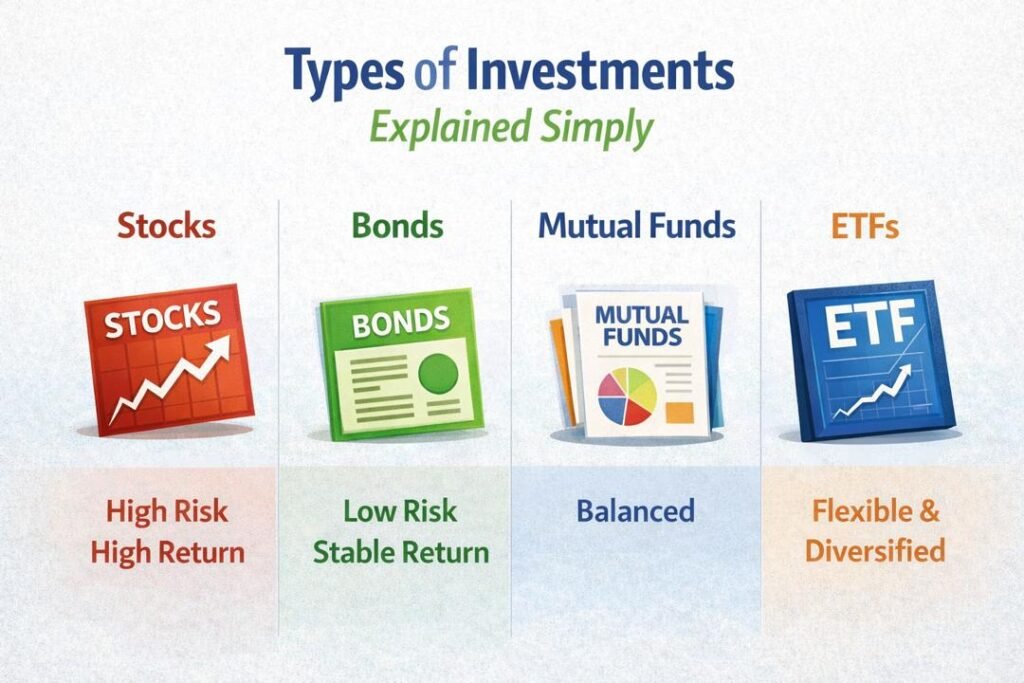
Types of Investments
Knowledge of the primary types of investments is crucial to novices. Both of the options have a degree of risk, potential of returns, and the purpose.
1. Stocks
Stocks are a form of ownership in a company. By purchasing a stock, you are a shareholder.
Advantages:
- High potential returns
- Opportunity to earn dividends
- Shares in developing businesses.
Risks:
- Prices are not stable.
- The possibility of loss in case of poor performance by the company.
Stocks are recommended to investors who are prepared to take more risk in order to have more returns in the long term.
2. Bonds
Bonds are loans you issue to governments/corporations. In their turn they pay you an interest during a certain period.
Advantages:
- Stable as compared to stocks.
- Stable revenue by the way of interest payments.
Risks:
- Reduced returns than stocks.
- Risk of issuer default
Conservative investors or investors seeking stable income tend to invest in bonds.
3. Mutual Funds
Mutual funds combine the resources of several investors to invest in a diversified portfolio of stocks, bonds or other resources.
Advantages:
- Professional management
- Instant diversification
- Suitable for beginners
Risks:
- Management fees
- Reduced freedom of decision-making on investment.
Those who want to invest in a hands-off manner can use mutual funds.
4. Exchange-Traded Funds (ETFs)
The ETFs are like mutual funds, only that they are listed in the stock exchanges like stocks.
Advantages:
- Low fees
- Portable and simple to purchase and sell.
- Diversified
Risks:
- Market fluctuations
- Some ETFs can be tracking volatile areas.
ETFs are also a favorite among novices in the sense that they have diversification and flexibility.
Understanding Risk Tolerance
Risk tolerance is how much you can and are willing to risk by losing part or all of your investment in order to get some returns.
There are a number of determinants of risk tolerance:
- Age
- Income level
- Financial goals
- Investment timeline
For example:
- A young investor, who has a consistent income, might also assume greater risks since he/she will have time to make up his/her losses.
- A person who is approaching retirement age would wish to invest in less risky securities to cushion his or her savings.
Understanding your risky level will enable you to select appropriate combination of investments and to avoid unnecessary stress.
The Importance of Diversification
Diversification refers to diversifying your investments to decrease the risk.
Investing all your money on one stock is not advisable, you invest on a variety of assets like:
- Stocks of various industries.
- Bonds
- ETFs or mutual funds.
Why diversification matters:
- Minimizes the effects of one loss.
- Offers greater stable returns.
- Manages risk and reward.
Diversification can be best defined as the popular saying that one should not put all his eggs in one basket.
Long-Term Investing Strategy
It is not about timing the market, but rather time in the market that makes successful investing.
The reasons why long-term investing is effective
- Compounding Growth: Incomes breed more incomes with time resulting in geometric expansion.
- Market Recovery: There is a short term decline of markets but in the long term, market trends are expected to pick up and improve.
- Reduced Stress: Long term investors do not have to deal with the daily market fluctuations.
Key Long-Term Strategies
- Contribute on a regular basis (e.g. monthly payments)
- Reinvest dividends
- Remain consistent even when market is down.
- Don’t respond to immediate news.
One of the key values of a successful investor is patience.
How to get started
You do not need much money to get started in your investment. Consistency and discipline are of paramount importance.
1. Set Financial Goals
Outline your purpose of investment:
- Retirement
- Education
- Buying a home
This is because you have clear goals that will guide you in making investment decisions.
2. Create a Budget
Ensure you have:
- Emergency savings
- Stable income
- No high-interest debt
Invest money only you can leave without visiting it awhile.
3. Choose an Investment Platform
Select a reliable brokerage or investment app that suits your needs.
Look for:
- Low fees
- User-friendly interface
- Availability of various types of assets.
4. Start Small
You do not have to start off with a huge amount of money. Invest what you have at hand and make a progressive investment.
5. Educate Yourself
Continue to learn about financial markets and investment strategies. Education minimizes risk and confidence.
Common pitfalls to be avoided
Numerous novices end up losing their money not due to the risks involved in investment but due to mistakes they make easily.
1. Emotional Trading
It is not possible to make decisions when one is afraid or excited as it can result in poor decisions.
- Purchasing (when there is hype) at high prices.
- Selling when market falls due to panic selling.
Recommendation: Continue with your long term plan.
2. Chasing Quick Profits
One of the largest pitfalls of new investors is the so-called get-rich-quick-schemes.
Examples include:
- Impossibly high promises.
- Verified Internet investment sites.
- Ponzi schemes
Fact: Investing legitimately is time consuming and patient.
3. Lack of Diversification
Investing all the money in a single investment poses a lot of risk.
Remedy: Diversify by investing in various assets.
4. Ignoring Fees
Exorbitant charges might decrease your total returns in the long term.
Resolution: Select cheap investment alternatives such as ETF.
5. Not Doing Research
Buy anything without knowing what you are getting.
Advice: It is best to do research before investing.
6. Attempting to Time the Market.
It is almost impossible to ensure highs and lows of the market at all times.
Fix: Invest on a regular basis rather than the best time.
Developing Self-confidence as a Beginner
Knowledge, experience and discipline bring about confidence in investing for beginners.
1. Start with Simple Investments
Get familiar with the simple strategies such as ETFs or mutual funds and then consider the complex strategies.
2. Track Your Progress
Periodically check on your investments, but not too often.
3. Learn from Mistakes
All investors are wrong. Learning and improving is what counts.
4. Stay Consistent
It is better to be consistent, rather than perfect. Consistent investment leads to accumulation of wealth.
The importance of Discipline in investing
Successful investors and unsuccessful investors are divided by the discipline.
Key habits include:
- Being consistent with your plan.
- Avoiding impulsive decisions
- Being long term oriented.
It is not investment luck but an investment strategy and discipline.
Conclusion
Investment is an influential means to accumulate wealth and ensure your financial future. Although investing for beginners might appear complicated initially, the knowledge of the basics can reduce the process to a much easier one. Through understanding the various investments, like stocks, bonds, mutual funds and ETFs, you will be able to make rational decisions that match your objectives and risk-taking ability.
Another critical point is not to make typical errors such as emotional trading, not to diversify, and believe in unreasonable promises of fast money. These traps may derail you and make you lose what is not necessary.
Patience, discipline and never stopping learning are the key to successful investing. Begin small, be regular and concentrate on long term growth, as opposed to short term profits. Your investments can greatly increase over time and you will be able to be financially independent and at peace.
Keep in mind, all the professional investors were at first amateurs. That first step today may prove to be a big difference when it comes to your financial future.
Get more well researched information about investing for beginners here.