
In the current digital world, the design of products cannot be done without putting into consideration the end user. Applications, websites, and software that disregard the needs of the user tend not to attract their audience and as a result, they get frustrated, abandoned, and poorly perceived on the brand. It is at this point that user-centered design (UCD) is very important. UCD is a design philosophy that puts the user central in the design process, as well as making sure that the products are not only functional, but also intuitive, enjoyable, as well as efficient.
The foundations of core principles of user-centered design offer guidelines that designers and developers can use to develop solutions that are compatible with human actions, expectations and preferences. Through these principles, organizations are able to make their things easier to use, increase customer satisfaction, and become more interested in their products in the long term.
What Is User-Centered Design?
User centered design denotes a disciplined form of design which deals with the cognizance of the requirements, actions, and objectives of the users. In contrast to design approaches in the past where the focus can be on aesthetics or technological advancement, UCD focuses on empathy and practical use. It aims at making experiences functional as well as intuitively and emotionally resonative.
Key Features of UCD
- Being Humane to the User: UCD starts by having a profound knowledge of the context, problems, and wants of the user.
- Iterative Process: It is a development process whereby designs are created and tested until they are perfected.
- Usability Focus: The functionality is tested in terms of ease of use, ease of access and effectiveness.
- Collaborative Approach: CYCs and other stakeholders work together with designers, developers, and stakeholders in terms of cross-functional working groups with user input leading in the decision-making process.
UCD focuses on the end user as the core of the process thus making sure that products are not designed based on what is supposed to be needed but the actual human behavior.
User-Centered Design: Why It Is Important
UCD is significant because it helps to develop experiences that have an impact on consumers. It is true that companies that implement UCD principles tend to record higher engagement rates, customer loyalty, and reduced complaints or errors.
Improved Usability
User-centered design has a direct influence on usability. In case of intuitive interfaces, users are able to complete their work within a short time and with less frustration. As an illustration, online stores that utilize well-known design patterns to ease down transactions with checkout systems record fewer checkout abandonment instances and increased conversion rates.
Improved Satisfaction and Active participation
A product which is in line with the expectations of the user gives the feeling of control and confidence. Users feel appreciated and they will come back. As an example, user-first applications, like mobile applications enabling the customization of the interface or offering context-sensitive suggestions, increase the level of interaction.
Reduced Development Costs
Though UCD might demand greater initial research and testing, in the end it lowers the cost of development. Early problems of usability keep the company out of costly repairs after the product is launched and enables the company to provide products that address the needs of the users at the first instance.
Basic Tenets of User-Centered Design

To have a successful UCD application, it is important to be familiar with the main concepts of this method. These principles are a guideline that is used when designing functional and enjoyable designs.
Early Concentration on the User and his work
The principle of UCD first is that one should comprehend the users and their intentions and only then design solutions. To collect information on user behaviors and needs, designers use interviews, surveys, observations, and analytics to conduct their research. This is to make sure that the design would be solving actual problems instead of a hypothetical problem.
Scenario: A booking site travels asks the user to complete interviews on how they plan their trips. Insights indicate that price, duration and destination filtering have become important to the users. The addition of these filters at the beginning of the process will make sure that the platform matches up to the expectations of the user.
Empirical Measurement
UCD is based on evidence-based construction. The assumptions should be proved by usability, A/B, and analytics. The interaction with prototypes or live products can be measured, and thus the designers can make informed changes to enhance the usability.
Case Study: A financial technology application tries a new account creation process on a small scale. By seeing what users are afraid or give up during the process, the designer can streamline the process to allow them to sign up without such a process.
Iterative Design
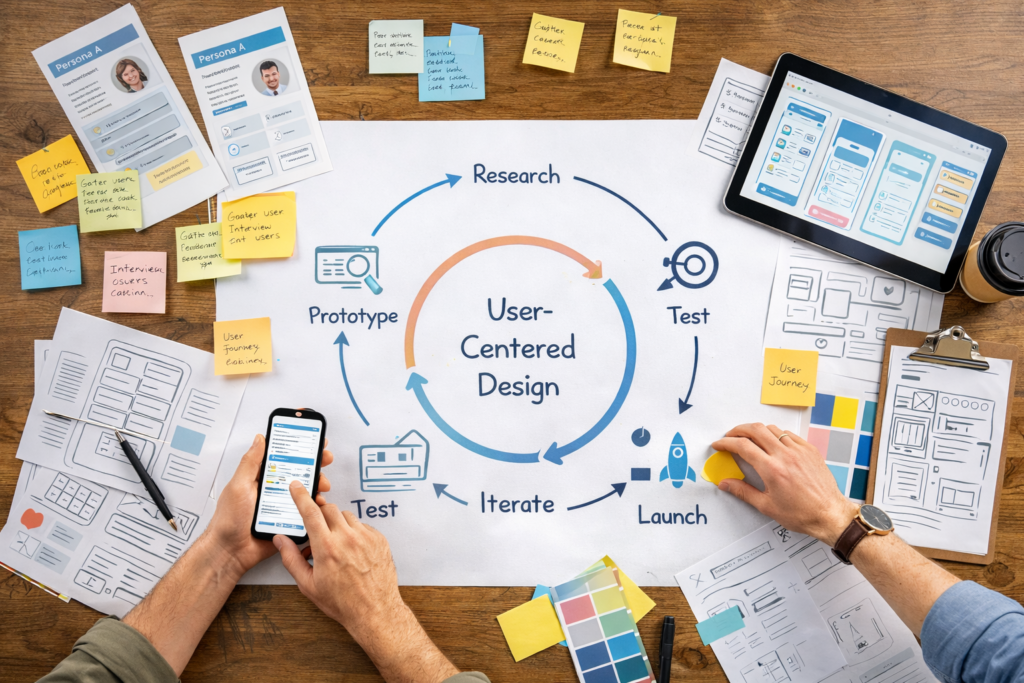
In most cases, design does not work out the first time. UCD encourages cyclic improvement which is the design of prototypes, user testing and refinement and re-testing. The product is brought a step nearer to user needs and expectations in every cycle.
Example: Video streaming services constantly experiment with new layouts of the interface with user panels. The results of these tests inform changes to be added in-between to enhance navigation and content discovery.
Design Driven by the User Requirement
All the design choices must be informed with the collected information about users. Features, layout and workflow are only implemented when they address actual user issues or improve the experience. Such principle avoids the needless complexity and makes the product easy to use.
Sample: An educational application will include a dark mode following the study that students would like to have less brightness on their screens during long learning periods. This aspect responds directly to the needs of the users as opposed to fulfilling the aesthetic value.
Multidisciplinary Collaboration
UCD succeeds when teams comprising a variety of skills such as designers, developers, content creators and marketers work together. Cross-functional teamwork is important to make sure that the needs of the user are taken into consideration in more than one way to make the experience even better.
Example: When making a healthcare app, medical professionals will provide the precision, technical feasibility will be provided by the developers, and usability will be provided by the designers, and then a safe and convenient platform will be created.
Advocacy and Acceptability
The user-centered design is non-discriminatory. Products should be able to meet the requirement of different users based on their abilities, backgrounds, and devices. The product will be user-friendly by all as its accessibility controls, such as using a screen reader, color contrast, and navigating the screen with a keyboard.
Example: A transportation application can introduce a voice guided navigation system enabling visually impaired customers to have fair access to important services.
Approaches and Strategies of User-Centered Design
To implement UCD, particular approaches should be in place to learn and authenticate the needs of users. These methods present practical information on designing.
User Research
UCD is based on user research. Common methods include:
- Interviews: Face to face talks with users to know what motivates and what hurts them.
- Surveys: Gathering quantitative data by a greater number of people.
- Observation: Monitoring the users when interacting with products to determine challenges.
- User profile: Developing representative users on which the design should be based.
Prototyping and Wireframing
Wireframes and prototypes give designers a chance to experiment, prior to being developed fully. Low-fidelity wireframes deal with layout and flow whereas high-fidelity prototypes are used to model the product to be used in testing.
Usability Testing
Effectiveness can only be assessed by testing it on real users. Techniques include:
- Think-Aloud Protocol: The users will talk as they browse the product.
- Task Completion Tests: It is a measure of the ease with which users can perform a certain task.
- Feedback Sessions: Gathering qualitative impressions on the part of the users.
Iterative Refinement
Designs based on the results of the testing process are refined, retested, and optimized. This trial and error style of development ensures that the developed product is close to the anticipation of the users.
User-Centered Design at Work
The effectiveness of UCD is evidenced by a number of organizations that incorporate the concepts into their designs.
E-Commerce Platforms
The most important features of e-commerce giants are convenient navigation, a simplified checkout process, and individual recommendations. They reduce the cart abandonment by constantly testing and refining interfaces depending on the behavior of the users, and enhances the overall satisfaction.
Mobile Applications
Such applications as language learning platforms utilize gamification, instructional paths, and customized notices. These characteristics are founded on massive research by the user and the trial and error, making the learners remain active and motivated.
Public Services
UCD is implemented on government websites and health care platforms in order to enhance accessibility. The services will provide easy access to critical information and simplify steps such as appointments or payments through various user needs.
Problems with User-Centered Design Implementation
As much as the UCD has immense advantages, it is fraught with challenges that can be encountered by organizations.
- Resource Intensity: User research, testing and iterative design takes time, money and expertise.
- Striking a balance between these Stakeholder Goals: Designer needs to compromise between user needs and business goals, technical constraints, and legal requirements.
- Quick Technology Change: The devices, software, and user expectations keep changing and require a continuous adjustment.
These issues notwithstanding, UCD proves to be a worthwhile investment in the long-term with the improvement of usability, satisfaction and loyalty.
Conclusion
The fundamental concepts of user-centered design give a guide to developing products that will really benefit its users. Organizations can develop efficient and engaging experiences by focusing on empathy, usability, iterative development, and collaboration. Since e-commerce sites to mobile applications and government services, UCD makes sure that products are based on actual human demands and not assumptions. With such values, it is not only possible to increase the level of satisfaction and engagement but it also leads to the loyalty and trust, which will eventually lead to success in the ever-competitive digital environment.