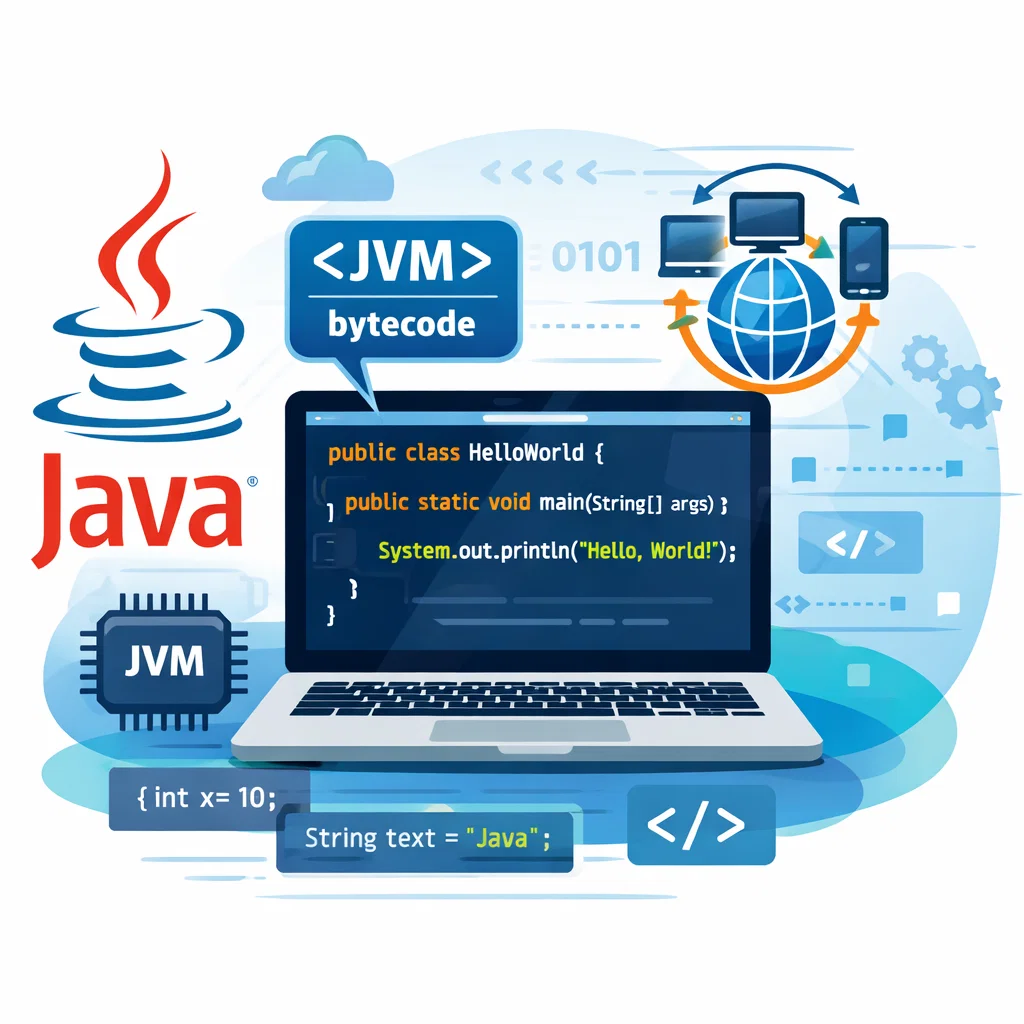
Java is a very popular and versatile programming language in the world today. Famous due to its portability and ease of use, as well as due to its ubiquitous use in mobile apps, as well as in enterprise-level systems, Java remains one of the easiest solutions that developers in different domains use. Be it you are new to the world of programming or you want to advance your knowledge base; it is important to learn the basics of the Java programming language.
This paper will present the main ideas of Java, syntax, structure, and basic components that comprise the foundation of Java programming. Upon completion of this article, an inexperienced reader will be in a proper position to understand how the Java code is written, compiled and executed, and the fundamental elements the language is built on.
Java Syntax and Structure
What is Java Syntax?
The core of Java programming is the syntax which sets of rules of how the Java code should be written. In syntax, it is important so that the code can be interpreted by the Java compiler and the Java Virtual machine (JVM) so that your program can be executed successfully.
Java has a fundamental syntax that comprises of a few major elements which are:
- Statements: A Java program consists of statements which are separate instructions. No statement is normally punctuated with a full stop.
- Blocks: Java code can be divided into blocks which are surrounded with curly braces { } to enclose them. These blocks can delineate body of a class, method or control structure.
- Keywords: Java has reserved words so-called keywords, class, public, static, void, and some others, which are special words in the language, and which may not be used as identifiers.
- Variables, methods, and classes have names assigned to them, which are called identifiers. They should begin with a letter, underscore or dollar sign ($) and may consist of letters, numbers, underscores and dollar signs.
- Comments: Code is explained using comments and is not executed. Java allows one-line comments (//) and multi-line comments (/* */).
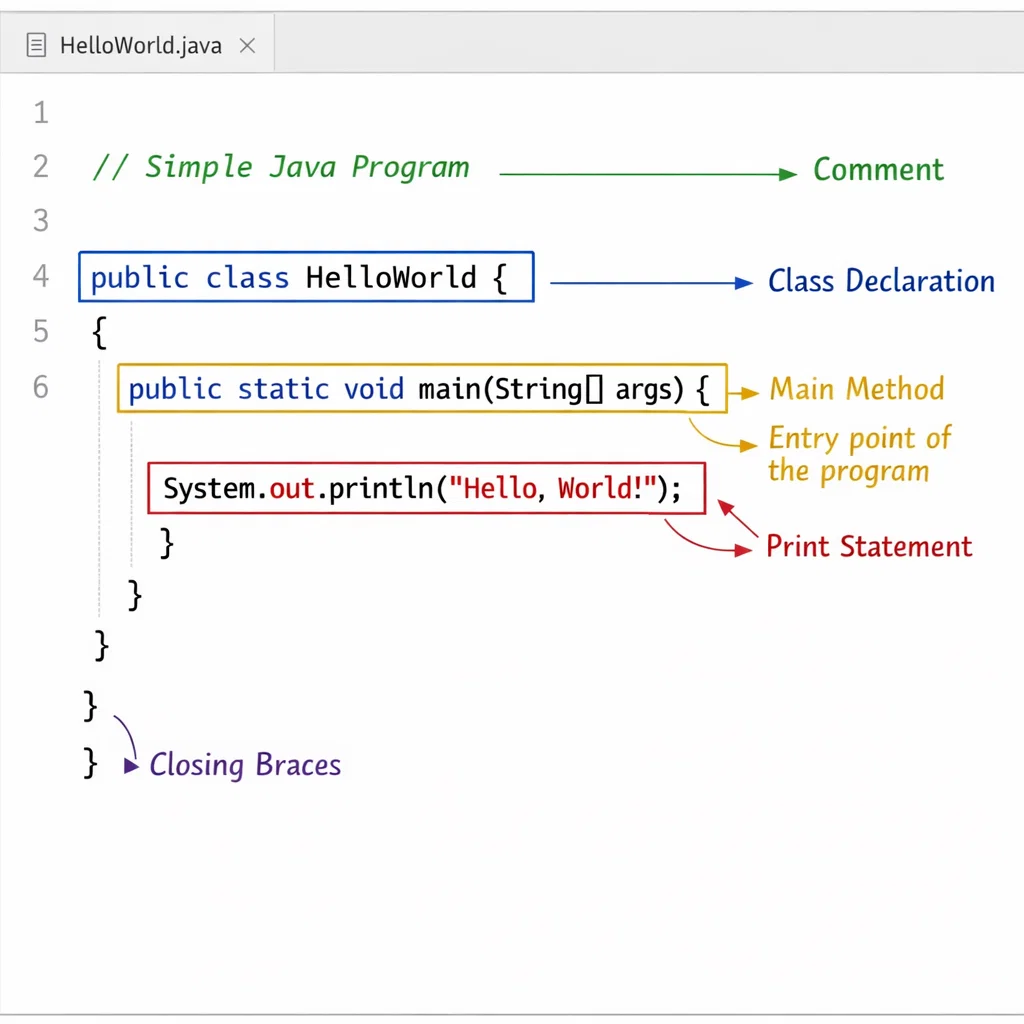
The following is a basic Java code:
public class HelloWorld {
void main(String[] args) is a public method.
// This is a comment
System.out.println(“Hello, World!”); // Log a statement to a console.
}
}
Structure of a Java Class
Java organizes all the code in classes. A blueprint of objects (instances) is known as a class. A Java program should contain at least one class that will be the basis upon which the code should be organized and encapsulated.
An elementary Java class will include the following parts:
- Class Declaration: The declaration of classes starts with the declaration of class which is then succeeded by the name of the class.
- Main Method: The main method is an entry point of any Java program. Here is the point where the program begins to run in case you run it.
- Fields: These are those variables, which contain the state or data of the class. Different access modifiers can be created to fields such as private, public and protected.
- Methods: Methods specify the manner of the class. A method is a block of code that executes a particular task and it can or can not have a value.
public class ExampleClass {
int number; // Field
// Method
public void displayMessage() {
System.out.println(“This is a method.”);
}
// Main method (entry point)
public static void main(String[] args) {
ExampleClass obj = new ExampleClass();
obj.displayMessage(); // Method call.
}
}
In the above example, the ExampleClass has a field number, a method displayMessage(), and the main() method.
Role of the main() Method
In Java, the first method is the main() method which is the entry point of the program. When you start up a Java application, the JVM searches through the program to find the main() method to start running the program. The main() method should be publicized as: main(String[ ] args) where:
- public refers to the fact that the method can be accessed everywhere.
- static implies that you do not have to create one of the class to invoke the method.
- void is the technique that does not have any value.
- String[] args is an array of strings that are passed to the program itself through the command line (used to handle arguments).
The Java Virtual Machine (JVM)
Java Virtual Machine (Java VM) is an important component of Java environment. It performs the execution of Java byte code and translates them into machine code that can support other hardware platforms. The JVM enables Java to be platform-neutral, that is, write Java code once, and execute anywhere.
A Java compiler is a program that transforms the source code (.java file), into a binary form (.class file) when a Java program is compiled. This is a platform-independent bytecode that can be run on any JVM and as a result, the Java programs are very portable. The JVM takes care of memory management, garbage collection and more generally running programs, so programmers do not need to be concerned with low-level programming when writing their code.
The Fundamentals of Java Programming
Variables and Data Types
In Java, variables are places where data can be stored which can be recalled and manipulated in the program. A type is a characteristic that defines the type of data that each variable is capable of storing. The most typical types of data in Java are:
Primitive Data Types:
- int: Stores integer values.
- double: Floating point numbers are stored.
- char: stores one character.
- boolean: true or false values.
- byte, short, long: These are used in varying sizes of integers.
- float: Stores floating-point numbers with a reduced precision to double.
Reference Data Types:
- String: An arrangement of characters.
- Arrays: Groups of variables of a similar type.
Example:
int age = 25;
double price = 19.99;
char grade = ‘A’;
boolean isActive = true;
String name = “John”;
Operators in Java
Java has operators that are used to operate on variables and values. The most widespread forms of operators are:
Arithmetic Operators:
These operators are used in performing mathematical operations.
- +, -, *, /, % (addition, subtraction, multiplication, division, modulus)
Relational Operators:
Relational operators are used to compare values.
- ==, !=, <, >, <=, >= (equal to, not equal to, less than, greater than, less than or equal to, greater than or equal to)
Logical Operators:
These are operators that are used to perform logical operations.
- &&, ||, ! (AND, OR, NOT)
Assignment Operators:
Operators that are used to assign values to variables.
- =, +=, -=, *=, /=
Example:
int a = 5;
int b = 10;
int total = a + b; // Arithmetic operator
a = b; // Assignment operator
boolean isPositive = (a > 0 && b > 0); // Logical operator
Control Statements
Execution in a Java program occurs with control statements. Control statements are of the following main types:
Conditional Statements:
- if: Performs a block of code in the case of a condition being true.
- else: This executes a piece of code in case the condition is not true.
- switch: Jumps to one of multiple code blocks according to a particular condition.
Looping Statements:
- for: Loop When one needs to execute a piece of code multiple times, a for loop can be used.
- while: Repeats a block of code until a condition is met.
- do-while: Runs an expression at least once and repeats while a condition is met.
Example:
if (age > 18) {
System.out.println(“You are an adult.”);
} else {
System.out.println(“You are a minor.”);
}
for (int i = 0; i < 5; i++) {
System.out.println(i);
}
Conclusion
Java is a highly versatile and powerful language, and its principles are important to learn to be able to master the art of programming. Knowing the syntax of the Java language, the internal structure of classes and methods, and the very basics of Java such as variables, data types, operators, and control statements, you will be close to becoming a Java programmer. No matter what you want to create, whether it is applications, big data or you want to explore how to work with Android, the knowledge you develop today will be the building blocks to more advanced Java-related skills in the future.