The role of imaging in how human beings view, analyze and comprehend the world is silent but quite potent. Imaging technology has become an essential part of the contemporary science and industry, with medical scans that allow one to see the inner workings of the human body through satellites which capture images of the Earth in space. To amateurs, though, the word may seem too technical and abstract. In this article, the author gives a simple and well-organized introduction to the world of imaging technology, describing what it entails, its functionality, the main parts of the technology, and why it is necessary in various disciplines. At the close of it, the reader will have an excellent conceptual background that will set them on a level more prepared to deal with more sophisticated subjects on imaging systems and their practical use.
What Is Imaging Technology?
The term imaging technology can be used to describe the use of equipment, apparatus and methods to provide a visual depiction of an object, structure or process. These images, which are also referred to as representations enable human beings and machines to see small details that cannot be seen by the naked eye. Imaging may be done using visible light (e.g. photographs and video recordings) or non-visible energy (e.g. X-rays, sound waves, infrared radiation, or magnetic field).
Simply put, imaging technology transforms physical signals in the real world into visual data, which can be interpreted, analyzed, stored and shared. Through this process, they will be able to make more decisions, diagnose correctly, control quality, and make scientific discoveries.
Readers can find a detailed description of the concept somewhere in this complete explanation of imaging technology, which provides an overview of the various types of imaging technology and their underlying principles.
A Short Historical Overview
Technology in imaging did not come out in a vacuum. Its evolution has been influenced by the centuries of the scientific progress.
Early Imaging Methods
Simple drawings and sketches used to record the observations can be traced as the earliest type of imaging. Modern photography was based on the invention of the camera obscura that proved that light could project an image onto a surface.
The Emergence of the Photographic Imaging
This took a significant shift in the 19 th Century when photographic film was invented. With the help of photography, the image could be recorded forever and thus visual records were more precise and available to a larger audience.
Contemporary Imaging Development
The 20th and the 21st centuries were characterized by revolutionary imaging methods which included the X-rays imaging, ultrasound, computerized tomography (CT), magnetic resonance imaging (MRI), and the digital imaging. The development of the computing power and the sensors has further changed the imaging into the field of data-rich and highly precise.
Key Concepts of Imaging Technology
Even though there are many different types of imaging systems, they are all based on several basic tenets.
Interaction of Energy with Matter
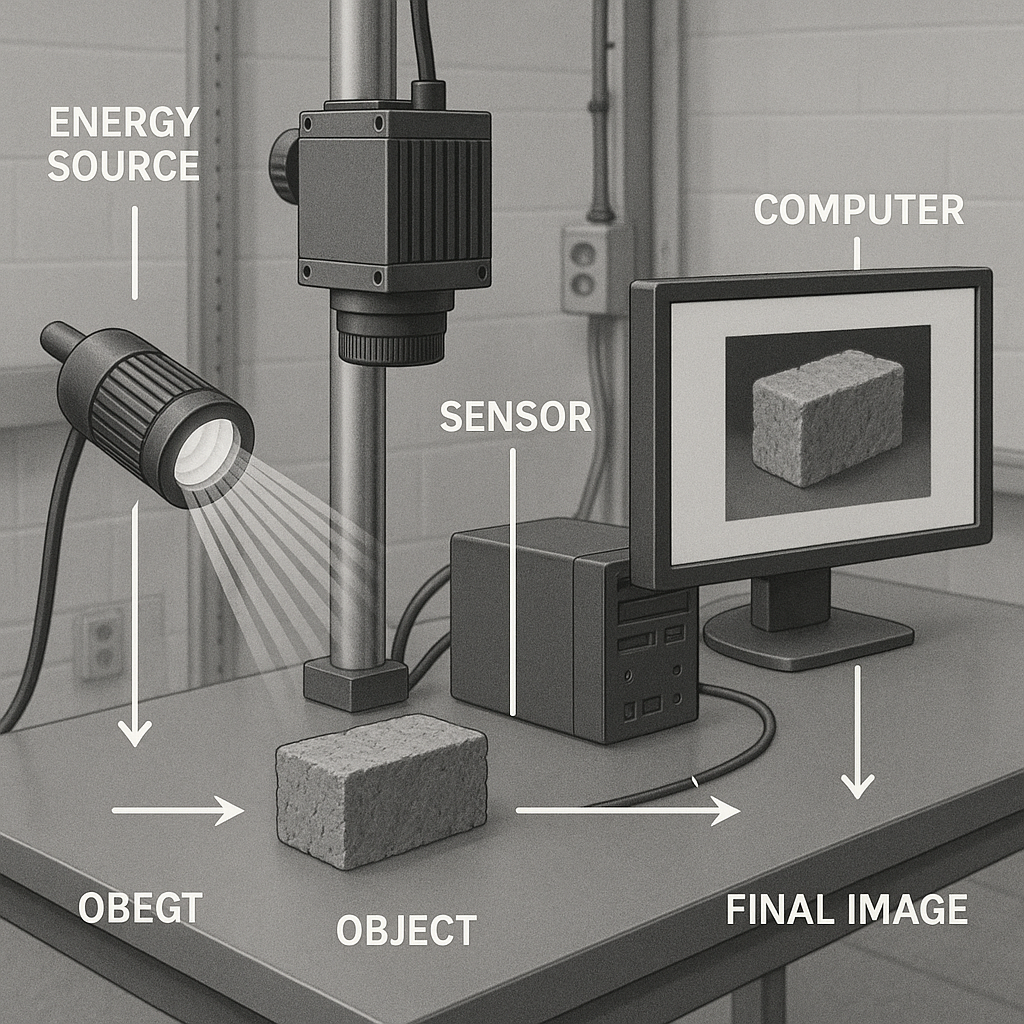
The interaction of energy and matter is at the core of imaging technology. Various imaging techniques require various types of energy like light, sound, or electromagnetic energy. As this energy acts upon an object, it is reflected, absorbed, transmitted or scattered in some special manner.
Signal Detection and Conversion
Sensors pick up the changes in the energy which is brought by contact with an object. These sensors translate the physical signals into electrical signals which in turn can be processed and converted into images.
Formation and Interpretation of Image
After receiving the signals, they are then processed with the help of algorithms to create an image. Human beings or computer systems interpret or analyze this image to obtain meaningful information.
Important Elements of Imaging Systems
The study of imaging technology needs one to understand the fundamental aspects of this technology. Although certain systems can vary, the majority of the imaging systems have common components.
Energy Source
The signal to be used in imaging is produced by the source of energy. This may be visible light, X-rays, ultrasound waves or radiofrequency signals depending on the use. the type of information that can be obtained depends upon the choice of the energy source.
Object or Subject
This is the object that is being imaged which may be a human organ, an industrial part, a landscape, or a microscopic sample. The nature of the object determines the interaction of energy with the object.
Detector or Sensor
Sensors are charged with the duty of absorbing the energy once it comes into contact with the object. The examples of these are camera sensors, X-ray sensors, ultrasound transducers and infrared sensors. Image resolution and accuracy is a direct effect of sensor quality.
Signal Processing Unit
Sensors provide raw signals which are typically noisy or incomplete. Algorithms are used in signal processing units to improve image quality, remove noise and extract useful features.
Display and Storage Systems
The last picture has to be put in a usable form which can be a screen or printed work. Photos also exist in digital form so as to be referred to, analysed or be shared in future.

Types of Imaging Technology
The imaging technology can be divided according to the nature of the energy used and intent of imaging.
Optical Imaging
In optical imaging, visible light is used to get images. These are photography, video recording and microscopy. It is popular because it is simple and can generate a high-resolution image.
Medical Imaging
Medical imaging involves the study of the internal organs in the human body to identify diseases and treatment. Usual methods are the X-ray, ultrasound, CT scanning, and MRI. These are the ways that enable us to have a non-invasive study of organs and tissues.
Thermal Imaging
Thermal imaging identifies objects through radiations of infrared that are emitted according to the temperature. It is also applied in inspecting the building, security, and in maintaining industry to determine the patterns of heating and anomalies.
Industrial Imaging
Imaging technology has applications in manufacturing and engineering in terms of inspection, quality control and automation. Machine vision systems aid in detecting defects, dimension measurement as well as robot system guidance.
Remote Sensing and Satellite Imaging
Remote sensing is a process of taking photographs of the earth or other planets at a distance, which is usually done by satellites or drones. With these pictures, environmental monitoring, agriculture, urban planning and disaster management are all imperative.
Why Imaging Technology Is Essential in Modern Science
Imaging technology has become a fundamental tool in scientific research across disciplines.
Enhancing Observation and Measurement
Many scientific phenomena cannot be observed directly. Imaging allows researchers to visualize microscopic structures, astronomical objects, and complex processes that would otherwise remain hidden.
Supporting Data-Driven Research
Images are a form of data. Advanced imaging techniques generate large datasets that can be analyzed quantitatively, enabling more accurate and reproducible research outcomes.
Accelerating Discovery
By revealing patterns and relationships within data, imaging technology helps scientists make discoveries faster and more efficiently.
Function of Imaging Technology in Medicine
Medicine is one of the few areas to enjoy the benefits of imaging technology as much.
Diagnosis and Prevention in the Early Stages
Through medical imaging, diseases can be identified at an early stage before symptoms are realized. The early diagnosis of the disease enhances the treatment outcomes and saves on healthcare expenditures.
Non-Invasive Examination
The imaging enables the doctors to view the internal organs without the use of surgery. This brings risk, pain and recovery time to patients at a minimum.
Treatment Monitoring and Planning
Photographs assist surgeons in operations and assist clinicians to check the progress of treatment. Imaging makes therapies to be focused and effective.
Imaging in Industrial Engineering
Imaging technology aids in engineering and industrial setup in terms of precision, safety, and efficiency.
Quality Inspection and Control
The imaging systems are able to identify defects that are not visible to the human eye. Automated checking would help maintain consistency of the quality of the product and decrease waste.
Process Optimization
Through visualization of production processes, the engineers are in a position to establish inefficiencies and enhance performance of the system.
Safety and Risk Reduction
Thermal and visual imaging systems are used to identify dangerous conditions, check the condition of equipment, and avert accidents.
Digital Transformation and Imaging Technology
Imaging technology is now integrated with digital systems which have enhanced its possibilities.
Image Processing and Analysis
The present-day imaging is dependent on software algorithms to improve the image and retrieve information. Filtering, segmentation and pattern recognition techniques enhance usability of images.
Machine Learning and Artificial Intelligence
Systems of AI-driven imaging are able to process images automatically, detect patterns, and predict. This is useful in medical diagnostics and industrial automation in particular.
Storage of Data and Clouded Integration
Digital imaging enables storage, sharing and access of images all over the world. Cloud systems allow teamwork and massive analysis of data.
Ethical and Practical Issues
Imaging technology has vast advantages but it also triggers concerns.
Privacy and Data Security
The imaging information particularly in medical and surveillance should be handled responsibly to ensure privacy and confidentiality.
Precision and Meaning
Unless analyzed properly, images may be interpreted wrongly. The correct training and confirmation should be done to facilitate sound conclusions.
Accessibility and Cost
High-end imaging technology is costly. The provision of fair access is also an obstacle especially in resource constrained environments.
Advancements in Imaging Systems Preparation
The first step to becoming familiar with imaging technology is to learn the fundamentals and the elements of the technology as a beginner. With this groundwork, more complex issues like algorithms of image reconstruction can be investigated easily, 3D images, multimodal imaging systems, and real-time image processing.
With the ever-growing technology advancements, imaging systems will be smarter, more accurate, and closer to daily life processes. An effective conceptual framework will help learners to be flexible to these developments and use imaging knowledge in other disciplines.
Conclusion
Imaging technology has much more to do with capturing pictures than it has to do with taking pictures. It is a complex discipline that integrates physics, engineering, computing, and data analysis in order to convert invisible signals into a relevant visual representation. In the medical sphere and scientific studies, as well as in the engineering and industrial world, the imaging technology is underlying most of the systems that describe modern life.
Learning about what imaging technology is, how its key elements work in unison, and why it is necessary in various areas, newcomers can get a good idea about one of the most significant technological spheres of the modern world. Such background knowledge does not only make complicated ideas easier to understand but it also preconditions a further analysis of imaging systems and their practical implementation.