Experienced corporate photographers know that at any given headshot photoshoot many of the people present are usually attending on sufferance.
Let’s face it, in most workplaces, people would rather be getting on with their jobs than being asked to appear in front of a camera by a colleague in the marketing or corporate communications departments. And for the camera shy, a company photoshoot is about as fun as a trip to the dentist for root canal work.
CEOs are people too
What’s perhaps surprising is that among the camera shy are senior executives, including CEOs and other board directors. These are highly professional colleagues who recognize it’s an essential part of their role to be photographed, but there’s no disguising that for some corporate headshot photography is something to be endured.
Even if someone is not particularly camera shy, most people when first arriving for a corporate photoshoot are distracted by thoughts of the day ahead or an imminent work deadline. It’s therefore my job to get them to focus on the task in hand.
Time is money
My golden rule to making photography sessions run smoothly is to use people’s time as efficiently as possible. Among my firm’s clients many are headquartered in London and they are particularly time conscious and will want every minute of a corporate photoshoot to be used wisely. This means setting up the lighting and backgrounds in advance.
What’s critical is being ready to welcome the first person as soon as they arrive and then cracking on with the photography immediately.
Technical consistency is paramount
Again, in preparation, the photographer will have decided where to position themselves and their camera and tripod which will not move during the session. A fixed and unchanging camera position is essential to creating a consistent set of images which corporate clients value highly.
However, large shoots involving up to 150 people photographed individually over several days normally need constant fine tuning of lighting to accommodate changes in the position of the sun or to any changes in the weather as the day progresses, should a view through a window be included in the client brief.
Treat everyone personally
The second golden rule for a corporate headshot session is to pay real attention to the person being photographed and not ‘go through the ropes.’ It is a horrible cliché but everyone is different and the photographer needs to try and quickly work out the best approach for each person appearing before their camera. They want and need to gain their trust, which is especially necessary if someone is very shy or uncomfortable.
At Piranha Photography our preference is to use humour to make a person feel at ease, including very senior executives. While we hope they enjoy the conversation, deep down we know if a subject truly relaxes this increases substantially the chance of capturing a great set of images.
Putting people at ease becomes easier with age and experience. I’ve been taking corporate headshots for over 25 years, and while technically I was competent when first starting out, today I recognize that my people skills have been burnished with the years. For the best results and the best light, we use large Elinchrom soft boxes, which can look imposing when a subject first walks into the room, so people skills are vital.
Everyone has an off day
I have also grown to accept that everyone can have an off day which includes famous politicians, CEOs, actors and presidents as well as regular members of staff. But whoever is being photographed, the corporate communications team will still expect a strong set of images and it is the job of the photographer to manage confidently the situation to make sure the day is a success.
Experience also comes into play if there is last-minute change to the schedule. For example, when a corporate communications person suggests moving the shoot to outdoors because it is a nice day. It’s up to the photographer to be flexible and enthusiastic when faced with unexpected changes of plan.
Post-production is value added work
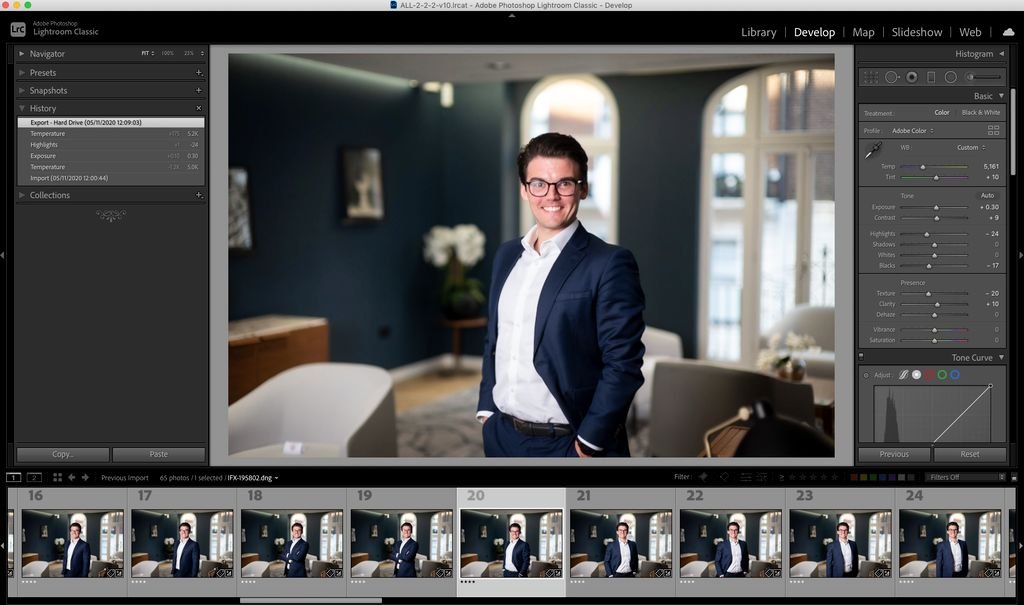
Handling post-production, whether it is retouching images in Photoshop or selecting the final shots, is just as crucial as the photoshoot itself. In today’s fast-paced workplaces, images must be processed quickly, stored securely, and accurately named, tagged and filed for easy future access.
Enthusiasm for the work shows in the results
But there’s one last essential element for a successful corporate headshot, it is the magic ingredient of enjoying oneself. If it’s present while taking photographs, somehow, almost ineffably, the sparkle of inspiration and pleasure in the work becomes evident in the final results.
Author
Douglas Fry is the lead corporate photographer at Piranha Photography based in central London. Douglas has been a professional photographer for over 25 years, photographing about 300 commissions a year around the UK and Europe. Photographic assignments range from London corporate headshots through to events and PR photography. Douglas has photographed many of the country’s leading executives, including CEOs of companies based in the City of London.