There are over 460 million podcast listeners worldwide in 2026, and the barrier to entry has never been lower. You can start a podcast for under a hundred dollars, record in your living room, and distribute to Spotify, Apple Podcasts, and YouTube in the same afternoon. The technical side is no longer the hard part.
The hard part is doing it consistently and doing it well. This guide covers everything you need to launch a podcast that actually holds an audience, from defining your concept to choosing your gear to getting your first episode live. No unnecessary detours.
step 1 — define your concept before you buy anything
The most common mistake new podcasters make is buying equipment before they have a clear concept. The microphone does not matter if you do not know what you are going to say or who you are saying it to.
A solid podcast concept answers three questions clearly. First, what is the show about, specifically? Not just fitness, but running for people over 40 who have never done a race. Not just business, but how solo founders build profitable companies without investors. Specificity is what makes a show findable and what keeps an audience coming back. Second, who is it for? Describe your listener in enough detail that you could write an email addressed directly to them. Third, can you sustain it? Try to list 20 episode ideas right now. If you can do that easily, you have a concept with enough depth to build a show around.
Once the concept is clear, decide on your format: solo episodes, interviews, co-hosted conversations, or narrative storytelling. Each format has different production requirements and a different relationship with the audience. Interviews are the most common because guests bring credibility and built-in promotion. Solo episodes are harder to sustain but build the deepest personal connection with listeners over time.
step 2 — get the right equipment without overspending
You need three things to start: a microphone, headphones, and recording software. That is it. Everything else is optional at launch.
microphone
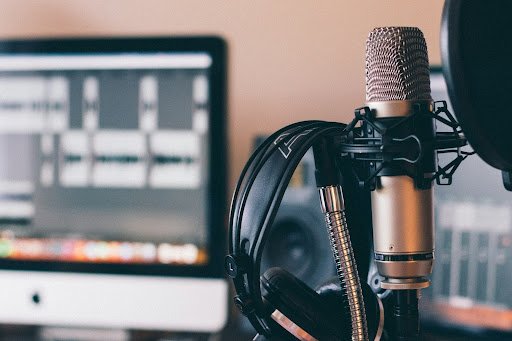
The Samson Q2U ($70) is the most recommended beginner microphone for podcasting in 2026. It is a dynamic USB microphone, which means it plugs directly into your computer, picks up less background noise than condenser mics, and requires no additional interface. The RODE PodMic ($99) is the step-up choice, offering broadcast-quality sound that will hold up as your show grows. Both are used by working podcasters with hundreds of episodes.
One important and often ignored point: your recording environment matters more than your microphone. A $70 mic in a quiet room with carpet, curtains, and soft furniture will sound better than a $500 mic in a hard, echo-prone space. Record in a small room with soft surfaces before spending money on acoustic treatment.
headphones
Closed-back headphones are essential for monitoring while recording. They prevent the audio from your headphones bleeding into your mic. The Sony MDR-7506 and Audio-Technica M20x are the most recommended options in the $60 to $80 range and are standard equipment in professional podcasting studios.
recording software
GarageBand (free, Mac) and Audacity (free, all platforms) are both sufficient for recording and basic editing. If you are doing remote interviews, Riverside.fm and Zoom (local track recording mode) are the standard tools. Riverside records each participant in high quality locally rather than over a compressed internet connection, which eliminates the audio degradation that ruins remote interviews.
step 3 — record and edit your first episode
Record a test episode before your official launch episode. Listen back to it critically. Is the audio clean? Is the pacing natural? Are you giving your listener a reason to keep listening past the first two minutes? The opening of a podcast episode is where most listeners decide whether to stay or leave. Do not use your first two minutes on a long intro, a recap of what the episode will cover, or thanking your guests. Get to the point.
When editing, the priorities are removing long silences, cutting filler words that break the flow, and leveling the audio so the volume is consistent throughout. You do not need a perfect edit. You need an edit that does not distract the listener. AI tools like Descript and Adobe Podcast (Enhance Speech) are useful for cleaning up audio quickly, but they work best on well-recorded tracks. They cannot fix a bad room or a bad microphone technique.
Episode length should match your audience’s likely listening context, not your preference. Commuters have 20 to 40 minutes. People who listen while working out or cooking may have 45 to 90 minutes. True crime and deep-dive shows run longer because the content demands it. A good rule: make each episode as long as it needs to be, and cut everything that does not earn its place.
step 4 — choose a hosting platform and publish
A podcast hosting platform stores your audio files and generates the RSS feed that directories read. You cannot upload directly to Spotify or Apple Podcasts. You upload to a host, and the host distributes to the platforms.
Buzzsprout, Transistor, and Podbean are the most recommended hosting platforms for new podcasters. All three offer free trials or entry-level plans, one-click distribution to Apple Podcasts, Spotify, and Amazon Music, and analytics that tell you how many people are listening and where they are coming from. Buzzsprout has helped over 400,000 podcasters launch their shows since 2009 and has strong documentation for first-timers.
When you submit to Apple Podcasts, the process is manual: you submit your RSS feed URL through Apple’s Podcasts Connect platform. Spotify and most other directories pull your feed automatically once you submit it once through your hosting platform. Google shut down Google Podcasts in 2024, and YouTube Music replaced it, so submitting your show to YouTube is now part of a complete distribution strategy.
step 5 — cover art, show name, and description
Your cover art is the first thing a potential listener sees. It needs to work at 55 by 55 pixels (the size it displays in most podcast apps) and at larger sizes. High contrast, readable typography, and no photographs of microphones or headphones. Your artwork should suggest what the show is about without relying on podcasting imagery to signal that it is a podcast. That is already obvious from the context.
Your show name should be four words or fewer if possible and include a keyword your target listener would actually search. Your description should open with a clear statement of who the show is for and what they will get from listening, not a paragraph about you. Listeners are looking for a reason to subscribe, and the description is your best opportunity to give them one before they ever press play.
step 6 — grow your audience consistently
The top three ways listeners find new podcasts, according to Edison Research, are word of mouth, social media, and search within podcast apps. That means the most useful things you can do to grow are: tell everyone you know to follow and review the show on launch day (a concentrated burst of activity signals quality to platform algorithms), share clips and episodes consistently on the social platforms where your target listener spends time, and optimize your episode titles and descriptions for the words people actually search.
In 2026, YouTube is also a major discovery channel. Publishing your podcast episodes as videos on YouTube, even just a static image with audio, gives them a second life in a search-driven environment. Many of the fastest-growing podcasts this year are growing their audio audience through YouTube clips and full-episode uploads, not through podcast app charts.
Consistency matters more than quality in the early months. A show that publishes every Tuesday at 6 a.m. builds a habit in its listeners. A show that publishes whenever it feels ready does not. Pick a schedule you can sustain without burning out and protect it.
step 7 — monetize when you are ready
Most podcast advertising networks require a minimum of 2,000 downloads per episode before they will work with you. That is not where most podcasters start, and it should not be the first goal. The most accessible early monetization options are Patreon or direct listener support, affiliate links to products you already use and recommend, and selling your own products, services, or courses to the audience you are building.
Once you reach 2,000 to 5,000 downloads per episode, host-read sponsorships become viable. Sponsors pay for access to your audience’s trust, and that trust is built through consistent, useful content over time. The shows that monetize most effectively are the ones where the audience already knows, likes, and trusts the host, which means monetization is a byproduct of doing everything else well, not a shortcut.