Starting RBI Grade A prep can feel heavy, especially when you are just a beginner and need to cover the vast RBI Grade A syllabus 2025.
Well, the trick is to keep it simple and start with a practical plan that you can actually follow.
In this article you’ll find why the RBI Grade A Syllabus 2025 matters and what are the high weightage topics that you need to pick first, so you can use your time well and prepare smartly.
Importance of the RBI Grade A Syllabus 2025
Below are the reasons why you should dive deep into the RBI GRade A syllabus before your preparation. RBI Grade A syllabus helps you:
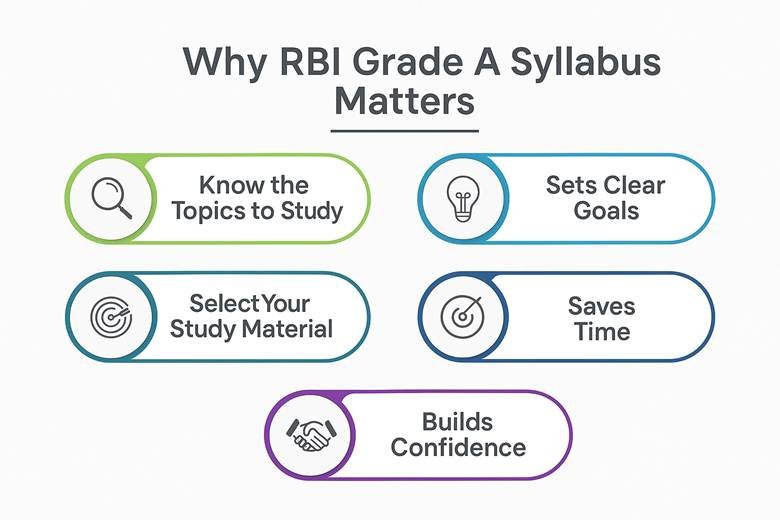
- Know the Topics to Study: A detailed RBI Grade A Syllabus provides you with all the subjects and their topics you need to cover for both the Phases.
- Select Your Study Material: It helps you choose the right books and resources that align with the latest RBI Grade A syllabus.
- Sets Clear Goals: You can set practical daily/weekly study goals by knowing the exact RBI Grade A syllabus.
- Saves Time: Knowing the exact syllabus prevents you from covering out of syllabus topics and extra chapters.
- Build Confidence: When you know exactly what to expect in the RBI Grade A exam, you’ll feel more confident and less stressed.
Now that you know why it is important to know the latest RBI Grade A syllabus 2025, let’s understand how to prioritize it.
A Beginner-Friendly Approach to Prioritize the RBI Grade A Syllabus 2025
Below, I have shared a practical approach to prioritize the RBI Grade A syllabus 2025 as a beginner:
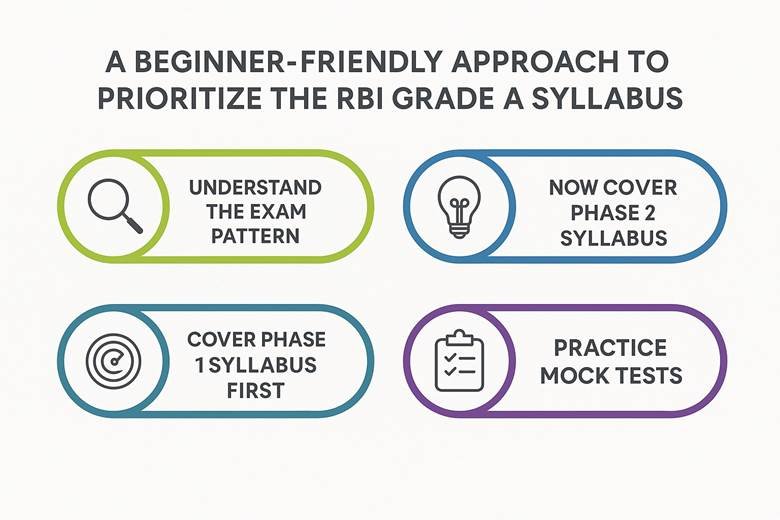
1. Understand the RBI Grade A Exam Pattern
You should start your preparation by understanding the RBI Grade A exam pattern for both Phase 1 and Phase 2. You must be wondering in order to cover the syllabus, why it is important to understand the pattern.
Because knowing the exam pattern helps you clearly see:
- All subjects you need to cover.
- Subject-wise number of questions.
- The marks assigned to each subject.
This crucial information helps you understand which subjects to prioritize first, allowing you to study smarter and allocate your precious time more effectively.
2. Cover Phase 1 RBI Grade A Syllabus First
The official RBI Grade A notification is not out yet. But RBI Grade A Phase 1 Syllabus 2025 is expected to include 4 subjects similar to Grade B:
- General Awareness
- English Language
- Quantitative Aptitude
- Reasoning Ability
Let’s understand how to approach each subject.
General Awareness (GA)
The current affairs and general knowledge you study for Phase 1 GA will also help you in Phase 2 subjects, such as Finance and Economics and Social Issues.
You should prioritize the following GA topics:
- Government Schemes from Ministry of Finance, Skill Development and Entrepreneurship, Social Justice, Agriculture and Farmers Welfare, and Rural Development
- ESI Current Affairs topics like Social Justice, Sustainable Development and Environmental Issues, Regional Economic Cooperation, Industrial Agriculture
- Finance Current Affairs topics like Primary and Secondary Market, Recent/Key Developments in the Financial Sector, Fintech, Banking System in India.
- Reports including Trends and Progress of Banking in India, Financial Stability Report, Report on Currency and Finance, World Economic Outlook, World Development Report, RBI Annual Report, Union Budget, and Economic Survey
- Phase 1 specific General Awareness topics such as Sports, Science and Technology, First in News, Banking and Finance, Days in News, and Government Initiatives
Weekly loop: Convert daily notes into a 2–3 page capsule; practice 100–150 GA MCQs/week.
English
English is the most scoring subject next to GA as there are no complex formulas to remember.
You should prioritise the following English topics:
- Prepositions
- Complex Prepositions
- Rearrangement
- Tenses
- Cloze-Test
- Subject – Verb Agreement
- Reading Comprehension
Quantitative Aptitude
Unlike English and General Awareness subjects, Quant only appears in Phase 1. Even so, you can’t skip it! To get started with the RBI Grade A Quant syllabus for 2025, you need to build a strong foundation.
Here’s how to prioritize your Quant preparation:
- Number Series
- Profit and Loss
- Quadratic Equation
- Data Interpretation
- Ratio and Proportion
- Ages
- Percentage
- Partnership
Reasoning
Similar to the Quant subject, Reasoning is also tested only in Phase 1 subject, but you can not take it lightly as it also contributes to your overall Phase 1 marks. To excel in Reasoning, practice different types of questions regularly to improve your problem-solving speed and accuracy.
Here are the high-weightage Reasoning topics that you should prioritize:
- Alphanumeric Series
- Syllogism
- Machine Input Output
- Coding and Decoding
- Inequality
- Blood Relation
- Data Sufficiency
- Ranking and Order
- Direction Sense
3. Now Cover Phase 2 RBI Grade A Syllabus
RBI Grade A Phase 2 Syllabus 2025 is expected to include 3 subjects similar to Grade B:
- Descriptive English
- Finance and Management (FM)
- Economics and Social Issues (ESI)
Let’s understand how to approach each subject.
Descriptive English
In descriptive English you need to write well-structured answers. It tests your knowledge and skills to express your thoughts clearly.
Here is what you should practice for descriptive English:
- Essay (300–350 words): banking/economy, financial inclusion, digital payments, NPAs, climate risk, MSMEs.
- Precis
- Reading Comprehension
Finance and Management:
Finance and Management are the core subjects that will test your financial knowledge with management principles.
Here are the important Finance topics to prioritize:
- Introduction to the Indian Financial System
- Derivative Market (Future, Forward, Swaps, & Options)
- Primary & Secondary Markets (Equity, Debt, & Forex)
- RBI and Its Functions
- Banking System in India – Structure & Developments Inequality
- Financial Risk Management
- Financial Institutions
- Inflation
Here are the important Management topics to prioritize:
- General Management
- Motivation
- Leadership
- Communication
- Ethics
Economics and Social Issues
The ESI subject focuses on current economic and social challenges in India. You’ll find a mix of questions based on current affairs and static concepts.
Here are the important ESI topics to focus on:
- Monetary and Fiscal Policy Since Reforms of 1991
- Measurement of Growth: National Income and Per Capita Income
- Economic History of India
- Poverty Alleviation and Employment Generation in India
- International Economic Institutions – IMF and World Bank – WTO
- Opening up of the Indian Economy – Balance of Payments
4. Practice Mock Tests
Even for a beginner, looking at Previous Year Questions (PYQs) asked in the actual exam helps you understand the exam pattern, the types of questions asked, and their difficulty level in detail.
However, since official RBI Grade A PYQs aren’t available (as this exam hasn’t been conducted in the past 2 decades), you should practice mock tests. It will give you an idea of what the RBI Grade A exam might look like.
Regularly practicing mock tests helps you:

- Identify Your Weak Areas: Mock tests help you identify your strengths and weaknesses.
- Optimise Time Management: You learn how to manage your time more effectively during the exam.
- Improve Speed & Accuracy: Regular practice makes you solve questions quickly and accurately.
- Boost Confidence: Scoring good marks in mock tests surely builds self-assurance for the actual exam.
- Refine Your Strategy: You can test multiple approaches to solve mock tests and help you find which strategy is best for you.
What Next? Your Final Steps!
You’ve just gone through a complete guide on how to approach and prioritize the RBI Grade A syllabus as a beginner.
Now, it’s time to put this knowledge into action:
- Start your preparation today.
- Create a realistic study plan that you can actually stick to.
- Practice mock tests consistently to identify your strengths and weaknesses.
- Stay updated with current affairs.
Remember, every topper was once a beginner. Stay consistent, stay focused, and you’ll be well on your way to clearing the RBI Grade A exam. You’ve got this!


