Introduction
Cassava is an important staple food in the world particularly in Africa, Asia and South America. The crop is popular for its adaptability to sub-optimal soil and water conditions, and its capacity to yield well under drought and well-managed conditions. Cassava is not only a food crop for many of the rural and commercial farmers, but also a primary source of income for these farmers with cassava products like garri, fufu, cassava starch, cassava flour, animal feed and others. To ensure optimal productivity, minimize losses, and maximize profits, it is crucial to grasp the entire cassava cultivation process. This is a comprehensive and practical explanation of how to grow cassava successfully including land preparation, selection of stems, planting methods, weed control, fertilizations, pest control and harvesting. The measures described are applicable to smallholder farmers as well as to extensive farming operations, and can help to enhance the quality of the harvested produce and promote sustainable farming.
Land Preparation for Cassava Farming
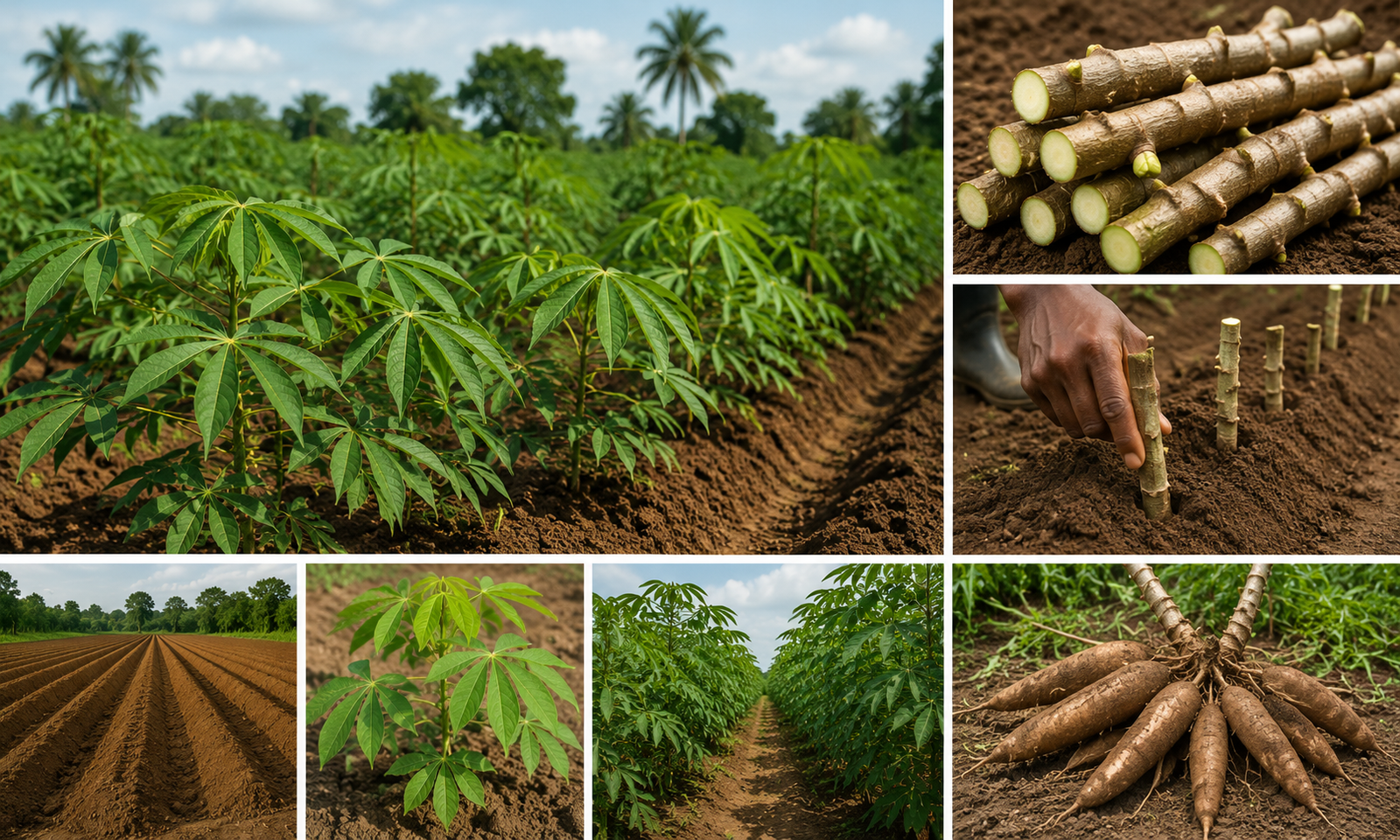
Land preparation is a very important process in the production of cassava as this process has an effect on the development of the roots and growth of the cassava over time. Cassava requires loose, well drained soil for best growth and development and the tubers should be given sufficient room to grow. The first step that a farmer should take is to remove weeds, shrubs and previous crop residue from the soil. This is followed by a process of ploughing and harrowing the soil to loosen any compacted layers and aerate the soil. Ridging/mounding is strongly recommended in regions with excessive rainfall to minimize waterlogging and subsequent root rot causing yield reductions. Soil testing for nutrient content and pH is also an essential aspect of land preparation, which enables farmers to adjust the soil’s nutrient balance and pH prior to planting. Fertility and soil structure can be enhanced by adding organic material like compost or well-decomposed manure. Proper land preparation provides a favorable environment for cassava growth and development, and helps to produce marketable tubers.
Healthy Cassava Stems Selection
The planting material is the most important consideration for successful cassava farming as it contributes to the germination rate, plant vigour and yield. Farmers are required to carefully choose healthy cassava mother plants that are free from disease for propagation, because cassava is propagated by stem cutting. Mature plants (8-12 months old) with ample starch reserves are the best stems to harvest for early growth. Infected stems, stems damaged by pests or physical damage should not be used by farmers. For proper sprouting of cuttings, they should be approximately 20–25 cm long, with 5–8 nodes. If stem cuttings are not planted immediately it is important to store them in a cool, shaded location to avoid drying out. With better varieties and high yielding cassava, productivity can be greatly improved, particularly if agronomic practices are employed. The most important part of good cassava farming is making good plantings.
Method and Spacing in Cassava Cultivation
Uniform growth and yield for cassava production required good planting methods. Cassava is usually planted at the onset of the rainy season to assure sufficient moisture for early establishment. Cuttings should be planted vertically, horizontally or at a slant, depending upon soil type and moisture conditions, but planting slanted is frequently recommended as it will result in better root development. Spacing is also significant with general recommendations of 1 m x 1 m or 1 m x 0.8 m depending on the variety and farming system. Spacing provides plants with enough sunlight, nutrients and water and helps reduce competition. It is important to stress at this stage that knowledge of the entire process of cassava cultivation can assist farmers to implement best practices from land preparation to harvesting, for better productivity and cassava farm efficiency. Learn more about the complete process of cassava farming. Once planted, farmers will need to keep an eye out for germination within 1-3 weeks after planting and add additional cuttings to ensure plant density.
Weed Control in Cassava Plantations
Weed control is a major factor that affects cassava yield since weeds are capable of intercepting sunlight, nutrients and water from the cassava plant particularly in the early stages of growth. Weeds are a major factor in reducing productivity and labour costs at harvest if not adequately managed. Weeds should be controlled early from the time of planting (usually 3–6 weeks) and should be done in conjunction with manual weeding, mechanical cultivation and where applicable, application of herbicide. In small farms, manual weeding is often used and in larger farms herbicide application may be more efficient. Another effective mulching technique is used to help control weed growth and retain moisture in the soil. Deep hoeing should be avoided close to cassava plants to avoid the damage of developing tubers. Field inspections are conducted regularly which helps to control weeds before they become established. Weed control is very important throughout the early stages since the weed competition and self-sufficiency of cassava increase with maturity.
Fertilizer and Soil Nutrient Management
Although it is generally believed that cassava is a hardy crop, the benefit of proper fertilization is great in terms of yield and quality of produced tubers. For healthy growth, soil nutrients, particularly nitrogen, phosphorus and potassium, are needed, particularly where the soil has been under continuous cultivation. Soil testing should be done before planting to check for nutrient deficiencies and fertilizers based on the recommendations should be applied. Organic fertilisers, including compost and animal manures, are extremely beneficial fertilizers, as they enhance soil structure and long-term fertility. Also, inorganic fertilizer such as NPK can be used at the early growth stages to promote vegetative growth. Fertilizers should be applied in two applications to provide nutrients throughout the growth cycle. Excessive fertiliser use must be avoided since it can result in a decrease in tuber production and an increase in leaf growth. A balanced nutrient management will yield well-developed cassava plants with good stems, healthy leaves and good sized tubers for eating and industrial applications.
Pests and Diseases Control
Cassava is relatively robust against various environmental stresses but is susceptible to pests and diseases that impact yield and quality. Leaf, stem and root damage is caused by common pests such as cassava mealybugs, green mites and termites. However, diseases like cassava mosaic disease and bacterial blight also can reduce productivity if not controlled. Integrated pest management measures such as the use of resistant varieties, crop rotation and good field cleanliness should be used to control pests. Routine crop monitoring that allows the early detection of infestation will enable prompt action that will prevent the infestation from spreading. In addition, biological control techniques can be useful in reducing pest population, such as the introduction of natural predators. Chemical control must be employed with care and only when it is needed and as per recommended guidelines to minimise environmental damage. Minimizing pest and disease outbreaks in cassava farming systems is best achieved by having healthy planting materials and proper farm hygiene in place as a long-term approach.
Harvesting and Post-Harvest Handling
Cassava is ready for harvest between 9-18 months after planting, depending on the variety and the purpose of harvesting. The time of maturity of the varieties can differ; early-maturing varieties may be picked earlier, late-maturing varieties may be left longer to allow for the largest possible tubers. Care must be taken to ensure that no harm is done to the tubers during harvesting because it may affect their market value and shelf life. Typically, the roots are first cut back from the stem and then the soil is raked around the plant and the roots are pulled out. Cassava has a high water content and is prone to spoilage after harvest if not processed or sold soon after the harvest. Post harvest handling involves peeling, drying, fermentation or processing into products like garri, flour or starch. Cassava can be stored properly using suitable storage methods such as cold dry storage to minimize spoilage. Reducing the losses in cassava harvesting operations and improving the profitability of cassava production depends largely on the efficient handling and post-harvest management.
Increasing Profit by Smart Cassava Farming
Effective cassava cultivation is dependent on good planning, on correct agronomic practices and on the application of correct field management to the point of harvest. Those farmers who put effort into preparing their land, planting high quality stem cuttings, spacing properly and keeping weeds and pests under control will be more likely to be able to harvest a high yield. Productivity is further bolstered through careful fertilization and soil management, and losses and market value are minimized through careful harvest and post-harvest management. There is also substantial business potential for cassava production, particularly if the farmers do not just produce the cassava but go into value-added processing like flour, starch and packaged food products. If used properly, the entire process of cassava cultivation can help farmers enhance food security, boost income and promote agricultural development in their communities. When knowledge and commitment are right, cassava can be a very lucrative and sustainable agribusiness enterprise.
Conclusion
If cultivated correctly, cassava farming can yield a good income for farmers. Every activity affecting the site preparation, seedling selection, fertilization and harvesting has a significant impact on the final yield and returns to the grower.
Improved production practices for cassava, both for smallholders farmers and commercial agribusiness operators can generate high return in productivity and improve food security as well as sustain income opportunity. Cassava is one of the most consistent plants for farmers to grow successfully given proper knowledge, discipline and inputs.